
| From | Comptroller Brad Lander <[email protected]> |
| Subject | How can a shareholder proposal combat gun violence? |
| Date | September 23, 2022 3:03 PM |
Links have been removed from this email. Learn more in the FAQ.
Links have been removed from this email. Learn more in the FAQ.
Or uplift workers? Or fight climate change?
Dear New Yorkers,
The Comptroller’s Office wears a lot of hats. Investment adviser to the pension funds. Auditor of City agencies. Registerer of contracts. Watchdog for city spending. But one unique role we have is custodian and investment advisor to the New York City Retirement Systems: shareholder in hundreds of companies across the entire economy.
Our corporate governance team in the Bureau of Asset Management (BAM) keeps a close eye on the companies we invest in and engages them on behalf of pensioners (and really, of all of us) to hold companies accountable on issues that matter for their bottom line and our shared wellbeing. And I’m happy to share with you that BAM have been on a roll.
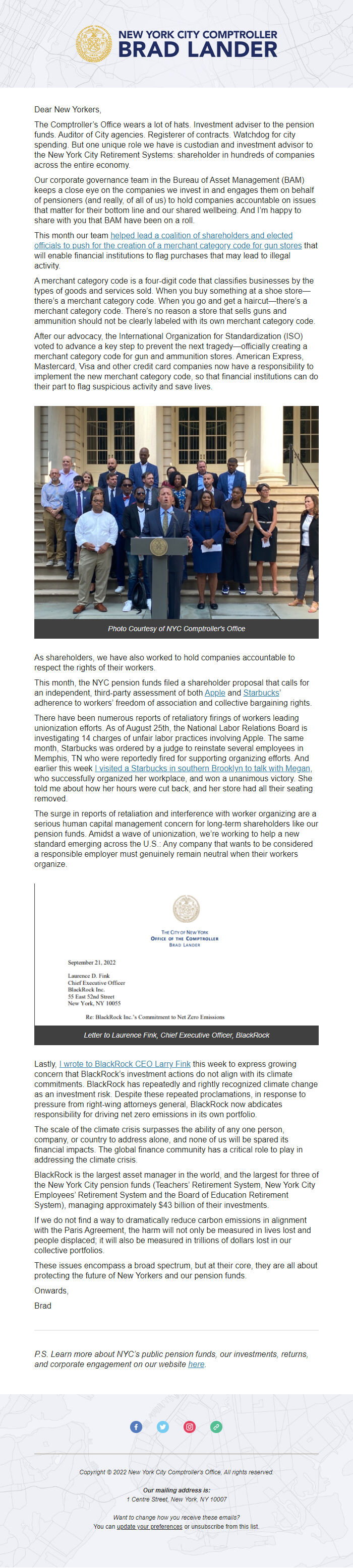
This month our team helped lead a coalition of shareholders and elected officials to push for the creation of a merchant category code for gun stores ([link removed]) that will enable financial institutions to flag purchases that may lead to illegal activity.
A merchant category code is a four-digit code that classifies businesses by the types of goods and services sold. When you buy something at a shoe store—there’s a merchant category code. When you go and get a haircut—there’s a merchant category code. There’s no reason a store that sells guns and ammunition should not be clearly labeled with its own merchant category code.
After our advocacy, the International Organization for Standardization (ISO) voted to advance a key step to prevent the next tragedy—officially creating a merchant category code for gun and ammunition stores. American Express, Mastercard, Visa and other credit card companies now have a responsibility to implement the new merchant category code, so that financial institutions can do their part to flag suspicious activity and save lives.
[link removed]
Photo Courtesy of NYC Comptroller's Office
As shareholders, we have also worked to hold companies accountable to respect the rights of their workers.
This month, the NYC pension funds filed a shareholder proposal that calls for an independent, third-party assessment of both Apple ([link removed]) and Starbucks ([link removed]) ’ adherence to workers’ freedom of association and collective bargaining rights.
There have been numerous reports of retaliatory firings of workers leading unionization efforts. As of August 25th, the National Labor Relations Board is investigating 14 charges of unfair labor practices involving Apple. The same month, Starbucks was ordered by a judge to reinstate several employees in Memphis, TN who were reportedly fired for supporting organizing efforts. And earlier this week I visited a Starbucks in southern Brooklyn to talk with Megan ([link removed]) , who successfully organized her workplace, and won a unanimous victory. She told me about how her hours were cut back, and her store had all their seating removed.
The surge in reports of retaliation and interference with worker organizing are a serious human capital management concern for long-term shareholders like our pension funds. Amidst a wave of unionization, we’re working to help a new standard emerging across the U.S.: Any company that wants to be considered a responsible employer must genuinely remain neutral when their workers organize.
[link removed]
Letter to Laurence Fink, Chief Executive Officer, BlackRock
Lastly, I wrote to BlackRock CEO Larry Fink ([link removed]) this week to express growing concern that BlackRock’s investment actions do not align with its climate commitments. BlackRock has repeatedly and rightly recognized climate change as an investment risk. Despite these repeated proclamations, in response to pressure from right-wing attorneys general, BlackRock now abdicates responsibility for driving net zero emissions in its own portfolio.
The scale of the climate crisis surpasses the ability of any one person, company, or country to address alone, and none of us will be spared its financial impacts. The global finance community has a critical role to play in addressing the climate crisis.
BlackRock is the largest asset manager in the world, and the largest for three of the New York City pension funds (Teachers’ Retirement System, New York City Employees’ Retirement System and the Board of Education Retirement System), managing approximately $43 billion of their investments.
If we do not find a way to dramatically reduce carbon emissions in alignment with the Paris Agreement, the harm will not only be measured in lives lost and people displaced; it will also be measured in trillions of dollars lost in our collective portfolios.
These issues encompass a broad spectrum, but at their core, they are all about protecting the future of New Yorkers and our pension funds.
Onwards,
Brad
P.S. Learn more about NYC’s public pension funds, our investments, returns, and corporate engagement on our website here ([link removed]) .
============================================================
** Facebook ([link removed])
** Twitter ([link removed])
** Link ([link removed])
** New York City Comptroller's Office ([link removed])
Copyright © 2022 New York City Comptroller's Office, All rights reserved.
Our mailing address is:
1 Centre Street, New York, NY 10007
Want to change how you receive these emails?
You can ** update your preferences ([link removed])
or ** unsubscribe from this list ([link removed])
.
Dear New Yorkers,
The Comptroller’s Office wears a lot of hats. Investment adviser to the pension funds. Auditor of City agencies. Registerer of contracts. Watchdog for city spending. But one unique role we have is custodian and investment advisor to the New York City Retirement Systems: shareholder in hundreds of companies across the entire economy.
Our corporate governance team in the Bureau of Asset Management (BAM) keeps a close eye on the companies we invest in and engages them on behalf of pensioners (and really, of all of us) to hold companies accountable on issues that matter for their bottom line and our shared wellbeing. And I’m happy to share with you that BAM have been on a roll.
This month our team helped lead a coalition of shareholders and elected officials to push for the creation of a merchant category code for gun stores ([link removed]) that will enable financial institutions to flag purchases that may lead to illegal activity.
A merchant category code is a four-digit code that classifies businesses by the types of goods and services sold. When you buy something at a shoe store—there’s a merchant category code. When you go and get a haircut—there’s a merchant category code. There’s no reason a store that sells guns and ammunition should not be clearly labeled with its own merchant category code.
After our advocacy, the International Organization for Standardization (ISO) voted to advance a key step to prevent the next tragedy—officially creating a merchant category code for gun and ammunition stores. American Express, Mastercard, Visa and other credit card companies now have a responsibility to implement the new merchant category code, so that financial institutions can do their part to flag suspicious activity and save lives.
[link removed]
Photo Courtesy of NYC Comptroller's Office
As shareholders, we have also worked to hold companies accountable to respect the rights of their workers.
This month, the NYC pension funds filed a shareholder proposal that calls for an independent, third-party assessment of both Apple ([link removed]) and Starbucks ([link removed]) ’ adherence to workers’ freedom of association and collective bargaining rights.
There have been numerous reports of retaliatory firings of workers leading unionization efforts. As of August 25th, the National Labor Relations Board is investigating 14 charges of unfair labor practices involving Apple. The same month, Starbucks was ordered by a judge to reinstate several employees in Memphis, TN who were reportedly fired for supporting organizing efforts. And earlier this week I visited a Starbucks in southern Brooklyn to talk with Megan ([link removed]) , who successfully organized her workplace, and won a unanimous victory. She told me about how her hours were cut back, and her store had all their seating removed.
The surge in reports of retaliation and interference with worker organizing are a serious human capital management concern for long-term shareholders like our pension funds. Amidst a wave of unionization, we’re working to help a new standard emerging across the U.S.: Any company that wants to be considered a responsible employer must genuinely remain neutral when their workers organize.
[link removed]
Letter to Laurence Fink, Chief Executive Officer, BlackRock
Lastly, I wrote to BlackRock CEO Larry Fink ([link removed]) this week to express growing concern that BlackRock’s investment actions do not align with its climate commitments. BlackRock has repeatedly and rightly recognized climate change as an investment risk. Despite these repeated proclamations, in response to pressure from right-wing attorneys general, BlackRock now abdicates responsibility for driving net zero emissions in its own portfolio.
The scale of the climate crisis surpasses the ability of any one person, company, or country to address alone, and none of us will be spared its financial impacts. The global finance community has a critical role to play in addressing the climate crisis.
BlackRock is the largest asset manager in the world, and the largest for three of the New York City pension funds (Teachers’ Retirement System, New York City Employees’ Retirement System and the Board of Education Retirement System), managing approximately $43 billion of their investments.
If we do not find a way to dramatically reduce carbon emissions in alignment with the Paris Agreement, the harm will not only be measured in lives lost and people displaced; it will also be measured in trillions of dollars lost in our collective portfolios.
These issues encompass a broad spectrum, but at their core, they are all about protecting the future of New Yorkers and our pension funds.
Onwards,
Brad
P.S. Learn more about NYC’s public pension funds, our investments, returns, and corporate engagement on our website here ([link removed]) .
============================================================
** Facebook ([link removed])
** Twitter ([link removed])
** Link ([link removed])
** New York City Comptroller's Office ([link removed])
Copyright © 2022 New York City Comptroller's Office, All rights reserved.
Our mailing address is:
1 Centre Street, New York, NY 10007
Want to change how you receive these emails?
You can ** update your preferences ([link removed])
or ** unsubscribe from this list ([link removed])
.
Message Analysis
- Sender: Brad Lander
- Political Party: Democratic
- Country: United States
- State/Locality: New York New York City
- Office: City Council
-
Email Providers:
- MailChimp