|
 |



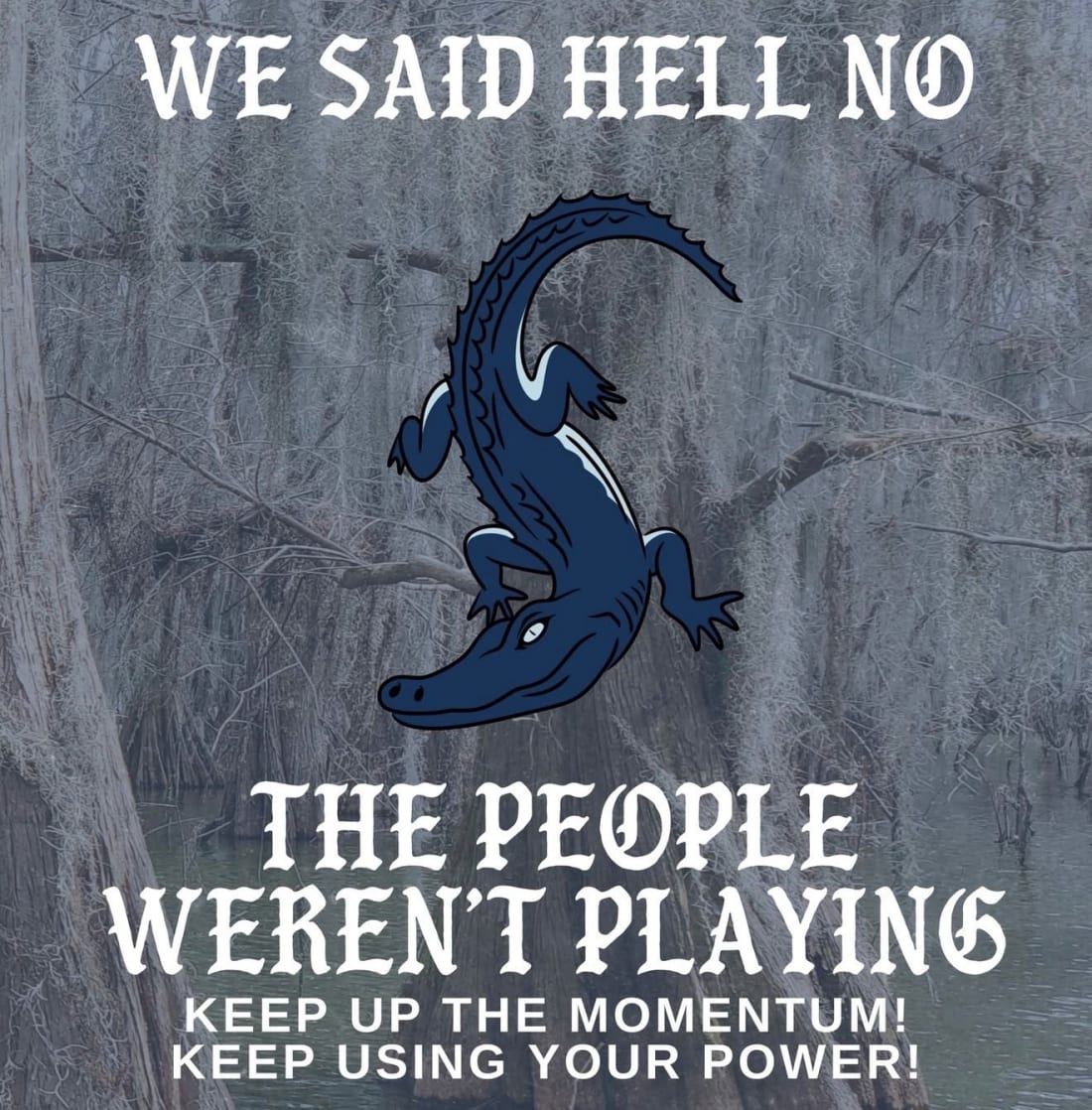
In March of 2025, Louisiana voters did something powerful:
we said no.
No to a set of far-right Project 2025–style permanent amendments to our Constitution. Amendments that created kangaroo courts (Amendment 1), a tax-code bait and switch (Amendment 2), expanded the incarceration of children (Amendment 3), and rigged judicial elections to lock in partisan power (Amendment 4).
And this wasn’t a fringe response. A broad coalition of Democrats, independents, and Republicans rejected those amendments together — urban and rural voters, Black and white voters, parents, teachers, faith leaders, and small-business owners — united by a shared understanding that permanently rewriting the Constitution to concentrate power and strip safeguards was a step too far.
The message was clear.
 |
Now, the same project is back — narrower in form, but identical in purpose.
Below is a clear-eyed preview of the five constitutional amendments on the May ballot, and why voters should reject all of them — again.
Amendment 1: The Corporate Inventory Tax Shell Game
For nearly three decades, Louisiana has had a strange compromise baked into its tax system.
Local governments tax business inventory — the goods sitting in warehouses, refineries, plants, and distribution centers. Parishes rely on that revenue to fund schools, sheriffs, roads, and basic services. Corporations, especially large industrial ones, hated the tax and pushed to eliminate it from the Constitution for decades.
Parishes refused. They needed the money.
So around 1998, the state struck a deal: keep the inventory tax in place locally, but have the state reimburse corporations for what they paid through a tax credit. That subsidy eventually grew to roughly $500 million a year — a massive corporate giveaway, written into statutory law, not the Constitution.
Recently, the Legislature eliminated that subsidy. On its face, that could have been a rare moment of corporate accountability. But that’s not what’s happening here.
Instead of ending the subsidy and letting corporations absorb the cost, the strategy now is to put parishes under pressure.
Without the state reimbursement, inventory-heavy industries face large local tax bills. Those industries will do what they always do: lean on parish officials, threaten relocation, and point to neighboring parishes that don’t tax inventory. The result is a race to the bottom.
This amendment is the workaround.
It gives parishes the option to eliminate the inventory tax themselves, sweetened with a one-time payment from the state’s rainy day fund. Once the tax is gone, it’s hard to restore. And the amendment locks the system into the Constitution, preventing a future statewide fix.
Over time, parishes with heavy industry will lose major revenue and be forced to raise sales taxes and residential property taxes to fill the gap.
This isn’t tax reform. It’s a giant corporate tax cut in disguise, shifting the cost from corporations to local communities.
If this amendment fails, the GOP supermajority will likely reinstate the subsidy with a simple majority vote. They shouldn’t. The right answer isn’t reviving the giveaway — it’s refusing this shell game altogether.
Amendment 2: Let Judges Stay Longer
This amendment raises the mandatory retirement age for judges from 70 to 75.
Raising the age slows judicial turnover and extends the influence of today’s political majority over the courts. It doesn’t address accountability, performance, or fairness — it simply extends tenure.
If voters want a conversation about judicial quality, that conversation should be honest and direct. This amendment isn’t that.
Amendment 3: Politicizing Civil Service
Louisiana’s civil service system protects roughly 60,000 state workers — nurses, health inspectors, engineers, child-welfare caseworkers, environmental scientists, biologists, auditors, state troopers, university staff, IT specialists, and many others who keep the state functioning. These employees are hired on merit, not loyalty, and they can’t be fired for refusing illegal or unethical orders.
This amendment allows the Legislature to strip those protections away job category by job category, turning professional public servants into at-will political employees. Once a position is reclassified, the independent Civil Service Commission cannot restore it.
That’s a one-way door.
Civil service exists to prevent patronage, corruption, and political purges. Weakening it doesn’t make government more efficient. It makes it more political — and less competent.
Amendment 4: Raiding Education Trust Funds to Avoid Real Funding
This amendment liquidates long-standing education trust funds — including funds created from offshore oil revenues and the tobacco settlement — and redirects the money to pay down teacher pension debt.
Supporters say this will free up money for teacher raises. That’s misleading.
Permanent teacher pay is supposed to be funded through the Minimum Foundation Program (MFP) — the formula that equalizes pay across districts so a teacher in a poor parish isn’t punished for where they live. This amendment bypasses the MFP entirely.
Instead, raises depend on pension “savings,” which vary by district. Wealthier districts with larger payrolls benefit more. Poorer districts benefit less. Inequality widens.
And once these trust funds are gone, they’re gone forever — money originally set aside for classrooms, early childhood programs, and instructional support used to patch over chronic underfunding while the state refuses to raise new revenue.
We are selling off our children’s future to avoid asking corporations to contribute more.
Amendment 5: St. George and Segregation by Design
This amendment allows the St. George area to create its own school system, separate from East Baton Rouge Parish.
St. George is a newly formed city carved out of the wealthiest, predominantly white parts of the parish. Its separation leaves behind a poorer, heavily Black school district while taking local tax base and political power with it.
Supporters call this “local control.” In practice, it’s segregation through finance.
State education dollars follow students into the new district. Local property wealth follows the new city. East Baton Rouge Parish loses revenue but keeps legacy costs — school debt, aging facilities, retiree obligations, and high-need students.
St. George, meanwhile, receives direct state funding through the Minimum Foundation Program on top of its local wealth. That creates a double advantage: more money per student and fewer high-cost obligations.
The result is higher per-student costs statewide, deeper inequality locally, and a modern version of segregation — not enforced by law, but by resource extraction.
This isn’t local control. It’s disinvestment — and it deserves a no vote.
The Pattern Matters
Taken individually, each amendment has a sales pitch. Taken together, the pattern is obvious:
Corporate tax cuts locked into the Constitution
Resulting higher tax burdens shifted onto communities
Worker protections weakened
Education trust funds drained
School systems fragmented along lines of wealth and race
Future lawmakers blocked from fixing the damage
This is the same agenda voters rejected in March 2025 — just broken into pieces and sent back to the ballot.
And that’s why the answer, again, should be no.
A Call to Do This Together — Again
What happened in March wasn’t partisan. It was civic.
A broad, multiracial coalition of Louisianans — Democrats, Republicans, and independents — looked at these amendments and said: this doesn’t add up.
We need that same coalition again.
Read the amendments. Talk to your neighbors. Share this with people who don’t follow politics every day. And when you vote in May, remember:
The Constitution is not a scratch pad for bad policy.
We stopped it once. We can stop it again.
What can you do to help change Louisiana?
Set up a $5 monthly contribution to the Louisiana Democratic Party here
We have to get back to nuts and bolts of what built Democratic domination in the past. Sign up your interest to become a precinct organizer here.
Who’s running for Congress in 2026? Check out Jamie Davis, Jabarie Walker & Tracie Burke running for U.S. Senate against Bill Cassidy, Conrad Cable & Matt Gromlich against Speaker Mike Johnson (LA-4), Lauren Jewett against Steve Scalise (LA-1), Tia Lebrun & Priscilla Gonzalez against Clay Higgins (LA-3) and Jessee Fleenor & Larry Foy against Julia Letlow’s successor (LA-5).
Dustin is a financial advisor and Certified Financial Planner with over 20 years of experience guiding Louisiana families as co-owner of Generation Wealth. A lifelong resident of Louisiana and LSU alumnus, he is also a proud #girldad. Dustin ran for Louisiana State Treasurer in 2023, bringing in more votes than any other statewide Democratic candidate, though he was ultimately unsuccessful. He has since focused on strengthening the Louisiana Democratic Party, having been elected Treasurer in 2024 and serving on the State Central Committee. As a delegate to the 2024 Democratic National Convention and a frequent commentator on social media and local TV networks, Dustin holds leaders accountable and champions progressive solutions for a revitalized Louisiana.
You're currently a free subscriber to Dustin Granger for Louisiana. For the full experience, upgrade your subscription.
| ||||||||||

