Expert analysis made easy. Breaking down the news with data, charts, and maps.
Edited by Brady Africk and Lexi Baker
Happy Thursday! In today’s newsletter, we examine the cost of Russia’s war with Ukraine, democratic contenders for the 2028 presidential election, and the rising US deficit.
Don’t forget—subscribe and send DataPoints to a friend!
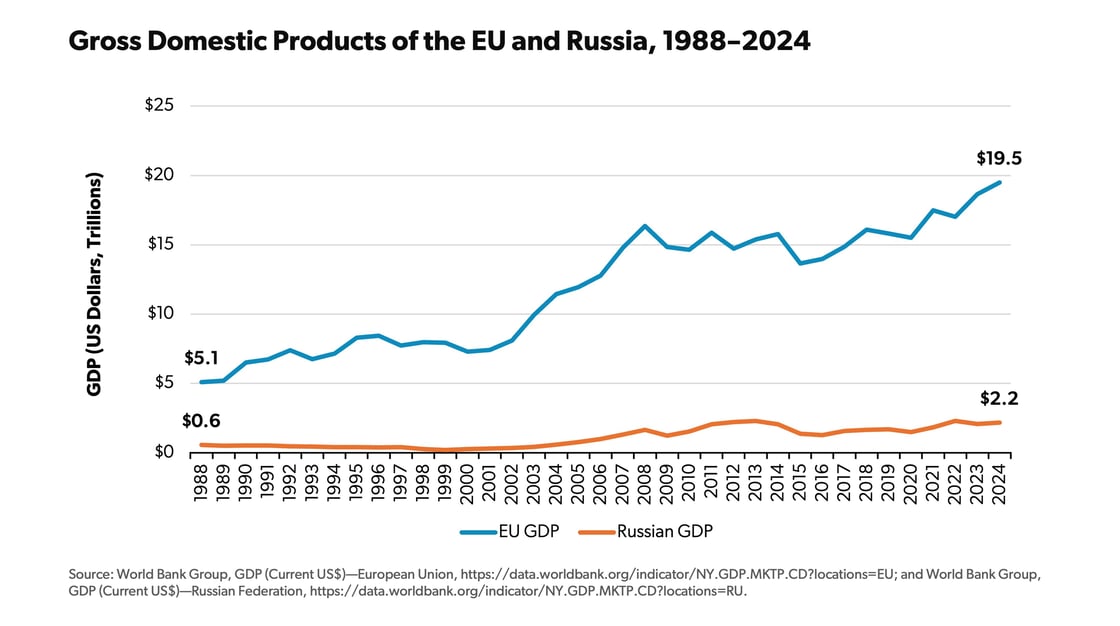
Topline: Russia accounts for just 2 percent of global GDP, roughly equivalent to New York state’s contribution in 1990. As we approach the fourth year of Russia’s full-scale invasion of Ukraine, AEI’s Danielle Pletka and Marc A. Thiessen examine the ailing state of Russia’s economy and what failure in Ukraine would cost the country.
Big Costs, Little Reward: Russia’s government is spending four out of every 10 rubles on the war in Ukraine and, at its current pace, will deplete the country’s cash reserves by 2030. Despite this massive outlay, Russia has netted just 7 percent of Ukrainian territory.
Economic Divergence: Moscow’s economic struggles stand in stark contrast to the condition of former Soviet states that joined the European Union. These EU countries have seen a tenfold average increase in GDP since 1990. By contrast, Russia and its non-EU neighbors have expanded just fourfold. Today, the combined GDP of the newer EU member states stands at $2.4 trillion—surpassing Russia’s $2 trillion economy.
“The cost to each Russian is simply incalculable because it’s not just the loss of the present prosperity, it’s the loss of future prosperity. Because these sanctions aren’t going to go away, there are more than 20,000 sanctions that have been levied on Russia.” —Danielle Pletka
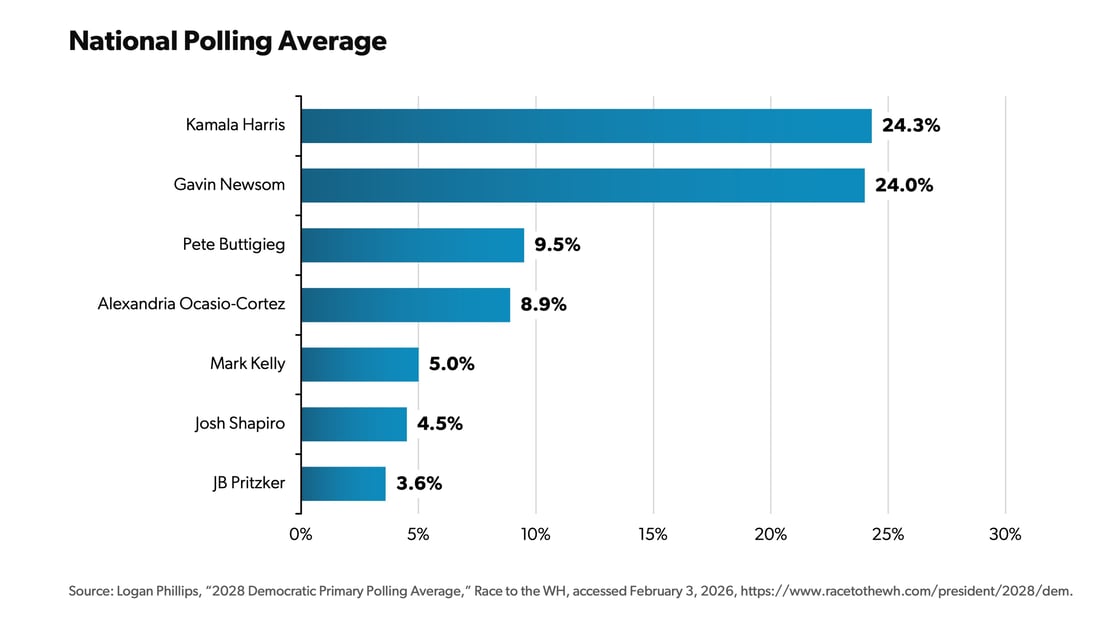
Topline: After polling in the single digits just a year ago and underperforming in 2022, California Governor Gavin Newsom has emerged as a front-runner in the 2028 Democratic primary. While momentum is important, candidates’ records and past positions matter considerably. AEI’s Ruy Teixeira warns that Newsom’s recent success may not translate to the general election.
A Betting Man: In betting markets, Newsom dominates the 2028 primary field, with Alexandria Ocasio-Cortez and Kamala Harris trailing far behind. He falls below only Vice President JD Vance in general election betting.
What Makes a Winner: A candidate’s track record matters, especially when facing a general electorate of nonpartisan and swing voters. While Newsom has unified his democratic base—from moderates to the anti-Trump resistance—he has yet to adapt his message to appeal to voters outside his base.
"Newsom’s gift (if you can call it that) of appealing to all the factions within his own base works well for individual candidates in blue states but terribly for the party as a whole and its presidential candidates. It encourages candidates to think their basic positions don’t have to change much and that their progressive record, commitments, and statements over the years won’t turn off voters.” —Ruy Teixeira
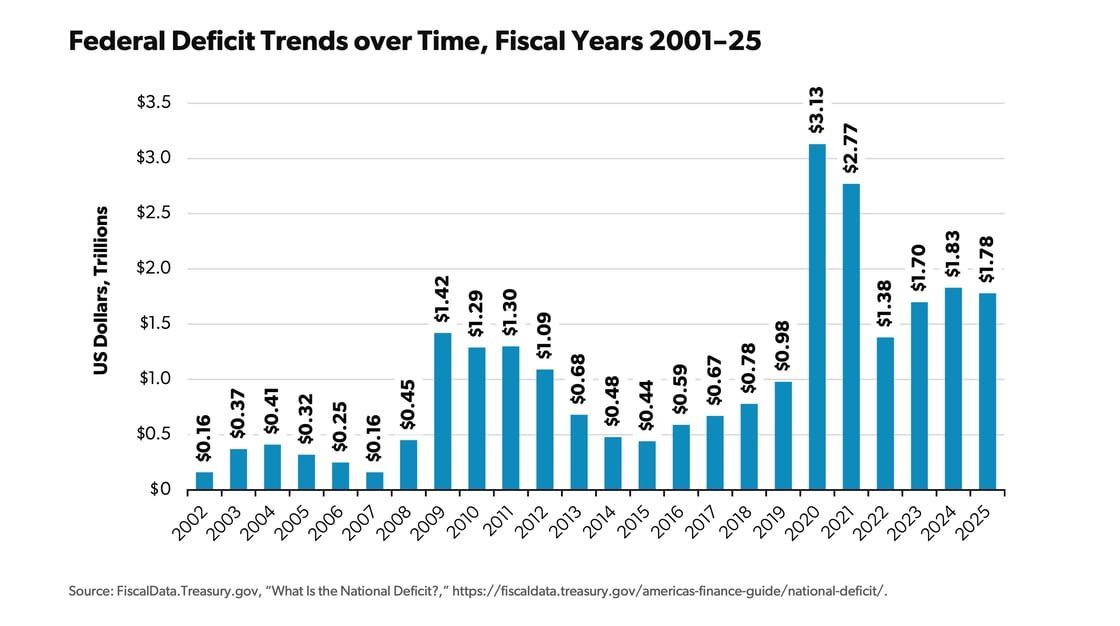
Topline: The United States ran a staggering $1.8 trillion deficit in 2025. Estimates indicate that this is unlikely to stop rising anytime soon, and AEI’s Kevin R. Kosar cautions that Washington shows little interest in reversing this costly course.
Breaking Records: The ear2025 marked the third straight year when the annual deficit totaled roughly 6 percent of GDP—far above the 50-year average of 3.8 percent. The average has been surpassed only eight times since 1946, including in 2023, 2024, and 2025.
No End in Sight: The Congressional Budget Office estimates the One Big Beautiful Bill, passed in July 2025, will add $3.4 trillion to the deficit by 2034. Congress’s rescission will cut $9 billion, and President Trump’s will cut $4.9 billion—both just drops in the bucket.
"There are a few signs that the White House or Capitol Hill is serious about reducing federal deficits. Trump is talking of acquiring Greenland and calling for a $600 billion increase in defense spending. Republicans, who control both chambers of Congress, continue to send the president appropriations bills that spend more than last year’s laws. Democrats have urged aggressively raising taxes on the wealthiest Americans. Done properly, well-targeted tax increases would at best slow the growth of the deficit.” —Kevin R. Kosar