
Email
Mississippi Homeowner Bill of Rights: End Property Tax
| From | Dana Criswell <[email protected]> |
| Subject | Mississippi Homeowner Bill of Rights: End Property Tax |
| Date | February 5, 2026 1:45 PM |
Links have been removed from this email. Learn more in the FAQ.
Links have been removed from this email. Learn more in the FAQ.
View this post on the web at [link removed]
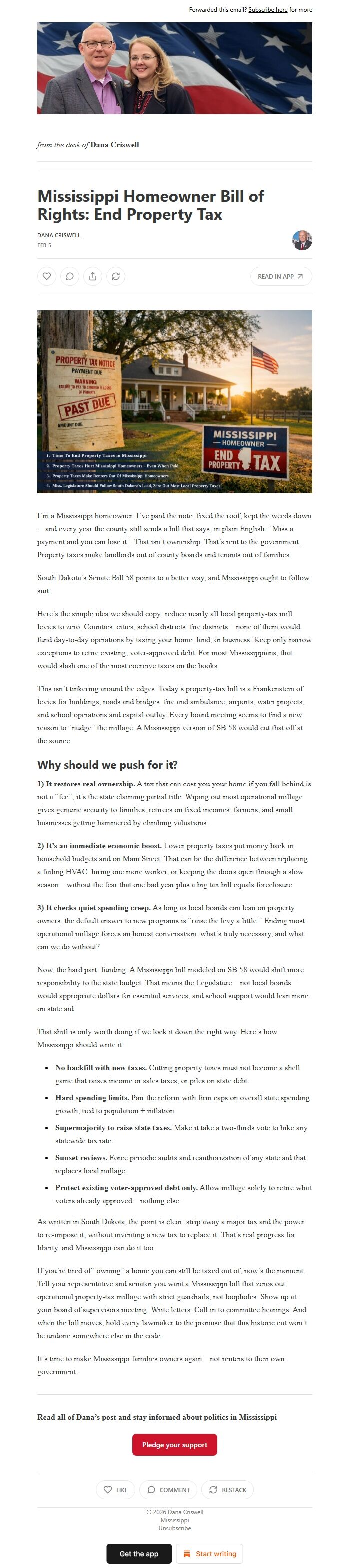
I’m a Mississippi homeowner. I’ve paid the note, fixed the roof, kept the weeds down—and every year the county still sends a bill that says, in plain English: “Miss a payment and you can lose it.” That isn’t ownership. That’s rent to the government. Property taxes make landlords out of county boards and tenants out of families.
South Dakota’s Senate Bill 58 points to a better way, and Mississippi ought to follow suit.
Here’s the simple idea we should copy: reduce nearly all local property-tax mill levies to zero. Counties, cities, school districts, fire districts—none of them would fund day-to-day operations by taxing your home, land, or business. Keep only narrow exceptions to retire existing, voter-approved debt. For most Mississippians, that would slash one of the most coercive taxes on the books.
This isn’t tinkering around the edges. Today’s property-tax bill is a Frankenstein of levies for buildings, roads and bridges, fire and ambulance, airports, water projects, and school operations and capital outlay. Every board meeting seems to find a new reason to “nudge” the millage. A Mississippi version of SB 58 would cut that off at the source.
Why should we push for it?
1) It restores real ownership. A tax that can cost you your home if you fall behind is not a “fee”; it’s the state claiming partial title. Wiping out most operational millage gives genuine security to families, retirees on fixed incomes, farmers, and small businesses getting hammered by climbing valuations.
2) It’s an immediate economic boost. Lower property taxes put money back in household budgets and on Main Street. That can be the difference between replacing a failing HVAC, hiring one more worker, or keeping the doors open through a slow season—without the fear that one bad year plus a big tax bill equals foreclosure.
3) It checks quiet spending creep. As long as local boards can lean on property owners, the default answer to new programs is “raise the levy a little.” Ending most operational millage forces an honest conversation: what’s truly necessary, and what can we do without?
Now, the hard part: funding. A Mississippi bill modeled on SB 58 would shift more responsibility to the state budget. That means the Legislature—not local boards—would appropriate dollars for essential services, and school support would lean more on state aid.
That shift is only worth doing if we lock it down the right way. Here’s how Mississippi should write it:
No backfill with new taxes. Cutting property taxes must not become a shell game that raises income or sales taxes, or piles on state debt.
Hard spending limits. Pair the reform with firm caps on overall state spending growth, tied to population + inflation.
Supermajority to raise state taxes. Make it take a two-thirds vote to hike any statewide tax rate.
Sunset reviews. Force periodic audits and reauthorization of any state aid that replaces local millage.
Protect existing voter-approved debt only. Allow millage solely to retire what voters already approved—nothing else.
As written in South Dakota, the point is clear: strip away a major tax and the power to re-impose it, without inventing a new tax to replace it. That’s real progress for liberty, and Mississippi can do it too.
If you’re tired of “owning” a home you can still be taxed out of, now’s the moment. Tell your representative and senator you want a Mississippi bill that zeros out operational property-tax millage with strict guardrails, not loopholes. Show up at your board of supervisors meeting. Write letters. Call in to committee hearings. And when the bill moves, hold every lawmaker to the promise that this historic cut won’t be undone somewhere else in the code.
It’s time to make Mississippi families owners again—not renters to their own government.
Unsubscribe [link removed]?
I’m a Mississippi homeowner. I’ve paid the note, fixed the roof, kept the weeds down—and every year the county still sends a bill that says, in plain English: “Miss a payment and you can lose it.” That isn’t ownership. That’s rent to the government. Property taxes make landlords out of county boards and tenants out of families.
South Dakota’s Senate Bill 58 points to a better way, and Mississippi ought to follow suit.
Here’s the simple idea we should copy: reduce nearly all local property-tax mill levies to zero. Counties, cities, school districts, fire districts—none of them would fund day-to-day operations by taxing your home, land, or business. Keep only narrow exceptions to retire existing, voter-approved debt. For most Mississippians, that would slash one of the most coercive taxes on the books.
This isn’t tinkering around the edges. Today’s property-tax bill is a Frankenstein of levies for buildings, roads and bridges, fire and ambulance, airports, water projects, and school operations and capital outlay. Every board meeting seems to find a new reason to “nudge” the millage. A Mississippi version of SB 58 would cut that off at the source.
Why should we push for it?
1) It restores real ownership. A tax that can cost you your home if you fall behind is not a “fee”; it’s the state claiming partial title. Wiping out most operational millage gives genuine security to families, retirees on fixed incomes, farmers, and small businesses getting hammered by climbing valuations.
2) It’s an immediate economic boost. Lower property taxes put money back in household budgets and on Main Street. That can be the difference between replacing a failing HVAC, hiring one more worker, or keeping the doors open through a slow season—without the fear that one bad year plus a big tax bill equals foreclosure.
3) It checks quiet spending creep. As long as local boards can lean on property owners, the default answer to new programs is “raise the levy a little.” Ending most operational millage forces an honest conversation: what’s truly necessary, and what can we do without?
Now, the hard part: funding. A Mississippi bill modeled on SB 58 would shift more responsibility to the state budget. That means the Legislature—not local boards—would appropriate dollars for essential services, and school support would lean more on state aid.
That shift is only worth doing if we lock it down the right way. Here’s how Mississippi should write it:
No backfill with new taxes. Cutting property taxes must not become a shell game that raises income or sales taxes, or piles on state debt.
Hard spending limits. Pair the reform with firm caps on overall state spending growth, tied to population + inflation.
Supermajority to raise state taxes. Make it take a two-thirds vote to hike any statewide tax rate.
Sunset reviews. Force periodic audits and reauthorization of any state aid that replaces local millage.
Protect existing voter-approved debt only. Allow millage solely to retire what voters already approved—nothing else.
As written in South Dakota, the point is clear: strip away a major tax and the power to re-impose it, without inventing a new tax to replace it. That’s real progress for liberty, and Mississippi can do it too.
If you’re tired of “owning” a home you can still be taxed out of, now’s the moment. Tell your representative and senator you want a Mississippi bill that zeros out operational property-tax millage with strict guardrails, not loopholes. Show up at your board of supervisors meeting. Write letters. Call in to committee hearings. And when the bill moves, hold every lawmaker to the promise that this historic cut won’t be undone somewhere else in the code.
It’s time to make Mississippi families owners again—not renters to their own government.
Unsubscribe [link removed]?
Message Analysis
- Sender: n/a
- Political Party: n/a
- Country: n/a
- State/Locality: n/a
- Office: n/a