
| From | The American Prospect <[email protected]> |
| Subject | The scourge of online sports betting |
| Date | February 4, 2026 11:05 AM |
Links have been removed from this email. Learn more in the FAQ.
Links have been removed from this email. Learn more in the FAQ.
What an explosion of sports gambling means for a generation of bettors.Was this email forwarded to you? Sign up here to get The Daily Prospect Monday through Friday. [link removed]
[link removed]
**FEBRUARY 4, 2026**
Click to read this email in your browser. [link removed]
Trying to beat the house in the age of online sport betting is an algorithmically driven con game that few can win. (Finding a way past the algorithm too many times might just get you kicked off the apps.) All the sportsbooks need to reel in megabillions are a few good men—it’s mostly men—believing that they’re one more bet away from a new car or not having to work anymore. The thrill of online sports betting chews people up and spits them out. As the mental health and economic harms proliferate, state and federal regulators are going to have to get in the game.
**–Gabrielle Gurley, senior editor**
[link removed]
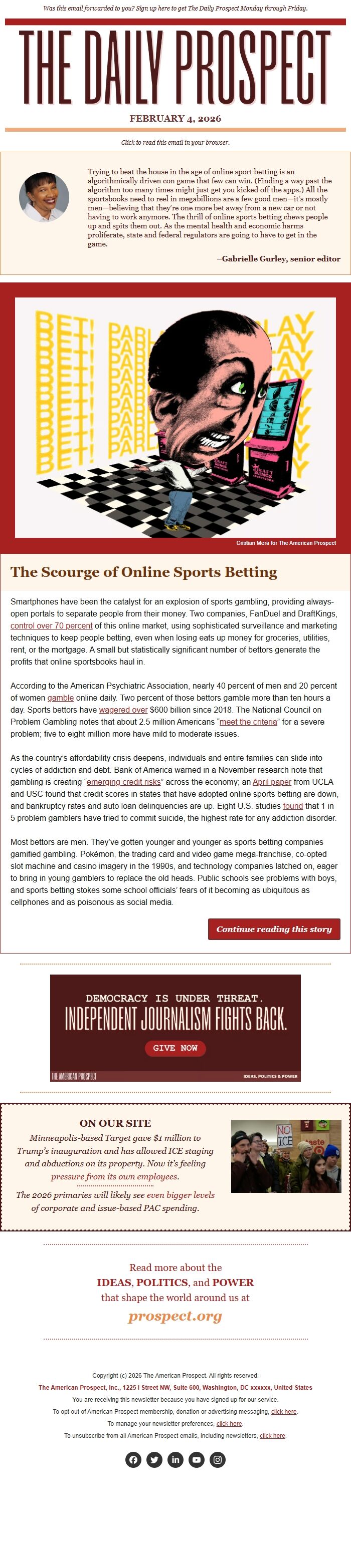
Cristian Mera for The American Prospect
The Scourge of Online Sports Betting [link removed]
Smartphones have been the catalyst for an explosion of sports gambling, providing always-open portals to separate people from their money. Two companies, FanDuel and DraftKings, control over 70 percent [link removed] of this online market, using sophisticated surveillance and marketing techniques to keep people betting, even when losing eats up money for groceries, utilities, rent, or the mortgage. A small but statistically significant number of bettors generate the profits that online sportsbooks haul in.
According to the American Psychiatric Association, nearly 40 percent of men and 20 percent of women gamble [link removed] online daily. Two percent of those bettors gamble more than ten hours a day. Sports bettors have wagered over [link removed] $600 billion since 2018. The National Council on Problem Gambling notes that about 2.5 million Americans “meet the criteria [link removed]” for a severe problem; five to eight million more have mild to moderate issues.
As the country’s affordability crisis deepens, individuals and entire families can slide into cycles of addiction and debt. Bank of America warned in a November research note that gambling is creating “emerging credit risks [link removed]” across the economy; an April paper [link removed] from UCLA and USC found that credit scores in states that have adopted online sports betting are down, and bankruptcy rates and auto loan delinquencies are up. Eight U.S. studies found [link removed] that 1 in 5 problem gamblers have tried to commit suicide, the highest rate for any addiction disorder.
Most bettors are men. They’ve gotten younger and younger as sports betting companies gamified gambling. Pokémon, the trading card and video game mega-franchise, co-opted slot machine and casino imagery in the 1990s, and technology companies latched on, eager to bring in young gamblers to replace the old heads. Public schools see problems with boys, and sports betting stokes some school officials’ fears of it becoming as ubiquitous as cellphones and as poisonous as social media.
Continue reading this story [link removed]
prospect.org/donate
****ON OUR SITE****
Minneapolis-based Target gave $1 million to Trump’s inauguration and has allowed ICE staging and abductions on its property. Now it’s feeling pressure from its own employees [link removed].
The 2026 primaries will likely see even bigger levels [link removed] of corporate and issue-based PAC spending.
[link removed]
Read more about the [link removed]
IDEAS, POLITICS, and POWER [link removed]
that shape the world around us at [link removed]
prospect.org [link removed]
Copyright (c) 2026 The American Prospect. All rights reserved.**The American Prospect, Inc., 1225 I Street NW, Suite 600, Washington, DC xxxxxx, United States**
You are receiving this newsletter because you have signed up for our service.
To opt out of American Prospect membership, donation or advertising messaging, click here [link removed].
To manage your newsletter preferences, click here [link removed].
To unsubscribe from all American Prospect emails, including newsletters, click here [link removed].
[link removed]
[link removed]
[link removed]
[link removed]
[link removed]
Sent to: [email protected]
Unsubscribe [link removed]
The American Prospect, Inc., 1225 I Street NW, Suite 600, Washington, DC xxxxxx, United States
[link removed]
**FEBRUARY 4, 2026**
Click to read this email in your browser. [link removed]
Trying to beat the house in the age of online sport betting is an algorithmically driven con game that few can win. (Finding a way past the algorithm too many times might just get you kicked off the apps.) All the sportsbooks need to reel in megabillions are a few good men—it’s mostly men—believing that they’re one more bet away from a new car or not having to work anymore. The thrill of online sports betting chews people up and spits them out. As the mental health and economic harms proliferate, state and federal regulators are going to have to get in the game.
**–Gabrielle Gurley, senior editor**
[link removed]
Cristian Mera for The American Prospect
The Scourge of Online Sports Betting [link removed]
Smartphones have been the catalyst for an explosion of sports gambling, providing always-open portals to separate people from their money. Two companies, FanDuel and DraftKings, control over 70 percent [link removed] of this online market, using sophisticated surveillance and marketing techniques to keep people betting, even when losing eats up money for groceries, utilities, rent, or the mortgage. A small but statistically significant number of bettors generate the profits that online sportsbooks haul in.
According to the American Psychiatric Association, nearly 40 percent of men and 20 percent of women gamble [link removed] online daily. Two percent of those bettors gamble more than ten hours a day. Sports bettors have wagered over [link removed] $600 billion since 2018. The National Council on Problem Gambling notes that about 2.5 million Americans “meet the criteria [link removed]” for a severe problem; five to eight million more have mild to moderate issues.
As the country’s affordability crisis deepens, individuals and entire families can slide into cycles of addiction and debt. Bank of America warned in a November research note that gambling is creating “emerging credit risks [link removed]” across the economy; an April paper [link removed] from UCLA and USC found that credit scores in states that have adopted online sports betting are down, and bankruptcy rates and auto loan delinquencies are up. Eight U.S. studies found [link removed] that 1 in 5 problem gamblers have tried to commit suicide, the highest rate for any addiction disorder.
Most bettors are men. They’ve gotten younger and younger as sports betting companies gamified gambling. Pokémon, the trading card and video game mega-franchise, co-opted slot machine and casino imagery in the 1990s, and technology companies latched on, eager to bring in young gamblers to replace the old heads. Public schools see problems with boys, and sports betting stokes some school officials’ fears of it becoming as ubiquitous as cellphones and as poisonous as social media.
Continue reading this story [link removed]
prospect.org/donate
****ON OUR SITE****
Minneapolis-based Target gave $1 million to Trump’s inauguration and has allowed ICE staging and abductions on its property. Now it’s feeling pressure from its own employees [link removed].
The 2026 primaries will likely see even bigger levels [link removed] of corporate and issue-based PAC spending.
[link removed]
Read more about the [link removed]
IDEAS, POLITICS, and POWER [link removed]
that shape the world around us at [link removed]
prospect.org [link removed]
Copyright (c) 2026 The American Prospect. All rights reserved.**The American Prospect, Inc., 1225 I Street NW, Suite 600, Washington, DC xxxxxx, United States**
You are receiving this newsletter because you have signed up for our service.
To opt out of American Prospect membership, donation or advertising messaging, click here [link removed].
To manage your newsletter preferences, click here [link removed].
To unsubscribe from all American Prospect emails, including newsletters, click here [link removed].
[link removed]
[link removed]
[link removed]
[link removed]
[link removed]
Sent to: [email protected]
Unsubscribe [link removed]
The American Prospect, Inc., 1225 I Street NW, Suite 600, Washington, DC xxxxxx, United States
Message Analysis
- Sender: American Prospect
- Political Party: n/a
- Country: United States
- State/Locality: n/a
- Office: n/a