
Email
⭐ This is what broken accountability looks like
| From | The Open Britain Team <[email protected]> |
| Subject | ⭐ This is what broken accountability looks like |
| Date | February 3, 2026 6:05 PM |
Links have been removed from this email. Learn more in the FAQ.
Links have been removed from this email. Learn more in the FAQ.
[link removed]
[link removed]
Dear John,
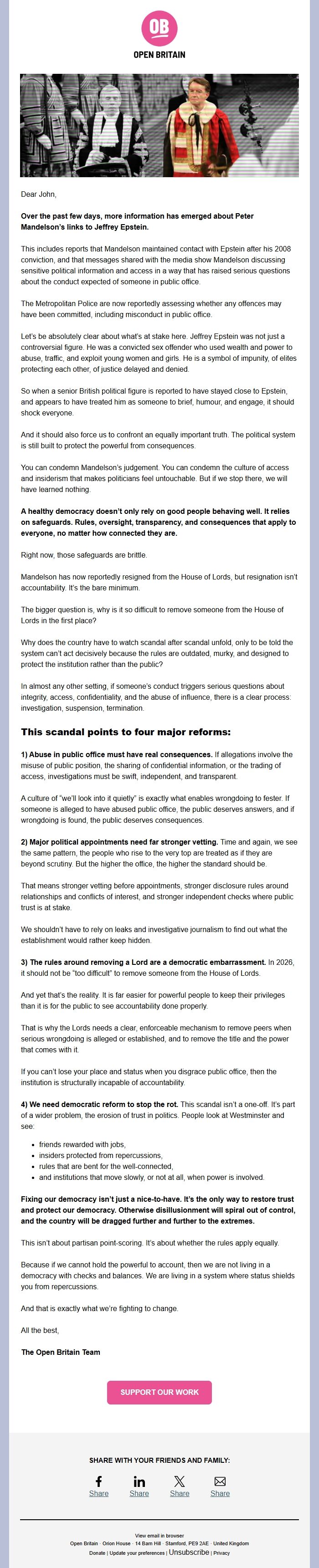
Over the past few days, more information has emerged about Peter Mandelson’s links to Jeffrey Epstein.
This includes reports that Mandelson maintained contact with Epstein after his 2008 conviction, and that messages shared with the media show Mandelson discussing sensitive political information and access in a way that has raised serious questions about the conduct expected of someone in public office.
The Metropolitan Police are now reportedly assessing whether any offences may have been committed, including misconduct in public office.
Let’s be absolutely clear about what’s at stake here. Jeffrey Epstein was not just a controversial figure. He was a convicted sex offender who used wealth and power to abuse, traffic, and exploit young women and girls. He is a symbol of impunity, of elites protecting each other, of justice delayed and denied.
So when a senior British political figure is reported to have stayed close to Epstein, and appears to have treated him as someone to brief, humour, and engage, it should shock everyone.
And it should also force us to confront an equally important truth. The political system is still built to protect the powerful from consequences.
You can condemn Mandelson’s judgement. You can condemn the culture of access and insiderism that makes politicians feel untouchable. But if we stop there, we will have learned nothing.
A healthy democracy doesn’t only rely on good people behaving well. It relies on safeguards. Rules, oversight, transparency, and consequences that apply to everyone, no matter how connected they are.
Right now, those safeguards are brittle.
Mandelson has now reportedly resigned from the House of Lords, but resignation isn’t accountability. It’s the bare minimum.
The bigger question is, why is it so difficult to remove someone from the House of Lords in the first place?
Why does the country have to watch scandal after scandal unfold, only to be told the system can’t act decisively because the rules are outdated, murky, and designed to protect the institution rather than the public?
In almost any other setting, if someone’s conduct triggers serious questions about integrity, access, confidentiality, and the abuse of influence, there is a clear process: investigation, suspension, termination.
** This scandal points to four major reforms:
------------------------------------------------------------
1) Abuse in public office must have real consequences. If allegations involve the misuse of public position, the sharing of confidential information, or the trading of access, investigations must be swift, independent, and transparent.
A culture of “we’ll look into it quietly” is exactly what enables wrongdoing to fester. If someone is alleged to have abused public office, the public deserves answers, and if wrongdoing is found, the public deserves consequences.
2) Major political appointments need far stronger vetting. Time and again, we see the same pattern, the people who rise to the very top are treated as if they are beyond scrutiny. But the higher the office, the higher the standard should be.
That means stronger vetting before appointments, stronger disclosure rules around relationships and conflicts of interest, and stronger independent checks where public trust is at stake.
We shouldn’t have to rely on leaks and investigative journalism to find out what the establishment would rather keep hidden.
3) The rules around removing a Lord are a democratic embarrassment. In 2026, it should not be “too difficult” to remove someone from the House of Lords.
And yet that’s the reality. It is far easier for powerful people to keep their privileges than it is for the public to see accountability done properly.
That is why the Lords needs a clear, enforceable mechanism to remove peers when serious wrongdoing is alleged or established, and to remove the title and the power that comes with it.
If you can’t lose your place and status when you disgrace public office, then the institution is structurally incapable of accountability.
4) We need democratic reform to stop the rot. This scandal isn’t a one-off. It’s part of a wider problem, the erosion of trust in politics. People look at Westminster and see:
* friends rewarded with jobs,
* insiders protected from repercussions,
* rules that are bent for the well-connected,
* and institutions that move slowly, or not at all, when power is involved.
Fixing our democracy isn’t just a nice-to-have. It’s the only way to restore trust and protect our democracy. Otherwise disillusionment will spiral out of control, and the country will be dragged further and further to the extremes.
This isn’t about partisan point-scoring. It’s about whether the rules apply equally.
Because if we cannot hold the powerful to account, then we are not living in a democracy with checks and balances. We are living in a system where status shields you from repercussions.
And that is exactly what we’re fighting to change.
All the best,
The Open Britain Team
SUPPORT OUR WORK ([link removed])
** SHARE WITH YOUR FRIENDS AND FAMILY:
------------------------------------------------------------
[link removed]
Share ([link removed])
[link removed]
Share ([link removed])
[link removed]
Share ([link removed])
[link removed]
Share ([link removed])
View email in browser ([link removed])
Open Britain . Orion House . 14 Barn Hill . Stamford, PE9 2AE . United Kingdom
Donate ([link removed]) | Update your preferences ([link removed]) | Unsubscribe ([link removed]) | Privacy ([link removed])
[link removed]
Dear John,
Over the past few days, more information has emerged about Peter Mandelson’s links to Jeffrey Epstein.
This includes reports that Mandelson maintained contact with Epstein after his 2008 conviction, and that messages shared with the media show Mandelson discussing sensitive political information and access in a way that has raised serious questions about the conduct expected of someone in public office.
The Metropolitan Police are now reportedly assessing whether any offences may have been committed, including misconduct in public office.
Let’s be absolutely clear about what’s at stake here. Jeffrey Epstein was not just a controversial figure. He was a convicted sex offender who used wealth and power to abuse, traffic, and exploit young women and girls. He is a symbol of impunity, of elites protecting each other, of justice delayed and denied.
So when a senior British political figure is reported to have stayed close to Epstein, and appears to have treated him as someone to brief, humour, and engage, it should shock everyone.
And it should also force us to confront an equally important truth. The political system is still built to protect the powerful from consequences.
You can condemn Mandelson’s judgement. You can condemn the culture of access and insiderism that makes politicians feel untouchable. But if we stop there, we will have learned nothing.
A healthy democracy doesn’t only rely on good people behaving well. It relies on safeguards. Rules, oversight, transparency, and consequences that apply to everyone, no matter how connected they are.
Right now, those safeguards are brittle.
Mandelson has now reportedly resigned from the House of Lords, but resignation isn’t accountability. It’s the bare minimum.
The bigger question is, why is it so difficult to remove someone from the House of Lords in the first place?
Why does the country have to watch scandal after scandal unfold, only to be told the system can’t act decisively because the rules are outdated, murky, and designed to protect the institution rather than the public?
In almost any other setting, if someone’s conduct triggers serious questions about integrity, access, confidentiality, and the abuse of influence, there is a clear process: investigation, suspension, termination.
** This scandal points to four major reforms:
------------------------------------------------------------
1) Abuse in public office must have real consequences. If allegations involve the misuse of public position, the sharing of confidential information, or the trading of access, investigations must be swift, independent, and transparent.
A culture of “we’ll look into it quietly” is exactly what enables wrongdoing to fester. If someone is alleged to have abused public office, the public deserves answers, and if wrongdoing is found, the public deserves consequences.
2) Major political appointments need far stronger vetting. Time and again, we see the same pattern, the people who rise to the very top are treated as if they are beyond scrutiny. But the higher the office, the higher the standard should be.
That means stronger vetting before appointments, stronger disclosure rules around relationships and conflicts of interest, and stronger independent checks where public trust is at stake.
We shouldn’t have to rely on leaks and investigative journalism to find out what the establishment would rather keep hidden.
3) The rules around removing a Lord are a democratic embarrassment. In 2026, it should not be “too difficult” to remove someone from the House of Lords.
And yet that’s the reality. It is far easier for powerful people to keep their privileges than it is for the public to see accountability done properly.
That is why the Lords needs a clear, enforceable mechanism to remove peers when serious wrongdoing is alleged or established, and to remove the title and the power that comes with it.
If you can’t lose your place and status when you disgrace public office, then the institution is structurally incapable of accountability.
4) We need democratic reform to stop the rot. This scandal isn’t a one-off. It’s part of a wider problem, the erosion of trust in politics. People look at Westminster and see:
* friends rewarded with jobs,
* insiders protected from repercussions,
* rules that are bent for the well-connected,
* and institutions that move slowly, or not at all, when power is involved.
Fixing our democracy isn’t just a nice-to-have. It’s the only way to restore trust and protect our democracy. Otherwise disillusionment will spiral out of control, and the country will be dragged further and further to the extremes.
This isn’t about partisan point-scoring. It’s about whether the rules apply equally.
Because if we cannot hold the powerful to account, then we are not living in a democracy with checks and balances. We are living in a system where status shields you from repercussions.
And that is exactly what we’re fighting to change.
All the best,
The Open Britain Team
SUPPORT OUR WORK ([link removed])
** SHARE WITH YOUR FRIENDS AND FAMILY:
------------------------------------------------------------
[link removed]
Share ([link removed])
[link removed]
Share ([link removed])
[link removed]
Share ([link removed])
[link removed]
Share ([link removed])
View email in browser ([link removed])
Open Britain . Orion House . 14 Barn Hill . Stamford, PE9 2AE . United Kingdom
Donate ([link removed]) | Update your preferences ([link removed]) | Unsubscribe ([link removed]) | Privacy ([link removed])
Message Analysis
- Sender: n/a
- Political Party: n/a
- Country: n/a
- State/Locality: n/a
- Office: n/a
-
Email Providers:
- MailChimp