|
 |



This weekend, I was in Los Angeles for Founders Day at the First African Methodist Episcopal Church, speaking about the 10 Steps Campaign. One speaker reminded us of the 1833 Alabama slave code, which made it illegal for more than five enslaved people to gather—especially in worship spaces—because authorities feared rebellion. That history came rushing back when, just days earlier, journalists and activists were arrested for protesting inside a church whose pastor owns a regional ICE field office. Much of the commentary, including some of my own, has focused on their innocence as journalists. But that misses the point. The issue isn’t why they were there—it’s that they were there, exercising the rights of citizens, and were punished for it.
Laws used to criminalize disruption in places of worship cut directly against the Constitution’s promise that Americans may raise their voices without fear. The hypocrisy is stark. ICE has repeatedly entered churches, disrupted services, and seized people in sanctuaries—actions that violate both the Freedom of Access to Clinic Entrances (FACE) Act and the spirit of religious freedom. As the daughter of two Methodist ministers, I was raised to believe faith is a shield, not a weapon. Churches are not sanctuaries from truth; they are where truth is confronted, where falsehoods are reckoned with, and where people learn how to be better. What this regime is doing on immigration violates the moral lessons taught in those spaces—regardless of faith tradition.
That is why I return to the 1833 slave code.
It was written because Black people gathered in churches to speak about their humanity—to say that having their children sold, their lives erased, and their dignity denied was wrong. Churches were the one place they believed they could imagine a future with mercy. Today, America is again in search of grace, and the people caught in our immigration system are in need of mercy. Instead, immigration is being wielded as a tool of fear. Recent deaths and raids have made clear that status is not safety, and that even sanctuaries are no longer sanctuary.
Immigration cannot be viewed in isolation.
It is a values test, a faith test, a truth-telling test. We see the same pattern when federal agents raid election centers and seize voter records the government is not entitled to have. If America has a faith, it is democracy—the belief that people may gather, speak, and choose their leaders without terror. These actions tell us that faith is no longer respected or protected.
Step 7 in the 10 Steps to Autocracy and Authoritarianism is scapegoating—treating marginalized people as disposable, denying their humanity. That is where a nation loses its soul. In this moment, we cannot afford distraction. Authoritarianism wears many masks, but our response must be rooted in clarity and courage. Our faith—civic and moral alike—must be that democracy, not fear, is how we are redeemed.

GO DEEPER
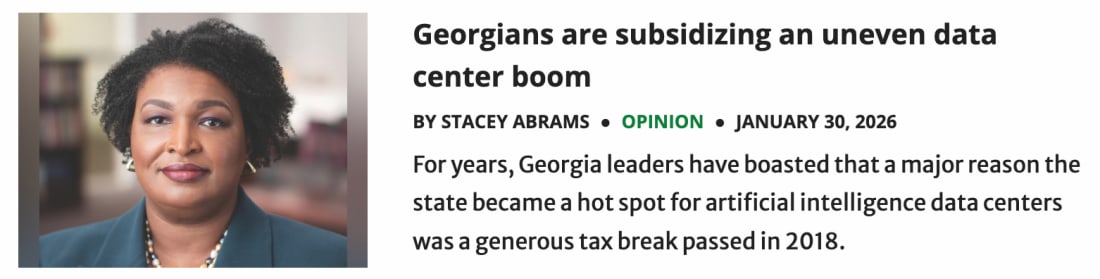
Read my latest Fine Print column for the Georgia Trust for Local News, where I wrote about how artificial intelligence data centers have cost Georgia taxpayers hundreds of millions, and left communities to bear the environmental, infrastructure, and economic burdens.
 |
You're currently a free subscriber to Assembly Notes by Stacey Abrams. For the full experience, upgrade your subscription.
| ||||||||||

