|
 |


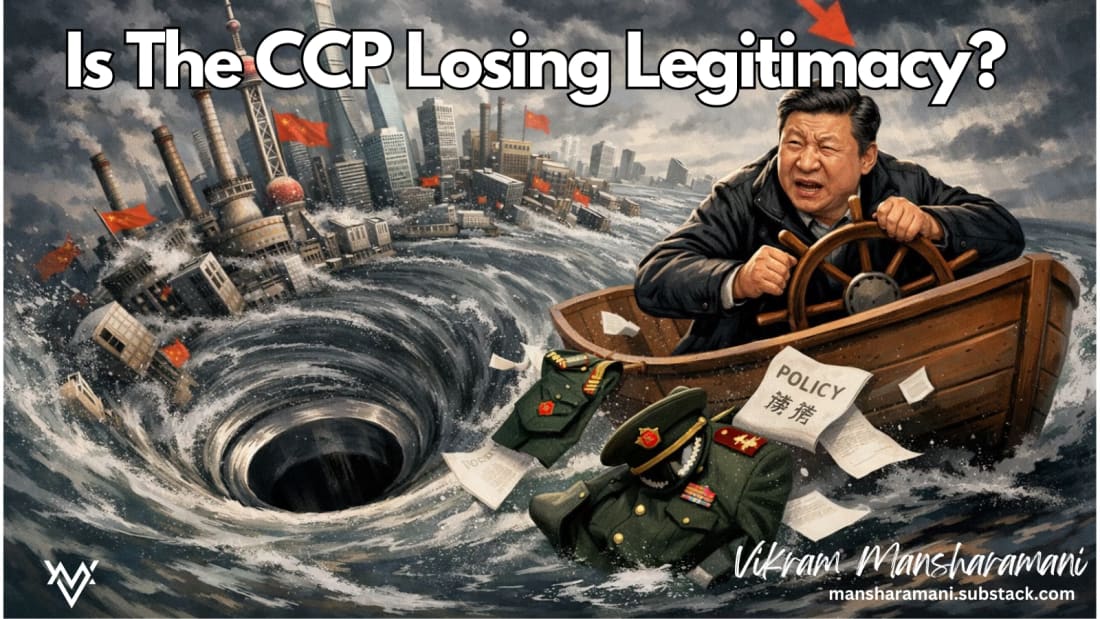 |
One of the most important global developments of the year got lost in the cacophony of January headlines. As the world focused on Greenland and its fate, the elites gathered in Davos to talk amongst and to themselves, Minneapolis residents took to the streets against ICE, and Wall Street began analyzing the implications of Kevin Warsh as the next Fed chair, major events in China that could have globe-shaking ramifications were under-reported.
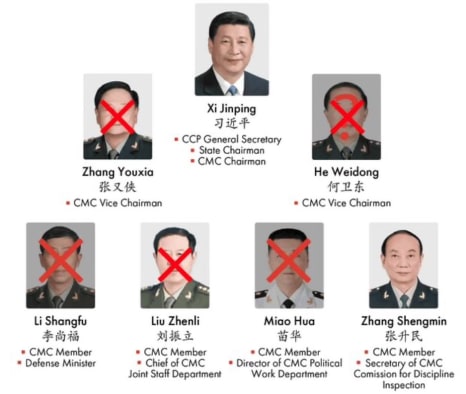
Chinese President Xi Jingping continued his purge of China’s military, this time targeting Zhang Youxia, the military’s top general and Senior Vice Chair of the Central Military Commission, along with another member of the commission. The move leaves Xi atop the military hierarchy and completes one of the largest purges in Chinese military history. Aside from Xi, only one of the other commission’s six members remains in place. The lone survivor is Zhang Shengmin; he was just elevated to vice chair last October, and he is widely regarded as more of a political officer than a military commander.
 |
Many diehard China-watchers (I admit to having been one since my undergraduate days when I spent a summer working at the US embassy in Beijing) noticed and began considering possible motivations and implications of the purge. Most reactions seem to focus on what the purge could mean for Taiwan’s future relationship with China.
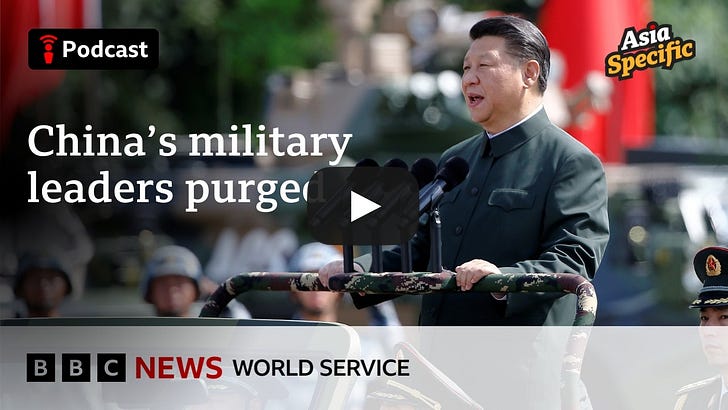
One camp argues that the purge was Xi’s attempt to remove opposition to his directive for the military to be ready to invade Taiwan by 2027. According to this thinking, the professional military knows how challenging the invasion will be and are resistant. Replacing skeptical officers with a political officer at the top of the military ensures loyalty to Xi, and virtually guarantees obedience should he order an invasion. The implication of this thinking: expect Beijing to move imminently to “reintegrate” Taiwan.
This is not the only perspective. Another camp argues the purges have weakened the military, and will seriously hinder its chances of success if it does invade Taiwan. A third splits the difference: some believe the purge means that China will not invade in the short-run, but in the long-run, when it finally does, it is more likely to be successful.
While all of these arguments have their merits, I want to offer a different take. I don’t think this has anything to do with Taiwan at all. I think Xi is worried about things at home and the purge is an attempt to batten down the hatches for what is likely to be a forthcoming storm.
The truth of the matter is, China is a mess. The economy is characterized by overproduction, underconsumption, stagnating wages, and a deflationary spiral. Youth unemployment is uncomfortably high, leading to plunging confidence in the future. There are also health and environmental issues, and the one-child policy set-up a demographic time bomb where the country could lose half of its population by the year 2100. All of this has resulted in internal divisions and dissent, and the conditions are ripe for social unrest.
Could Xi be tightening his grip on the military because he is concerned about the potential for his ouster? I think so. I believe he wants to protect himself against a military coup as well as a popular uprising, making sure that the only institution that has the ability to oust him is left unable to do so. He wants to solidify his position and make sure that, if necessary, the PLA will use tanks to run over protesters to ensure stability and quell popular discontent.

And while putting a political officer at the head of the military is puzzling when viewed through the Taiwan lens (prioritizing loyalty over lethality), it makes perfect sense when considered in the context of internal dissent. Suppressing protests doesn’t require officers; it requires obedience. As such, the purges may not be a sign of China’s strength, but rather a warning sign of its weakness.
Of course, it’s also worth considering the possibility that internal weakness leads to a scenario in which the CCP is more likely to military reintegrate Taiwan to bolster nationalism in a quest to quell protests. As I’ve learned from my travels around the world and from meetings with hundreds of elected officials, there’s one thing that most politicians want – to stay politicians. Let’s not forget that less than 10% of the Chinese population is affiliated with the Chinese Communist Party (CCP), meaning 90% or so of Chinese people are just interested in a better life for themselves and their families. Through this lens, the purges are all about Xi staying in power.

As I’ve often said, it’s impossible to navigate uncertainty by relying on any one lens. The only hope of making sense of complex and rapidly emerging cross-currents is to triangulate different perspectives. And in this regard, looking at the military purges through a military lens is likely missing a key part of the story. Considering domestic dynamics is, I believe, critical to understanding what is going on.
While it’s impossible to know what the future will hold for Taiwan, it’s increasingly clear that domestic threats to the CCP are a rising concern. The military purge seems to be a reflection of those dynamics and, if so, is a clear sign that the legitimacy of the CCP is at risk. And while a dethroned CCP would likely make the world a better place, the short-term implications for the global economy would likely be quite negative.
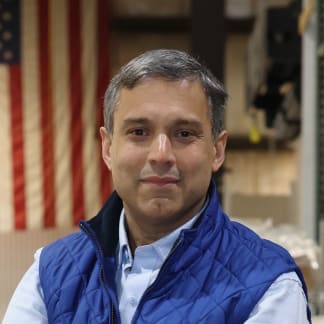 |
VIKRAM MANSHARAMANI is an entrepreneur, consultant, scholar, neighbor, husband, father, volunteer, and professional generalist who thinks in multiple-dimensions and looks beyond the short-term. Self-taught to think around corners and connect original dots, he spends his time speaking with global leaders in business, government, academia, and journalism. He’s currently the Chairman and CEO of Goodwell Foods, a manufacturer of private label frozen pizza. LinkedIn has twice listed him as its #1 Top Voice in Money & Finance, and Worthprofiled him as one of the 100 Most Powerful People in Global Finance. Vikram earned a PhD From MIT, has taught at Yale and Harvard, and is the author of three books, The Making of a Generalist: An Independent Thinker Finds Unconventional Success in an Uncertain World, Think for Yourself: Restoring Common Sense in an Age of Experts and Artificial Intelligence and Boombustology: Spotting Financial Bubbles Before They Burst. Vikram lives in Lincoln, New Hampshire with his wife and two children, where they can usually be found hiking or skiing.
You're currently a free subscriber to Navigating Uncertainty. For the full experience, upgrade your subscription.
| ||||||||||

