
Email
The Dangers of a More Crowded Nuclear World
| From | The American Enterprise <[email protected]> |
| Subject | The Dangers of a More Crowded Nuclear World |
| Date | January 30, 2026 8:31 PM |
Links have been removed from this email. Learn more in the FAQ.
Links have been removed from this email. Learn more in the FAQ.
Exploring pressing issues and ideas critical to a free society
TheAmericanEnterprise_test3 (1) ([link removed] )
January 2026
Welcome to the January edition of The American Enterprise. This month, we are featuring essays by Kyle Balzer ([link removed] ) on the future of US nuclear strategy, Ryan Fedasiuk ([link removed] ) on the questions that should guide America's relationship with China, and Heather A. Conley ([link removed] ) on the global competition for dominance in the Arctic.
Make sure to subscribe ([link removed] ) and read the online version here ([link removed] ) !
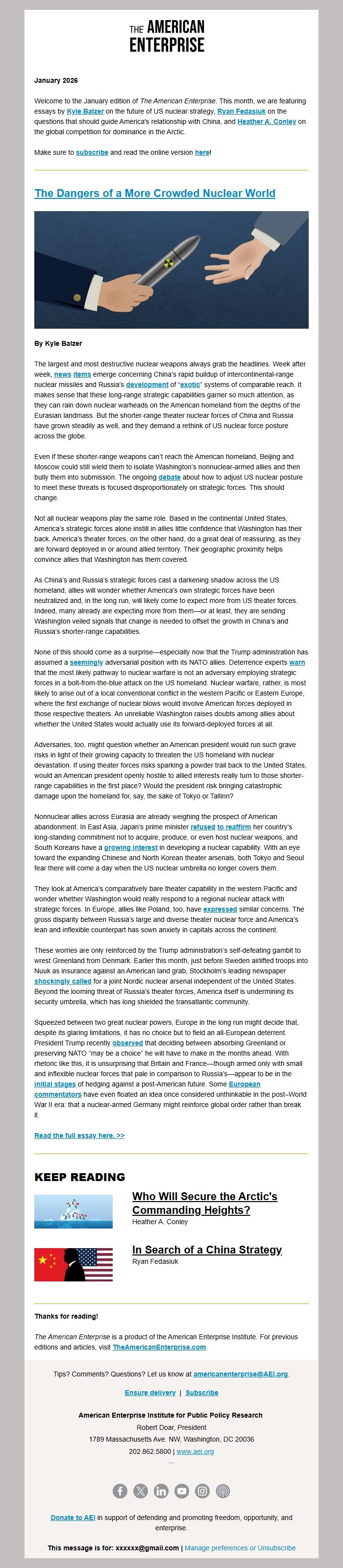
The Dangers of a More Crowded Nuclear World
([link removed] )
Jan-2026_Article-1_Image_1400x600_Final ([link removed] )
By Kyle Balzer
The largest and most destructive nuclear weapons always grab the headlines. Week after week, news ([link removed] ) items ([link removed] ) emerge concerning China’s rapid buildup of intercontinental-range nuclear missiles and Russia’s development ([link removed] ) of “exotic ([link removed] ) ” systems of comparable reach. It makes sense that these long-range strategic capabilities garner so much attention, as they can rain down nuclear warheads on the American homeland from the depths of the Eurasian landmass. But the shorter-range theater nuclear forces of China and Russia have grown steadily as well, and they demand a rethink of US nuclear force posture across the globe.
Even if these shorter-range weapons can’t reach the American homeland, Beijing and Moscow could still wield them to isolate Washington’s nonnuclear-armed allies and then bully them into submission. The ongoing debate ([link removed] ) about how to adjust US nuclear posture to meet these threats is focused disproportionately on strategic forces. This should change.
Not all nuclear weapons play the same role. Based in the continental United States, America’s strategic forces alone instill in allies little confidence that Washington has their back. America’s theater forces, on the other hand, do a great deal of reassuring, as they are forward deployed in or around allied territory. Their geographic proximity helps convince allies that Washington has them covered.
As China’s and Russia’s strategic forces cast a darkening shadow across the US homeland, allies will wonder whether America’s own strategic forces have been neutralized and, in the long run, will likely come to expect more from US theater forces. Indeed, many already are expecting more from them—or at least, they are sending Washington veiled signals that change is needed to offset the growth in China’s and Russia’s shorter-range capabilities.
None of this should come as a surprise—especially now that the Trump administration has assumed a seemingly ([link removed] ) adversarial position with its NATO allies. Deterrence experts warn ([link removed] ) that the most likely pathway to nuclear warfare is not an adversary employing strategic forces in a bolt-from-the-blue attack on the US homeland. Nuclear warfare, rather, is most likely to arise out of a local conventional conflict in the western Pacific or Eastern Europe, where the first exchange of nuclear blows would involve American forces deployed in those respective theaters. An unreliable Washington raises doubts among allies about whether the United States would actually use its forward-deployed forces at all.
Adversaries, too, might question whether an American president would run such grave risks in light of their growing capacity to threaten the US homeland with nuclear devastation. If using theater forces risks sparking a powder trail back to the United States, would an American president openly hostile to allied interests really turn to those shorter-range capabilities in the first place? Would the president risk bringing catastrophic damage upon the homeland for, say, the sake of Tokyo or Tallinn?
Nonnuclear allies across Eurasia are already weighing the prospect of American abandonment. In East Asia, Japan’s prime minister refused ([link removed] .) to reaffirm ([link removed] ) her country’s long-standing commitment not to acquire, produce, or even host nuclear weapons, and South Koreans have a growing interest ([link removed] ) in developing a nuclear capability. With an eye toward the expanding Chinese and North Korean theater arsenals, both Tokyo and Seoul fear there will come a day when the US nuclear umbrella no longer covers them.
They look at America’s comparatively bare theater capability in the western Pacific and wonder whether Washington would really respond to a regional nuclear attack with strategic forces. In Europe, allies like Poland, too, have expressed ([link removed] ) similar concerns. The gross disparity between Russia’s large and diverse theater nuclear force and America’s lean and inflexible counterpart has sown anxiety in capitals across the continent.
These worries are only reinforced by the Trump administration’s self-defeating gambit to wrest Greenland from Denmark. Earlier this month, just before Sweden airlifted troops into Nuuk as insurance against an American land grab, Stockholm’s leading newspaper shockingly called ([link removed] ) for a joint Nordic nuclear arsenal independent of the United States. Beyond the looming threat of Russia’s theater forces, America itself is undermining its security umbrella, which has long shielded the transatlantic community.
Squeezed between two great nuclear powers, Europe in the long run might decide that, despite its glaring limitations, it has no choice but to field an all-European deterrent. President Trump recently observed ([link removed] ) that deciding between absorbing Greenland or preserving NATO “may be a choice” he will have to make in the months ahead. With rhetoric like this, it is unsurprising that Britain and France—though armed only with small and inflexible nuclear forces that pale in comparison to Russia’s—appear to be in the initial stages ([link removed] ) of hedging against a post-American future. Some European ([link removed] ) commentators ([link removed] ) have even floated an idea once considered unthinkable in the post–World War II era: that a nuclear-armed Germany might reinforce global order rather than break it.
Read the full essay here. >> ([link removed] )
KEEP READING
heather conley fdp tae ([link removed] )
Who Will Secure the Arctic's Commanding Heights? ([link removed] )
Heather A. Conley
Fedasiuk-Essay-Image_FINAL-768x329 ([link removed] )
In Search of a China Strategy ([link removed] )
Ryan Fedasiuk
Thanks for reading!
The American Enterprise is a product of the American Enterprise Institute. For previous editions and articles, visit TheAmericanEnterprise.com ([link removed] ) .
Tips? Comments? Questions? Let us know at [email protected] (mailto:[email protected]) .
Ensure delivery ([link removed] ) | Subscribe ([link removed] )
American Enterprise Institute for Public Policy Research
Robert Doar, President
1789 Massachusetts Ave. NW, Washington, DC 20036
202.862.5800 | www.aei.org ([link removed] )
Unsubscribe at the link below. ([link removed] )
Facebook ([link removed] )
X ([link removed] )
LinkedIn ([link removed] )
YouTube ([link removed] )
Instagram ([link removed] )
Podcast Logo New_Gray ([link removed] )
Donate to AEI ([link removed] ) in support of defending and promoting freedom, opportunity, and enterprise.
This message is for: [email protected] | ([link removed] ) Manage preferences or Unsubscribe ([link removed] )
TheAmericanEnterprise_test3 (1) ([link removed] )
January 2026
Welcome to the January edition of The American Enterprise. This month, we are featuring essays by Kyle Balzer ([link removed] ) on the future of US nuclear strategy, Ryan Fedasiuk ([link removed] ) on the questions that should guide America's relationship with China, and Heather A. Conley ([link removed] ) on the global competition for dominance in the Arctic.
Make sure to subscribe ([link removed] ) and read the online version here ([link removed] ) !
The Dangers of a More Crowded Nuclear World
([link removed] )
Jan-2026_Article-1_Image_1400x600_Final ([link removed] )
By Kyle Balzer
The largest and most destructive nuclear weapons always grab the headlines. Week after week, news ([link removed] ) items ([link removed] ) emerge concerning China’s rapid buildup of intercontinental-range nuclear missiles and Russia’s development ([link removed] ) of “exotic ([link removed] ) ” systems of comparable reach. It makes sense that these long-range strategic capabilities garner so much attention, as they can rain down nuclear warheads on the American homeland from the depths of the Eurasian landmass. But the shorter-range theater nuclear forces of China and Russia have grown steadily as well, and they demand a rethink of US nuclear force posture across the globe.
Even if these shorter-range weapons can’t reach the American homeland, Beijing and Moscow could still wield them to isolate Washington’s nonnuclear-armed allies and then bully them into submission. The ongoing debate ([link removed] ) about how to adjust US nuclear posture to meet these threats is focused disproportionately on strategic forces. This should change.
Not all nuclear weapons play the same role. Based in the continental United States, America’s strategic forces alone instill in allies little confidence that Washington has their back. America’s theater forces, on the other hand, do a great deal of reassuring, as they are forward deployed in or around allied territory. Their geographic proximity helps convince allies that Washington has them covered.
As China’s and Russia’s strategic forces cast a darkening shadow across the US homeland, allies will wonder whether America’s own strategic forces have been neutralized and, in the long run, will likely come to expect more from US theater forces. Indeed, many already are expecting more from them—or at least, they are sending Washington veiled signals that change is needed to offset the growth in China’s and Russia’s shorter-range capabilities.
None of this should come as a surprise—especially now that the Trump administration has assumed a seemingly ([link removed] ) adversarial position with its NATO allies. Deterrence experts warn ([link removed] ) that the most likely pathway to nuclear warfare is not an adversary employing strategic forces in a bolt-from-the-blue attack on the US homeland. Nuclear warfare, rather, is most likely to arise out of a local conventional conflict in the western Pacific or Eastern Europe, where the first exchange of nuclear blows would involve American forces deployed in those respective theaters. An unreliable Washington raises doubts among allies about whether the United States would actually use its forward-deployed forces at all.
Adversaries, too, might question whether an American president would run such grave risks in light of their growing capacity to threaten the US homeland with nuclear devastation. If using theater forces risks sparking a powder trail back to the United States, would an American president openly hostile to allied interests really turn to those shorter-range capabilities in the first place? Would the president risk bringing catastrophic damage upon the homeland for, say, the sake of Tokyo or Tallinn?
Nonnuclear allies across Eurasia are already weighing the prospect of American abandonment. In East Asia, Japan’s prime minister refused ([link removed] .) to reaffirm ([link removed] ) her country’s long-standing commitment not to acquire, produce, or even host nuclear weapons, and South Koreans have a growing interest ([link removed] ) in developing a nuclear capability. With an eye toward the expanding Chinese and North Korean theater arsenals, both Tokyo and Seoul fear there will come a day when the US nuclear umbrella no longer covers them.
They look at America’s comparatively bare theater capability in the western Pacific and wonder whether Washington would really respond to a regional nuclear attack with strategic forces. In Europe, allies like Poland, too, have expressed ([link removed] ) similar concerns. The gross disparity between Russia’s large and diverse theater nuclear force and America’s lean and inflexible counterpart has sown anxiety in capitals across the continent.
These worries are only reinforced by the Trump administration’s self-defeating gambit to wrest Greenland from Denmark. Earlier this month, just before Sweden airlifted troops into Nuuk as insurance against an American land grab, Stockholm’s leading newspaper shockingly called ([link removed] ) for a joint Nordic nuclear arsenal independent of the United States. Beyond the looming threat of Russia’s theater forces, America itself is undermining its security umbrella, which has long shielded the transatlantic community.
Squeezed between two great nuclear powers, Europe in the long run might decide that, despite its glaring limitations, it has no choice but to field an all-European deterrent. President Trump recently observed ([link removed] ) that deciding between absorbing Greenland or preserving NATO “may be a choice” he will have to make in the months ahead. With rhetoric like this, it is unsurprising that Britain and France—though armed only with small and inflexible nuclear forces that pale in comparison to Russia’s—appear to be in the initial stages ([link removed] ) of hedging against a post-American future. Some European ([link removed] ) commentators ([link removed] ) have even floated an idea once considered unthinkable in the post–World War II era: that a nuclear-armed Germany might reinforce global order rather than break it.
Read the full essay here. >> ([link removed] )
KEEP READING
heather conley fdp tae ([link removed] )
Who Will Secure the Arctic's Commanding Heights? ([link removed] )
Heather A. Conley
Fedasiuk-Essay-Image_FINAL-768x329 ([link removed] )
In Search of a China Strategy ([link removed] )
Ryan Fedasiuk
Thanks for reading!
The American Enterprise is a product of the American Enterprise Institute. For previous editions and articles, visit TheAmericanEnterprise.com ([link removed] ) .
Tips? Comments? Questions? Let us know at [email protected] (mailto:[email protected]) .
Ensure delivery ([link removed] ) | Subscribe ([link removed] )
American Enterprise Institute for Public Policy Research
Robert Doar, President
1789 Massachusetts Ave. NW, Washington, DC 20036
202.862.5800 | www.aei.org ([link removed] )
Unsubscribe at the link below. ([link removed] )
Facebook ([link removed] )
X ([link removed] )
LinkedIn ([link removed] )
YouTube ([link removed] )
Instagram ([link removed] )
Podcast Logo New_Gray ([link removed] )
Donate to AEI ([link removed] ) in support of defending and promoting freedom, opportunity, and enterprise.
This message is for: [email protected] | ([link removed] ) Manage preferences or Unsubscribe ([link removed] )
Message Analysis
- Sender: n/a
- Political Party: n/a
- Country: n/a
- State/Locality: n/a
- Office: n/a
-
Email Providers:
- HubSpot