Also: The Child Care Tax Credit & Graduate Student Loans
Expert analysis made easy. Breaking down the news with data, charts, and maps.
Edited by Brady Africk and Carter Hutchinson
Happy Thursday! In today’s newsletter, we examine the demand for affordable housing in major cities, potential changes to the child and dependent care tax credit, and a proposal to expand limits on student loans for graduate degrees.
Don’t forget—subscribe and send DataPoints to a friend!
Topline: In 2024, New York approved 46,000 new housing units, while North Carolina, with half the population, issued more than 95,000. All but 12,366 units approved in New York were in buildings with multiple apartments that are more likely to be rented than owned. New York and other American cities that struggle to provide affordable housing for their residents would be best served by policies that allow for building more homes, writes AEI’s Howard Husock.
Construction Is Key: Affordable single-family homes are not being built fast enough to keep up with demand, nor are duplexes and triplexes, which serve as starters for young families. Planning and zoning boards determine the quantity and type of new housing permitted to be built at the granular, local level. To keep up with consumer demand, states like New York may need to relax environmental red tape, a politically difficult proposal in blue cities.
Public Housing Problems: New York Mayor Zohran Mamdani has proposed an alternative solution to the affordable-housing crisis: rent freezing and 200,000 new government-subsidized, income-restricted rental units. New York already has over 177,000 more public housing units than any other American city. Husock explains that if subsidized housing were the secret to affordability, New York would lead the way for the rest of the country instead of facing a perennial housing crisis.
“A healthy housing market provides a ladder from starter home to mansion, with a multitude of small steps in between.” —Howard Husock
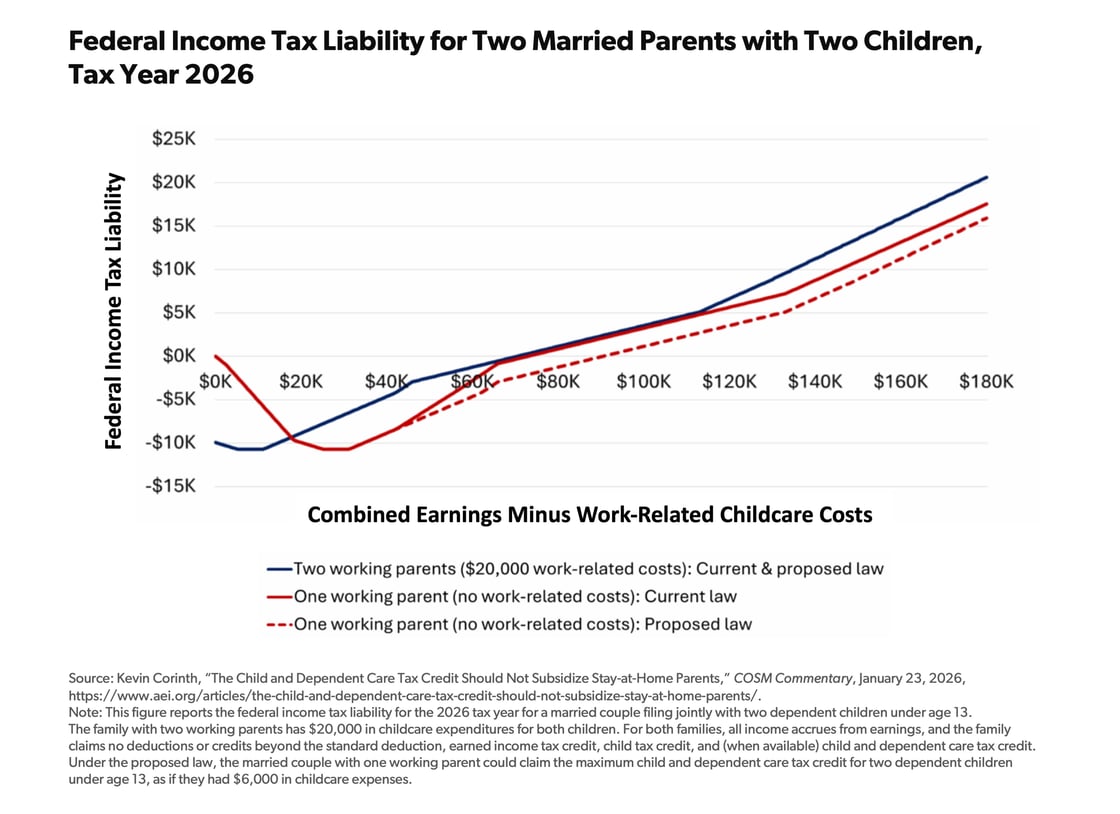
Topline: A new policy proposal from the Republican Study Committee would allow stay-at-home parents to claim the child and dependent care tax credit (CDCTC), a nonrefundable tax credit that is calculated as a percentage of eligible childcare costs incurred by working parents. AEI’s Kevin Corinth explains that the change would increase the federal deficit and ultimately make the tax code less fair to working parents.
Tax Code Fairness: A fair tax code would treat equally well-off families the same by requiring them to pay the same amount in taxes. The proposed change to the CDCTC would reduce the tax burden of families with a stay-at-home parent, increasing the tax discount they receive relative to families with two working parents. Under the current tax code, a family with two working parents—with one parent making $100,000, the other making $20,000, and childcare costing $20,000—owes $300 more in federal income taxes than a family with one parent making $100,000. The tax gap between these two families will grow to $2,400 under the new proposal.
Federal Deficit: The Republican Study Committee estimates that this proposal would reduce federal government revenues by $25 billion, presumably over 10 years, at a time with an exceptionally high federal deficit.
"As with work-related expenses more broadly, families should not be taxed on the money they earn that is used to pay for childcare. Otherwise, they face a higher tax burden than families who do not require childcare to work, despite having the same level of resources.” —Kevin Corinth
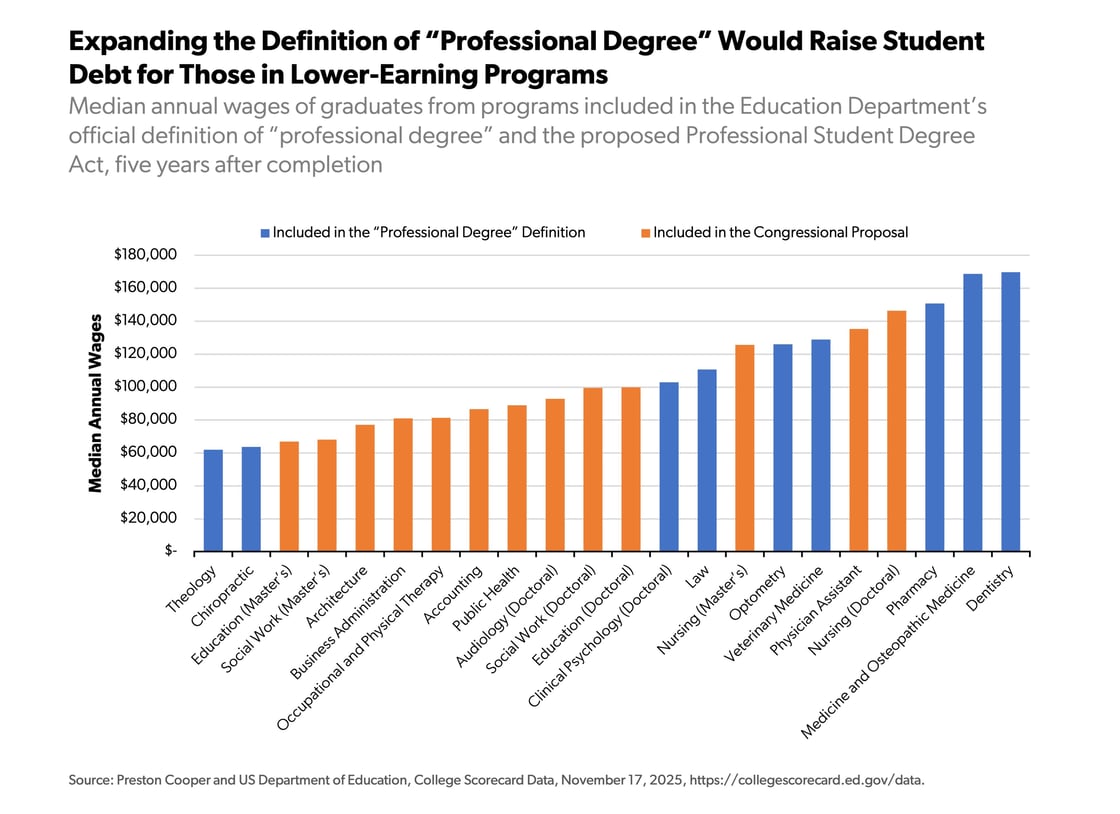
Topline: The One Big Beautiful Bill Act (OBBBA) limited federal graduate student loans for the first time since 2006. The bill split graduate degrees into two categories, standard and professional, with professional degree earners able to take out up to $200,000 in federal loans. Amid calls from universities to expand the definition of "professional degrees", AEI’s Preston Cooper argues Congress should be more focused on reducing student debt than on increasing ways to incur it.
Professional Degree Predicament: The OBBBA defines professional degrees to include medicine, dentistry, law, clinical psychology, and several other fields. These high-cost degrees lead to high-wage careers, setting the borrower up for more success in paying off their debt. By contrast, Cooper estimates that if Congress passes the Professional Student Degree Act, which would expand the definition of "professional degrees," most of the degree paths it covers would likely not pay enough to recoup a $200,000 loan allowance.
The Future of Graduate Loans Under OBBBA: It’s estimated that the OBBBA’s loan limits will save taxpayers close to $7 billion per year, prevent the unconstrained borrowing that allowed colleges to hike tuition, limit universities’ ability to rely on graduate degrees of questionable value for revenue, and ease the debt burden for American students. Radically expanding the definition of professional degrees could unravel much of this progress.
"Most people who reach a certain stage in their careers rightly consider themselves professionals. But being a professional doesn’t mean taking on $200,000 of debt for graduate school is a good idea. Unfortunately, this fairly obvious lesson is lost on some members of Congress.” —Preston Cooper

.jpeg?width=1120&upscale=true&name=01%20Husock%20(1).jpeg)
.jpeg?width=520&upscale=true&name=05%20Scissors%20(1).jpeg)