
Email
How the Gun Industry Quietly Governs
| From | March For Our Lives <[email protected]> |
| Subject | How the Gun Industry Quietly Governs |
| Date | January 28, 2026 10:41 PM |
Links have been removed from this email. Learn more in the FAQ.
Links have been removed from this email. Learn more in the FAQ.
View this post on the web at [link removed]
When most people think about the gun lobby, they think of the NRA. They think of politicians “bought and paid for” by gun money, of fiery speeches, of an organization that shows up after every shooting to block reform. For years, the NRA has been treated as a stand-in for the entire gun industry — the loudest voice in the room and the clearest symbol of why gun safety laws keep failing. It has dominated headlines, absorbed public outrage, and come to represent the force standing between communities and meaningful change.
That visibility has also made it easy to believe the story ends there.
But while public attention has remained fixed on the NRA, another force has been working quietly in the background. Less recognizable. Less controversial by design. And in many ways, more effective.
Most people have never heard of the National Shooting Sports Foundation, and that anonymity is not accidental. The NSSF describes itself as a trade association — a neutral representative of manufacturers and retailers. In practice, it functions as the political nerve center of the gun industry. Representing thousands of gun manufacturers, dealers, and sellers, its core mission is to protect and expand gun sales.
As the NRA has become mired in scandals and lawsuits, the NSSF has stepped into the vacuum. It has evolved from a low-profile industry group into one of the most influential forces shaping gun policy in the United States. Today, it outpaces the NRA in federal lobbying and exerts its power not through public outrage, but through behind-the-scenes control.
The NSSF does not need to mobilize voters in the open. It operates where the public rarely looks, by employing full-time lobbyists in Washington, spending millions of dollars each year pressuring lawmakers, and working directly with legislators to draft, advance, and defend industry-friendly policy.
Money is what makes its influence durable. Through its PAC, the NSSF funnels hundreds of thousands of dollars almost exclusively to Republican candidates. Those contributions lock in political loyalty and help ensure that industry priorities are written into law. Lawmakers who benefit from this support routinely sponsor NSSF-backed legislation, from nationwide concealed carry proposals to laws that protect gun companies from being sued when their products are used to cause harm.
Over time, this creates a closed loop. Industry money shapes policy. Policy protects industry profits. And accountability is pushed further out of reach.
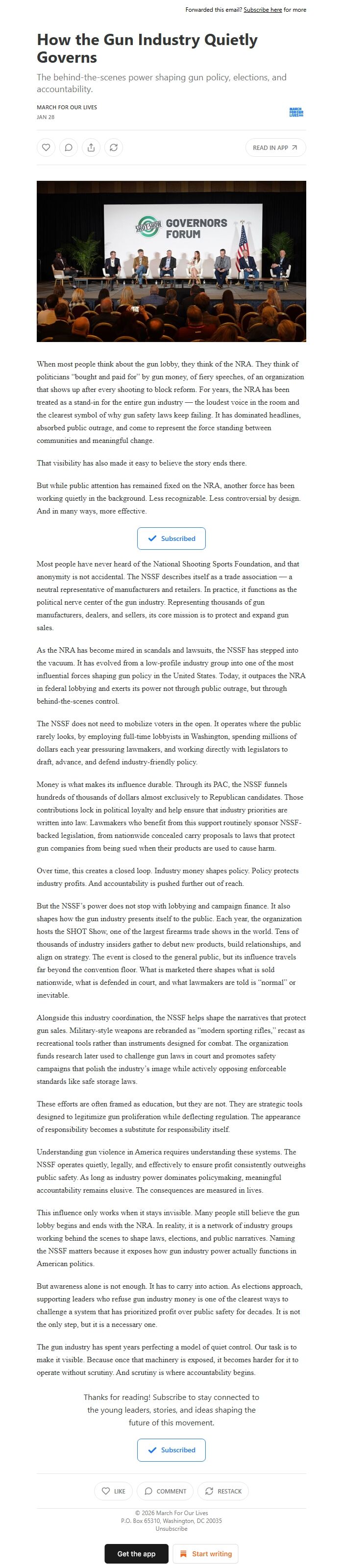
But the NSSF’s power does not stop with lobbying and campaign finance. It also shapes how the gun industry presents itself to the public. Each year, the organization hosts the SHOT Show, one of the largest firearms trade shows in the world. Tens of thousands of industry insiders gather to debut new products, build relationships, and align on strategy. The event is closed to the general public, but its influence travels far beyond the convention floor. What is marketed there shapes what is sold nationwide, what is defended in court, and what lawmakers are told is “normal” or inevitable.
Alongside this industry coordination, the NSSF helps shape the narratives that protect gun sales. Military-style weapons are rebranded as “modern sporting rifles,” recast as recreational tools rather than instruments designed for combat. The organization funds research later used to challenge gun laws in court and promotes safety campaigns that polish the industry’s image while actively opposing enforceable standards like safe storage laws.
These efforts are often framed as education, but they are not. They are strategic tools designed to legitimize gun proliferation while deflecting regulation. The appearance of responsibility becomes a substitute for responsibility itself.
Understanding gun violence in America requires understanding these systems. The NSSF operates quietly, legally, and effectively to ensure profit consistently outweighs public safety. As long as industry power dominates policymaking, meaningful accountability remains elusive. The consequences are measured in lives.
This influence only works when it stays invisible. Many people still believe the gun lobby begins and ends with the NRA. In reality, it is a network of industry groups working behind the scenes to shape laws, elections, and public narratives. Naming the NSSF matters because it exposes how gun industry power actually functions in American politics.
But awareness alone is not enough. It has to carry into action. As elections approach, supporting leaders who refuse gun industry money is one of the clearest ways to challenge a system that has prioritized profit over public safety for decades. It is not the only step, but it is a necessary one.
The gun industry has spent years perfecting a model of quiet control. Our task is to make it visible. Because once that machinery is exposed, it becomes harder for it to operate without scrutiny. And scrutiny is where accountability begins.
Thanks for reading! Subscribe to stay connected to the young leaders, stories, and ideas shaping the future of this movement.
Unsubscribe [link removed]?
When most people think about the gun lobby, they think of the NRA. They think of politicians “bought and paid for” by gun money, of fiery speeches, of an organization that shows up after every shooting to block reform. For years, the NRA has been treated as a stand-in for the entire gun industry — the loudest voice in the room and the clearest symbol of why gun safety laws keep failing. It has dominated headlines, absorbed public outrage, and come to represent the force standing between communities and meaningful change.
That visibility has also made it easy to believe the story ends there.
But while public attention has remained fixed on the NRA, another force has been working quietly in the background. Less recognizable. Less controversial by design. And in many ways, more effective.
Most people have never heard of the National Shooting Sports Foundation, and that anonymity is not accidental. The NSSF describes itself as a trade association — a neutral representative of manufacturers and retailers. In practice, it functions as the political nerve center of the gun industry. Representing thousands of gun manufacturers, dealers, and sellers, its core mission is to protect and expand gun sales.
As the NRA has become mired in scandals and lawsuits, the NSSF has stepped into the vacuum. It has evolved from a low-profile industry group into one of the most influential forces shaping gun policy in the United States. Today, it outpaces the NRA in federal lobbying and exerts its power not through public outrage, but through behind-the-scenes control.
The NSSF does not need to mobilize voters in the open. It operates where the public rarely looks, by employing full-time lobbyists in Washington, spending millions of dollars each year pressuring lawmakers, and working directly with legislators to draft, advance, and defend industry-friendly policy.
Money is what makes its influence durable. Through its PAC, the NSSF funnels hundreds of thousands of dollars almost exclusively to Republican candidates. Those contributions lock in political loyalty and help ensure that industry priorities are written into law. Lawmakers who benefit from this support routinely sponsor NSSF-backed legislation, from nationwide concealed carry proposals to laws that protect gun companies from being sued when their products are used to cause harm.
Over time, this creates a closed loop. Industry money shapes policy. Policy protects industry profits. And accountability is pushed further out of reach.
But the NSSF’s power does not stop with lobbying and campaign finance. It also shapes how the gun industry presents itself to the public. Each year, the organization hosts the SHOT Show, one of the largest firearms trade shows in the world. Tens of thousands of industry insiders gather to debut new products, build relationships, and align on strategy. The event is closed to the general public, but its influence travels far beyond the convention floor. What is marketed there shapes what is sold nationwide, what is defended in court, and what lawmakers are told is “normal” or inevitable.
Alongside this industry coordination, the NSSF helps shape the narratives that protect gun sales. Military-style weapons are rebranded as “modern sporting rifles,” recast as recreational tools rather than instruments designed for combat. The organization funds research later used to challenge gun laws in court and promotes safety campaigns that polish the industry’s image while actively opposing enforceable standards like safe storage laws.
These efforts are often framed as education, but they are not. They are strategic tools designed to legitimize gun proliferation while deflecting regulation. The appearance of responsibility becomes a substitute for responsibility itself.
Understanding gun violence in America requires understanding these systems. The NSSF operates quietly, legally, and effectively to ensure profit consistently outweighs public safety. As long as industry power dominates policymaking, meaningful accountability remains elusive. The consequences are measured in lives.
This influence only works when it stays invisible. Many people still believe the gun lobby begins and ends with the NRA. In reality, it is a network of industry groups working behind the scenes to shape laws, elections, and public narratives. Naming the NSSF matters because it exposes how gun industry power actually functions in American politics.
But awareness alone is not enough. It has to carry into action. As elections approach, supporting leaders who refuse gun industry money is one of the clearest ways to challenge a system that has prioritized profit over public safety for decades. It is not the only step, but it is a necessary one.
The gun industry has spent years perfecting a model of quiet control. Our task is to make it visible. Because once that machinery is exposed, it becomes harder for it to operate without scrutiny. And scrutiny is where accountability begins.
Thanks for reading! Subscribe to stay connected to the young leaders, stories, and ideas shaping the future of this movement.
Unsubscribe [link removed]?
Message Analysis
- Sender: n/a
- Political Party: n/a
- Country: n/a
- State/Locality: n/a
- Office: n/a