|
Welcome to You’re Probably Getting Screwed, a weekly newsletter and video series from J.D. Scholten and Justin Stofferahn about the Second Gilded Age and the ways economic concentration is putting politics and profits over working people.



 |
Welcome to You’re Probably Getting Screwed, a weekly newsletter and video series from J.D. Scholten and Justin Stofferahn about the Second Gilded Age and the ways economic concentration is putting politics and profits over working people.
My home has become a battleground. Renee Good, a mother and poet, and Alex Pretti, a Veterans Affairs ICU nurse, have been murdered by federal agents in the streets. A five-year old boy and a two-year old girl have been detained and sent to Texas. Constitutional observers have been threatened and tracked. Federal agents have stormed into homes and businesses without warrants. Immigrants are sheltering in place, too afraid to leave their homes. While driving this weekend I passed a group of police officers tending to a vehicle stuck in an exit ramp and without hesitation my 10-year old son asked if it was ICE. This is Minnesota over the past several weeks. It has generated anger and despair, but also a hearty amount of resolve.
While there were signs yesterday and even today as I write this that an exit strategy might be developing, Operation Metro Surge as the Department of Homeland Security (DHS) has called it, has sent some 3,000 federal agents from Immigration and Customs Enforcement (ICE) and Customs and Border Protection (CBP) into Minnesota. That number dwarfs the police departments in the state’s largest cities. Minneapolis, for example, has around 600 police officers. If you do not live in Minnesota it can be difficult to comprehend just how ubiquitous ICE and CPB agents have been, turning everyday activities into confrontations and in places all across the state. All of this in a place where the estimated number of undocumented immigrants is less than in Utah, a state with nearly 50 percent fewer people. Whatever your views on our immigration laws are, it is hard to see how this could possibly be about efficiently and effectively enforcing them.
To the topic we focus on in this newsletter, in the background of this chaos is a clear picture of the antidemocratic nature of concentrated corporate power. That is not only true when considering the growing marriage between DHS and the surveillance economy, but in the broader context of how events have unfolded.

 |
Let’s start with the marriage between the security state and the surveillance economy. Tech’s business model of extraction, collection and monetization of personal data plays an indispensable role in what the Center on Privacy & Technology at Georgetown Law School calls the American Dragnet. In a regulatory environment that is essentially nonexistent, private companies have created their own surveillance state that none of us, right or left, voted for. We have all come to accept, sort of, that there is a vast amount of our personal data floating around the tech industrial complex, but having it used by masked federal agents to spy on us carries a much different and more terrifying feeling than it being used to populate our browser with annoying ads the minute we type “shoe” into Google.
With a major boost to its funding last year, DHS agencies have been on a surveillance tech shopping spree that builds upon an already alarming surveillance infrastructure. Palantir, a company President Trump’s hardline immigration advisor Stephen Miller holds a significant financial stake in, recently built a new tool for ICE called ELITE that scrapes data from various sources to generate a dossier on people with a “confidence score” out of 100 on how certain the app is of a target’s address. Palantir has also built an AI-driven platform for ICE called ImmigrationOS to help track individual’s movements.
Given the way the Trump Administration has embraced AI, it should come as no surprise that ICE and CPB are deploying the technology in other ways as well. Clearview AI, which was sued for violating Illinois’ data privacy law, has built a facial recognition application that agents can use on their mobile devices. In Maine where immigration agents have recently increased operations, an ICE agent was caught on camera telling a legal observer the pictures of her face and vehicle he was taking were part of a “nice little database” the agency has, and the individual would now be “considered a domestic terrorist.” All this technology not only threatens your privacy, but overreliance on these unproven systems risks making dangerous errors.
In order to manage all of this data, ICE relies on Amazon Web Services. While you might think of Amazon as the company overtaxing third-party sellers, raising costs, misclassifying delivery drivers and crushing warehouse workers, it also accounts for nearly a third of the market for global cloud computing infrastructure. Today Amazon provides cloud computing services to over 11,000 government agencies and 90% of Fortune 100 companies. Just last year Amazon announced it would be spending $50 billion to build new AI capabilities for federal government clients of AWS that include many defense and national security agencies. There are also the big box retailers, major hotel chains and the private prison duopoly that all benefit from the money flowing into DHS while healthcare and food assistance is slashed.
The real terrifying part of the surveillance economy though is in the opaque and unregulated world of data brokers. The legal research giants Thomson Reuters and LexisNexis, both built by mergers, have products (CLEAR for Thomson Reuters and Accurint for LexisNexis) ICE uses for surveillance. These products connect thousands of datasets from court records, business filings, driving records, social media and proprietary databases. Data like this can be compiled by companies legally and then the government purchases it without any judicial oversight. Purchasing from data brokers enables law enforcement to circumvent the Fourth Amendment’s protections against unreasonable search and seizure. Beyond the issue with violating that foundation constitutional protection, no one, whether law enforcement or private tech companies, should have unfettered access to all of this data.
While it feels unlikely Congress will pass any sort of comprehensive privacy law, states have been taking steps. Montana became the first state to prohibit law enforcement from purchasing data from brokers. States have also been passing comprehensive data privacy laws, but they need a stronger approach. In 2024 Minnesota passed new privacy protections, but responsibility rests with individuals, an approach that one scholar has said “is a policy approach that is subsumed by a discourse of consumer empowerment that has been rendered meaningless in the contemporary environment of pervasive commercial surveillance.” States should look to Maryland, which in October became the 16th state with a comprehensive data privacy law, but the first one that prohibits the sale of sensitive data (including precise location data, health data and children’s data) under any circumstances.
 |
Beyond the surveillance economy, the last couple of weeks have also underscored the importance of rooting economic power in our local communities. There are 17 Fortune 500 companies headquartered in Minnesota, a significant concentration given our population size. This concentration of headquarters representing an array of industries is a source of local pride, particularly for policymakers on both sides of the aisle. Part of the mythos surrounding these companies is they constitute what is uniquely exceptional about Minnesota. They are local stewards rooted in community and form the fabric of our civic culture.
While long overdue, particularly in a state with a rich populist history, that mythos has been shattered. For weeks the state’s corporate giants remained totally silent at the increasing chaos enveloping the state. Finally, this weekend, the Minnesota Chamber of Commerce released an open letter from 60 CEOs of some of the state’s largest corporations and business organizations. As a colleague of mine asked, “How many attorneys did it take to review this and water it down?” To call it milquetoast is charitable.
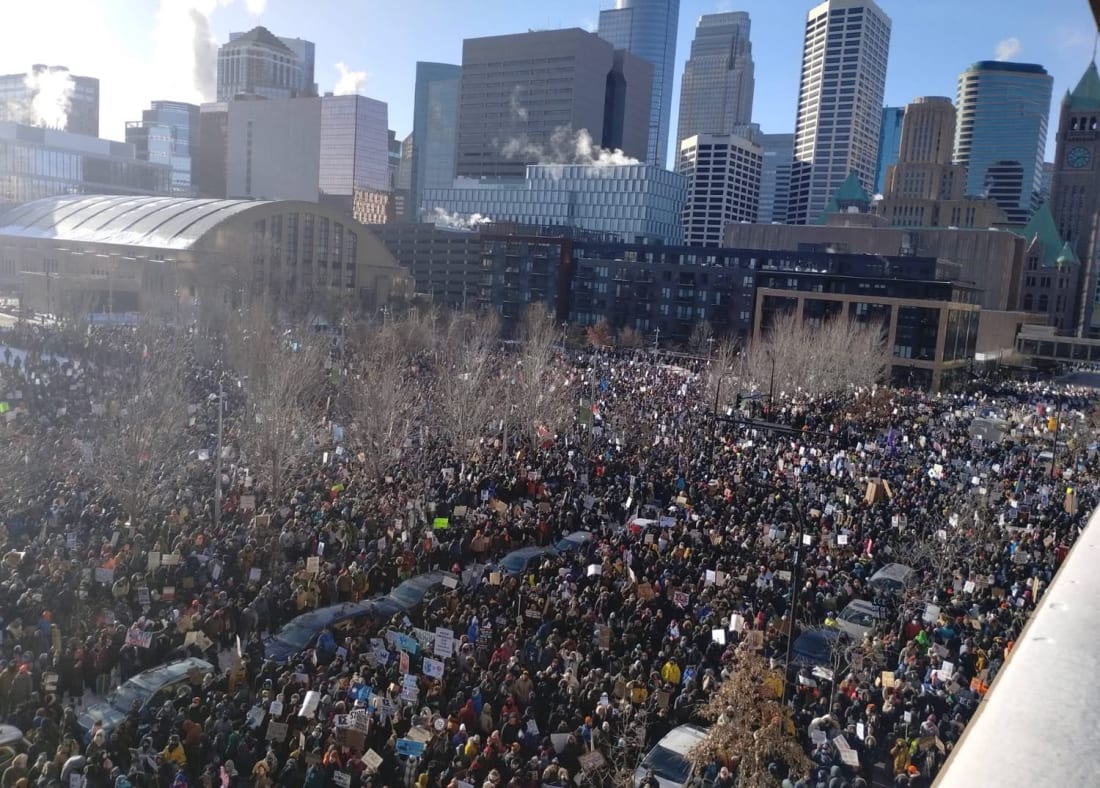
While Minnesota’s largest corporations dithered, its small businesses have risen to the moment. Just on social media I have tracked small businesses including local restaurants, tattoo shops, manufacturers, cooperatives, and others taking a stand against ICE and CPB’s violent occupation in Minnesota and doing what they can (donating food, gathering donations, providing mutual aid) to help their neighbors, often at great risk. Just one example is Mischief Toys in St. Paul, an independent store visited by federal agents the day after speaking out in the press. On Friday anywhere between 50 to 70 thousand Minnesotans gathered in Minneapolis in subzero temperatures to march as part of a general strike across the state that had workers and small businesses all over standing up.
This is why the sometimes technical or boring mechanics of commerce matter so much, not just for our economy but our society. If we do not crack down on the ways (mergers, unfair contracts, anticompetitive pricing practices and more) corporate consolidation harms small businesses, we will lose one of the key power centers that can grant our communities independence. Like many parts of America, Minnesota still has fewer small businesses than it did before the financial crisis and the share of the workforce at small businesses continues to decline. In this newsletter we’ve shared the trends that have hollowed out main streets, making communities ever more dependent on our corporate masters.
So no, cracking down on price discrimination will not stop masked federal agents from running roughshod over a city, but it is a down payment in building the democratic infrastructure that can help prevent it. Our corporate masters are not the defenders of democracy, everyday people are. Distributed economic power means distributed political power and that is essential to ensuring a vibrant democracy and we must do everything to protect and expand it.
YOU’RE PROBABLY (ALSO) GETTING SCREWED BY:
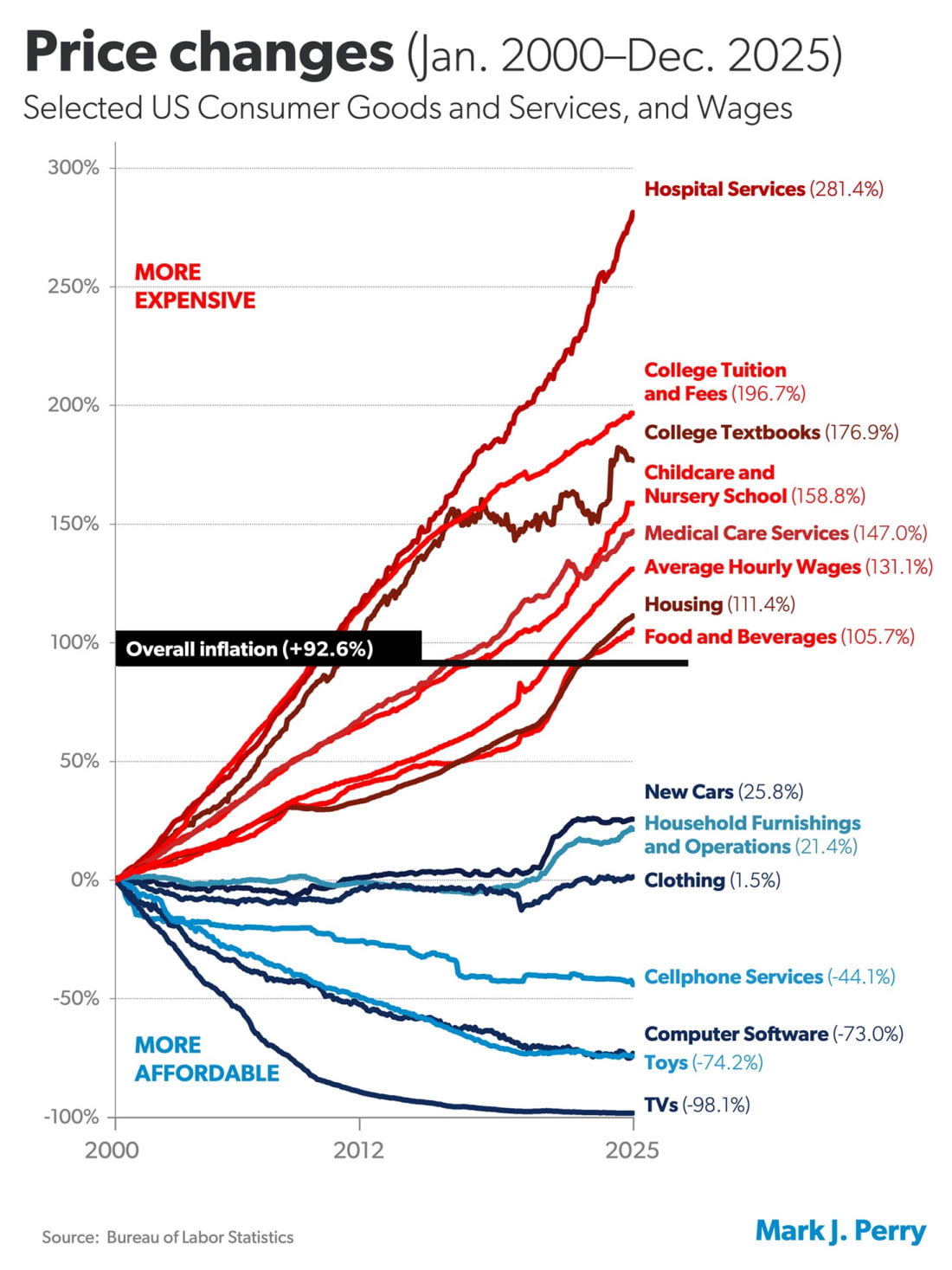
Prices
Who needs healthcare, childcare, housing and food. Just enjoy your cheap TV and shut up.
 |
Speaking of Surveillance
More Perfect Union details the story of Tyler Johnston, an AI watchdog who has been aggressively targeted by the industry.

Amazon
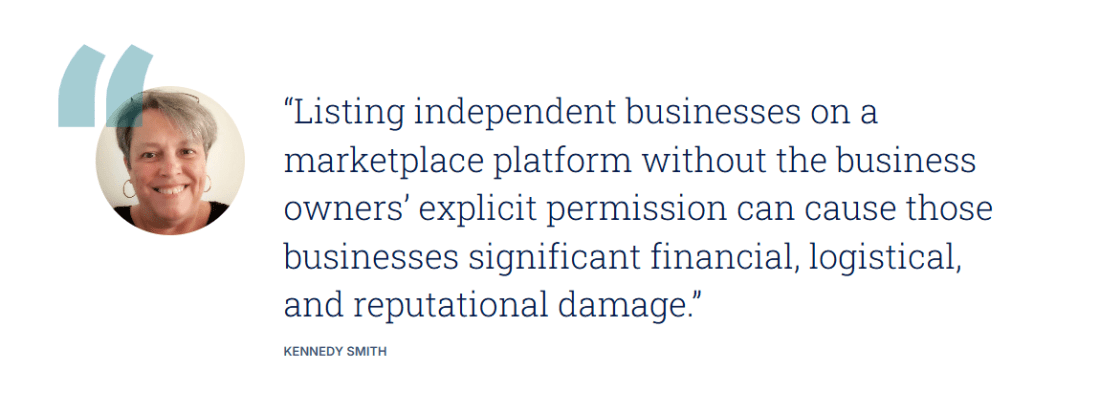
The Institute for Local Self Reliance is out with a new report on Amazon’s use of unauthorized listings. From the report: “In 2023, Amazon created Project Starfish with the goal of making Amazon the most comprehensive source of product information “for all products worldwide. A key component of its strategy: Add products not offered by Amazon by scraping the online catalogs of thousands of independent businesses and facilitating sales of those products, with Amazon as the middleman.” You can find the full report here.
 |
Private Equity
Ronan Farrow explains how Wall Street is turning your monthly bills into debt payments.

Price Discrimination
In my last post I discussed what the release of the FTC’s complaint against Walmart and Pepsi revealed about high grocery prices and what states can do to address the issue. Kainoa Lowman has a great piece in Washington Monthly further detailing the complaint and looking at federal options for protecting consumers and small businesses. You can find the story here.
Blue Collar Cops
Matt Stoller has a thought-provoking piece in BIG about the disconnect between how we fund white collar cops and blue collar cops. White collar cops, like the FTC, DOJ Antitrust Division and other regulatory agencies have seen their resources dwindle over the past four decades while blue collar cops, like ICE that primarily target working people, have seen their budgets expand. It’s yet another way of looking at what is happening in Minnesota through the lens of corporate power and control.
SOME GOOD NEWS
Congress roasts Health Executives
The House Ways & Means Committee held a hearing this week with various healthcare executives and a lot of focus was on the terrible practices of the nation’s vertically integrated pharmacy benefit managers. The hearing also had lots of bipartisan agreement although like with anything involving Congress, action will be key. That being said, Rep. Alexandria Ocasio-Cortez provided a master class in exposing CVS for its immense power.

BEFORE YOU GO
Before you go, I need two things from you: 1) if you like something, please share it on social media or the next time you have coffee with a friend. 2) Ideas, if you have any ideas for future newsletter content please comment below. Thank you.
Break Em Up,
Justin Stofferahn
| ||||||||||

