
| From | Hudson Institute Weekend Reads <[email protected]> |
| Subject | What’s Next If Trump Strikes Iran? |
| Date | January 24, 2026 2:00 PM |
Links have been removed from this email. Learn more in the FAQ.
Links have been removed from this email. Learn more in the FAQ.
No images? Click here [link removed]
Weekend Reads
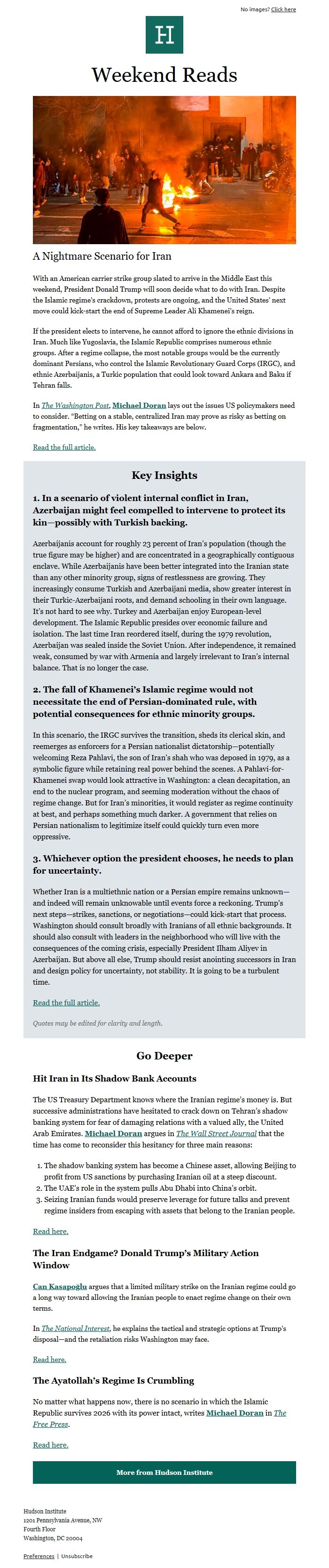
A Nightmare Scenario for Iran [[link removed]]
With an American carrier strike group slated to arrive in the Middle East this weekend, President Donald Trump will soon decide what to do with Iran. Despite the Islamic regime’s crackdown, protests are ongoing, and the United States’ next move could kick-start the end of Supreme Leader Ali Khamenei’s reign.
If the president elects to intervene, he cannot afford to ignore the ethnic divisions in Iran. Much like Yugoslavia, the Islamic Republic comprises numerous ethnic groups. After a regime collapse, the most notable groups would be the currently dominant Persians, who control the Islamic Revolutionary Guard Corps (IRGC), and ethnic Azerbaijanis, a Turkic population that could look toward Ankara and Baku if Tehran falls.
In The Washington Post [[link removed]], Michael Doran [[link removed]] lays out the issues US policymakers need to consider. “Betting on a stable, centralized Iran may prove as risky as betting on fragmentation,” he writes. His key takeaways are below.
Read the full article. [[link removed]]
Key Insights
1. In a scenario of violent internal conflict in Iran, Azerbaijan might feel compelled to intervene to protect its kin—possibly with Turkish backing.
Azerbaijanis account for roughly 23 percent of Iran’s population (though the true figure may be higher) and are concentrated in a geographically contiguous enclave. While Azerbaijanis have been better integrated into the Iranian state than any other minority group, signs of restlessness are growing. They increasingly consume Turkish and Azerbaijani media, show greater interest in their Turkic-Azerbaijani roots, and demand schooling in their own language. It’s not hard to see why. Turkey and Azerbaijan enjoy European-level development. The Islamic Republic presides over economic failure and isolation. The last time Iran reordered itself, during the 1979 revolution, Azerbaijan was sealed inside the Soviet Union. After independence, it remained weak, consumed by war with Armenia and largely irrelevant to Iran’s internal balance. That is no longer the case.
2. The fall of Khamenei’s Islamic regime would not necessitate the end of Persian-dominated rule, with potential consequences for ethnic minority groups.
In this scenario, the IRGC survives the transition, sheds its clerical skin, and reemerges as enforcers for a Persian nationalist dictatorship—potentially welcoming Reza Pahlavi, the son of Iran’s shah who was deposed in 1979, as a symbolic figure while retaining real power behind the scenes. A Pahlavi-for-Khamenei swap would look attractive in Washington: a clean decapitation, an end to the nuclear program, and seeming moderation without the chaos of regime change. But for Iran’s minorities, it would register as regime continuity at best, and perhaps something much darker. A government that relies on Persian nationalism to legitimize itself could quickly turn even more oppressive.
3. Whichever option the president chooses, he needs to plan for uncertainty.
Whether Iran is a multiethnic nation or a Persian empire remains unknown—and indeed will remain unknowable until events force a reckoning. Trump’s next steps—strikes, sanctions, or negotiations—could kick-start that process. Washington should consult broadly with Iranians of all ethnic backgrounds. It should also consult with leaders in the neighborhood who will live with the consequences of the coming crisis, especially President Ilham Aliyev in Azerbaijan. But above all else, Trump should resist anointing successors in Iran and design policy for uncertainty, not stability. It is going to be a turbulent time.
Read the full article. [[link removed]]
Quotes may be edited for clarity and length.
Go Deeper
Hit Iran in Its Shadow Bank Accounts [[link removed]]
The US Treasury Department knows where the Iranian regime’s money is. But successive administrations have hesitated to crack down on Tehran’s shadow banking system for fear of damaging relations with a valued ally, the United Arab Emirates. Michael Doran [[link removed]] argues in The Wall Street Journal [[link removed]] that the time has come to reconsider this hesitancy for three main reasons:
The shadow banking system has become a Chinese asset, allowing Beijing to profit from US sanctions by purchasing Iranian oil at a steep discount.The UAE’s role in the system pulls Abu Dhabi into China’s orbit.Seizing Iranian funds would preserve leverage for future talks and prevent regime insiders from escaping with assets that belong to the Iranian people.
Read here. [[link removed]]
The Iran Endgame? Donald Trump’s Military Action Window [[link removed]]
Can Kasapoğlu [[link removed]] argues that a limited military strike on the Iranian regime could go a long way toward allowing the Iranian people to enact regime change on their own terms.
In The National Interest [[link removed]], he explains the tactical and strategic options at Trump’s disposal—and the retaliation risks Washington may face.
Read here. [[link removed]]
The Ayatollah’s Regime Is Crumbling [[link removed]]
No matter what happens now, there is no scenario in which the Islamic Republic survives 2026 with its power intact, writes Michael Doran [[link removed]] in The Free Press [[link removed]].
Read here. [[link removed]]
More from Hudson Institute [[link removed]]
Hudson Institute
1201 Pennsylvania Avenue, NW
Fourth Floor
Washington, DC 20004
Preferences [link removed] | Unsubscribe [link removed]
Weekend Reads
A Nightmare Scenario for Iran [[link removed]]
With an American carrier strike group slated to arrive in the Middle East this weekend, President Donald Trump will soon decide what to do with Iran. Despite the Islamic regime’s crackdown, protests are ongoing, and the United States’ next move could kick-start the end of Supreme Leader Ali Khamenei’s reign.
If the president elects to intervene, he cannot afford to ignore the ethnic divisions in Iran. Much like Yugoslavia, the Islamic Republic comprises numerous ethnic groups. After a regime collapse, the most notable groups would be the currently dominant Persians, who control the Islamic Revolutionary Guard Corps (IRGC), and ethnic Azerbaijanis, a Turkic population that could look toward Ankara and Baku if Tehran falls.
In The Washington Post [[link removed]], Michael Doran [[link removed]] lays out the issues US policymakers need to consider. “Betting on a stable, centralized Iran may prove as risky as betting on fragmentation,” he writes. His key takeaways are below.
Read the full article. [[link removed]]
Key Insights
1. In a scenario of violent internal conflict in Iran, Azerbaijan might feel compelled to intervene to protect its kin—possibly with Turkish backing.
Azerbaijanis account for roughly 23 percent of Iran’s population (though the true figure may be higher) and are concentrated in a geographically contiguous enclave. While Azerbaijanis have been better integrated into the Iranian state than any other minority group, signs of restlessness are growing. They increasingly consume Turkish and Azerbaijani media, show greater interest in their Turkic-Azerbaijani roots, and demand schooling in their own language. It’s not hard to see why. Turkey and Azerbaijan enjoy European-level development. The Islamic Republic presides over economic failure and isolation. The last time Iran reordered itself, during the 1979 revolution, Azerbaijan was sealed inside the Soviet Union. After independence, it remained weak, consumed by war with Armenia and largely irrelevant to Iran’s internal balance. That is no longer the case.
2. The fall of Khamenei’s Islamic regime would not necessitate the end of Persian-dominated rule, with potential consequences for ethnic minority groups.
In this scenario, the IRGC survives the transition, sheds its clerical skin, and reemerges as enforcers for a Persian nationalist dictatorship—potentially welcoming Reza Pahlavi, the son of Iran’s shah who was deposed in 1979, as a symbolic figure while retaining real power behind the scenes. A Pahlavi-for-Khamenei swap would look attractive in Washington: a clean decapitation, an end to the nuclear program, and seeming moderation without the chaos of regime change. But for Iran’s minorities, it would register as regime continuity at best, and perhaps something much darker. A government that relies on Persian nationalism to legitimize itself could quickly turn even more oppressive.
3. Whichever option the president chooses, he needs to plan for uncertainty.
Whether Iran is a multiethnic nation or a Persian empire remains unknown—and indeed will remain unknowable until events force a reckoning. Trump’s next steps—strikes, sanctions, or negotiations—could kick-start that process. Washington should consult broadly with Iranians of all ethnic backgrounds. It should also consult with leaders in the neighborhood who will live with the consequences of the coming crisis, especially President Ilham Aliyev in Azerbaijan. But above all else, Trump should resist anointing successors in Iran and design policy for uncertainty, not stability. It is going to be a turbulent time.
Read the full article. [[link removed]]
Quotes may be edited for clarity and length.
Go Deeper
Hit Iran in Its Shadow Bank Accounts [[link removed]]
The US Treasury Department knows where the Iranian regime’s money is. But successive administrations have hesitated to crack down on Tehran’s shadow banking system for fear of damaging relations with a valued ally, the United Arab Emirates. Michael Doran [[link removed]] argues in The Wall Street Journal [[link removed]] that the time has come to reconsider this hesitancy for three main reasons:
The shadow banking system has become a Chinese asset, allowing Beijing to profit from US sanctions by purchasing Iranian oil at a steep discount.The UAE’s role in the system pulls Abu Dhabi into China’s orbit.Seizing Iranian funds would preserve leverage for future talks and prevent regime insiders from escaping with assets that belong to the Iranian people.
Read here. [[link removed]]
The Iran Endgame? Donald Trump’s Military Action Window [[link removed]]
Can Kasapoğlu [[link removed]] argues that a limited military strike on the Iranian regime could go a long way toward allowing the Iranian people to enact regime change on their own terms.
In The National Interest [[link removed]], he explains the tactical and strategic options at Trump’s disposal—and the retaliation risks Washington may face.
Read here. [[link removed]]
The Ayatollah’s Regime Is Crumbling [[link removed]]
No matter what happens now, there is no scenario in which the Islamic Republic survives 2026 with its power intact, writes Michael Doran [[link removed]] in The Free Press [[link removed]].
Read here. [[link removed]]
More from Hudson Institute [[link removed]]
Hudson Institute
1201 Pennsylvania Avenue, NW
Fourth Floor
Washington, DC 20004
Preferences [link removed] | Unsubscribe [link removed]
Message Analysis
- Sender: Hudson Institute
- Political Party: n/a
- Country: United States
- State/Locality: n/a
- Office: n/a
-
Email Providers:
- Campaign Monitor