
| From | Liberty Fund <[email protected]> |
| Subject | Niall Ferguson on the Forces That Shape War and Peace |
| Date | January 23, 2026 2:01 PM |
Links have been removed from this email. Learn more in the FAQ.
Links have been removed from this email. Learn more in the FAQ.
[link removed]
WEEK OF JANUARY 18, 2026
** This Week on the Ideas That Make War Possible and Peace Fragile
------------------------------------------------------------
[link removed]
** Dark Forces of the Twentieth Century ([link removed])
------------------------------------------------------------
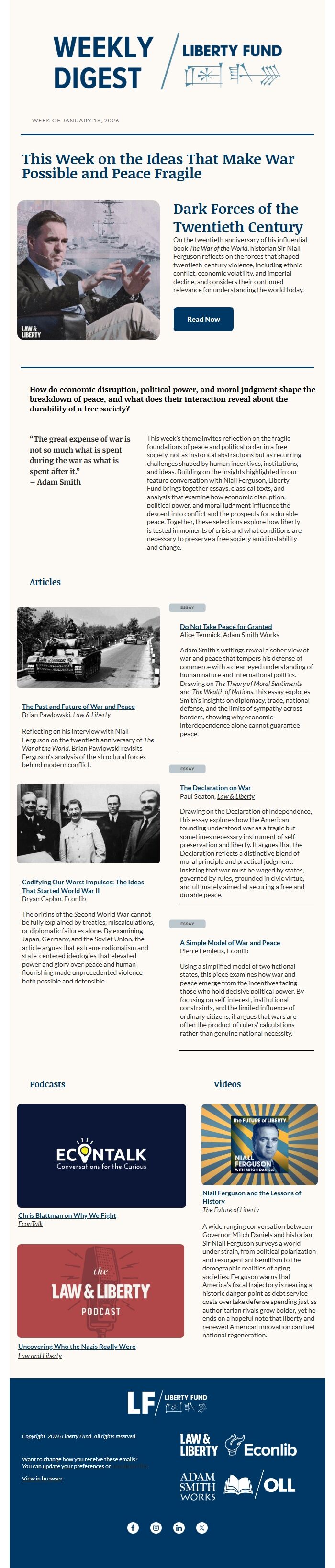
On the twentieth anniversary of his influential book The War of the World, historian Sir Niall Ferguson reflects on the forces that shaped twentieth-century violence, including ethnic conflict, economic volatility, and imperial decline, and considers their continued relevance for understanding the world today.
Read Now ([link removed])
** How do economic disruption, political power, and moral judgment shape the breakdown of peace, and what does their interaction reveal about the durability of a free society?
------------------------------------------------------------
** “The great expense of war is not so much what is spent during the war as what is spent after it.”
------------------------------------------------------------
** – Adam Smith
------------------------------------------------------------
This week’s theme invites reflection on the fragile foundations of peace and political order in a free society, not as historical abstractions but as recurring challenges shaped by human incentives, institutions, and ideas. Building on the insights highlighted in our feature conversation with Niall Ferguson, Liberty Fund brings together essays, classical texts, and analysis that examine how economic disruption, political power, and moral judgment influence the descent into conflict and the prospects for a durable peace. Together, these selections explore how liberty is tested in moments of crisis and what conditions are necessary to preserve a free society amid instability and change.
** Articles
------------------------------------------------------------
[link removed]
** The Past and Future of War and Peace ([link removed])
------------------------------------------------------------
Brian Pawlowski, Law & Liberty ([link removed])
Reflecting on his interview with Niall Ferguson on the twentieth anniversary of The War of the World, Brian Pawlowski revisits Ferguson’s analysis of the structural forces behind modern conflict.
[link removed]
** Codifying Our Worst Impulses: The Ideas That Started World War II ([link removed])
------------------------------------------------------------
Bryan Caplan, Econlib ([link removed])
The origins of the Second World War cannot be fully explained by treaties, miscalculations, or diplomatic failures alone. By examining Japan, Germany, and the Soviet Union, the article argues that extreme nationalism and state-centered ideologies that elevated power and glory over peace and human flourishing made unprecedented violence both possible and defensible.
** Do Not Take Peace for Granted ([link removed])
------------------------------------------------------------
Alice Temnick, Adam Smith Works ([link removed])
Adam Smith’s writings reveal a sober view of war and peace that tempers his defense of commerce with a clear-eyed understanding of human nature and international politics. Drawing on The Theory of Moral Sentiments and The Wealth of Nations, this essay explores Smith’s insights on diplomacy, trade, national defense, and the limits of sympathy across borders, showing why economic interdependence alone cannot guarantee peace.
** The Declaration on War ([link removed])
------------------------------------------------------------
Paul Seaton, Law & Liberty ([link removed])
Drawing on the Declaration of Independence, this essay explores how the American founding understood war as a tragic but sometimes necessary instrument of self-preservation and liberty. It argues that the Declaration reflects a distinctive blend of moral principle and practical judgment, insisting that war must be waged by states, governed by rules, grounded in civic virtue, and ultimately aimed at securing a free and durable peace.
** A Simple Model of War and Peace ([link removed])
------------------------------------------------------------
Pierre Lemieux,Econlib ([link removed])
Using a simplified model of two fictional states, this piece examines how war and peace emerge from the incentives facing those who hold decisive political power. By focusing on self-interest, institutional constraints, and the limited influence of ordinary citizens, it argues that wars are often the product of rulers’ calculations rather than genuine national necessity.
** Podcasts
------------------------------------------------------------
[link removed]
** Chris Blattman on Why We Fight ([link removed])
------------------------------------------------------------
EconTalk ([link removed])
[link removed]
** Uncovering Who the Nazis Really Were ([link removed])
------------------------------------------------------------
Law and Liberty ([link removed])
** Videos
------------------------------------------------------------
[link removed]
** Niall Ferguson and the Lessons of History ([link removed])
------------------------------------------------------------
The Future of Liberty ([link removed])
A wide ranging conversation between Governor Mitch Daniels and historian Sir Niall Ferguson surveys a world under strain, from political polarization and resurgent antisemitism to the demographic realities of aging societies. Ferguson warns that America’s fiscal trajectory is nearing a historic danger point as debt service costs overtake defense spending just as authoritarian rivals grow bolder, yet he ends on a hopeful note that liberty and renewed American innovation can fuel national regeneration.
[link removed]
Copyright 2026 Liberty Fund. All rights reserved.
Want to change how you receive these emails?
You can update your preferences ([link removed]) or unsubscribe ([link removed]) .
View in browser ([link removed])
[link removed] [link removed]
[link removed] [link removed]
[link removed]
[link removed]
[link removed]
[link removed]
WEEK OF JANUARY 18, 2026
** This Week on the Ideas That Make War Possible and Peace Fragile
------------------------------------------------------------
[link removed]
** Dark Forces of the Twentieth Century ([link removed])
------------------------------------------------------------
On the twentieth anniversary of his influential book The War of the World, historian Sir Niall Ferguson reflects on the forces that shaped twentieth-century violence, including ethnic conflict, economic volatility, and imperial decline, and considers their continued relevance for understanding the world today.
Read Now ([link removed])
** How do economic disruption, political power, and moral judgment shape the breakdown of peace, and what does their interaction reveal about the durability of a free society?
------------------------------------------------------------
** “The great expense of war is not so much what is spent during the war as what is spent after it.”
------------------------------------------------------------
** – Adam Smith
------------------------------------------------------------
This week’s theme invites reflection on the fragile foundations of peace and political order in a free society, not as historical abstractions but as recurring challenges shaped by human incentives, institutions, and ideas. Building on the insights highlighted in our feature conversation with Niall Ferguson, Liberty Fund brings together essays, classical texts, and analysis that examine how economic disruption, political power, and moral judgment influence the descent into conflict and the prospects for a durable peace. Together, these selections explore how liberty is tested in moments of crisis and what conditions are necessary to preserve a free society amid instability and change.
** Articles
------------------------------------------------------------
[link removed]
** The Past and Future of War and Peace ([link removed])
------------------------------------------------------------
Brian Pawlowski, Law & Liberty ([link removed])
Reflecting on his interview with Niall Ferguson on the twentieth anniversary of The War of the World, Brian Pawlowski revisits Ferguson’s analysis of the structural forces behind modern conflict.
[link removed]
** Codifying Our Worst Impulses: The Ideas That Started World War II ([link removed])
------------------------------------------------------------
Bryan Caplan, Econlib ([link removed])
The origins of the Second World War cannot be fully explained by treaties, miscalculations, or diplomatic failures alone. By examining Japan, Germany, and the Soviet Union, the article argues that extreme nationalism and state-centered ideologies that elevated power and glory over peace and human flourishing made unprecedented violence both possible and defensible.
** Do Not Take Peace for Granted ([link removed])
------------------------------------------------------------
Alice Temnick, Adam Smith Works ([link removed])
Adam Smith’s writings reveal a sober view of war and peace that tempers his defense of commerce with a clear-eyed understanding of human nature and international politics. Drawing on The Theory of Moral Sentiments and The Wealth of Nations, this essay explores Smith’s insights on diplomacy, trade, national defense, and the limits of sympathy across borders, showing why economic interdependence alone cannot guarantee peace.
** The Declaration on War ([link removed])
------------------------------------------------------------
Paul Seaton, Law & Liberty ([link removed])
Drawing on the Declaration of Independence, this essay explores how the American founding understood war as a tragic but sometimes necessary instrument of self-preservation and liberty. It argues that the Declaration reflects a distinctive blend of moral principle and practical judgment, insisting that war must be waged by states, governed by rules, grounded in civic virtue, and ultimately aimed at securing a free and durable peace.
** A Simple Model of War and Peace ([link removed])
------------------------------------------------------------
Pierre Lemieux,Econlib ([link removed])
Using a simplified model of two fictional states, this piece examines how war and peace emerge from the incentives facing those who hold decisive political power. By focusing on self-interest, institutional constraints, and the limited influence of ordinary citizens, it argues that wars are often the product of rulers’ calculations rather than genuine national necessity.
** Podcasts
------------------------------------------------------------
[link removed]
** Chris Blattman on Why We Fight ([link removed])
------------------------------------------------------------
EconTalk ([link removed])
[link removed]
** Uncovering Who the Nazis Really Were ([link removed])
------------------------------------------------------------
Law and Liberty ([link removed])
** Videos
------------------------------------------------------------
[link removed]
** Niall Ferguson and the Lessons of History ([link removed])
------------------------------------------------------------
The Future of Liberty ([link removed])
A wide ranging conversation between Governor Mitch Daniels and historian Sir Niall Ferguson surveys a world under strain, from political polarization and resurgent antisemitism to the demographic realities of aging societies. Ferguson warns that America’s fiscal trajectory is nearing a historic danger point as debt service costs overtake defense spending just as authoritarian rivals grow bolder, yet he ends on a hopeful note that liberty and renewed American innovation can fuel national regeneration.
[link removed]
Copyright 2026 Liberty Fund. All rights reserved.
Want to change how you receive these emails?
You can update your preferences ([link removed]) or unsubscribe ([link removed]) .
View in browser ([link removed])
[link removed] [link removed]
[link removed] [link removed]
[link removed]
[link removed]
[link removed]
[link removed]
Message Analysis
- Sender: Liberty Fund
- Political Party: n/a
- Country: United States
- State/Locality: n/a
- Office: n/a
-
Email Providers:
- MailChimp