
Email
*Breaking News* This Morning SCOTUS Asked State of California To Brief In the CAGOP's Emergency Application On Pro…
| From | FlashReport’s “So, Does It Matter?” <[email protected]> |
| Subject | *Breaking News* This Morning SCOTUS Asked State of California To Brief In the CAGOP's Emergency Application On Pro… |
| Date | January 22, 2026 8:48 PM |
Links have been removed from this email. Learn more in the FAQ.
Links have been removed from this email. Learn more in the FAQ.
View this post on the web at [link removed]
This is a breaking news analysis. The key facts and immediate implications appear above the paywall. The deeper legal and political analysis is reserved for paid subscribers. As is the case for most breaking news and afternoon posts (this is both).
🕒 5-minute read
A signal from the Court
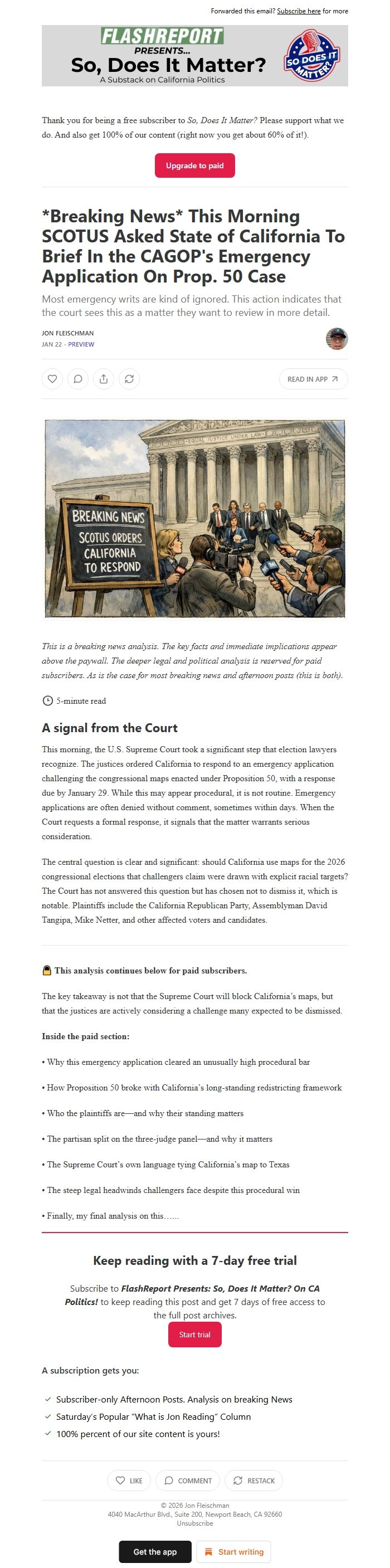
This morning, the U.S. Supreme Court took a significant step that election lawyers recognize. The justices ordered California to respond to an emergency application challenging the congressional maps enacted under Proposition 50, with a response due by January 29. While this may appear procedural, it is not routine. Emergency applications are often denied without comment, sometimes within days. When the Court requests a formal response, it signals that the matter warrants serious consideration.
The central question is clear and significant: should California use maps for the 2026 congressional elections that challengers claim were drawn with explicit racial targets? The Court has not answered this question but has chosen not to dismiss it, which is notable. Plaintiffs include the California Republican Party, Assemblyman David Tangipa, Mike Netter, and other affected voters and candidates.
🔒 This analysis continues below for paid subscribers.
The key takeaway is not that the Supreme Court will block California’s maps, but that the justices are actively considering a challenge many expected to be dismissed.
Inside the paid section:
• Why this emergency application cleared an unusually high procedural bar
• How Proposition 50 broke with California’s long-standing redistricting framework
• Who the plaintiffs are—and why their standing matters
• The partisan split on the three-judge panel—and why it matters
• The Supreme Court’s own language tying California’s map to Texas
• The steep legal headwinds challengers face despite this procedural win
• Finally, my final analysis on this…...
Unsubscribe [link removed]?
This is a breaking news analysis. The key facts and immediate implications appear above the paywall. The deeper legal and political analysis is reserved for paid subscribers. As is the case for most breaking news and afternoon posts (this is both).
🕒 5-minute read
A signal from the Court
This morning, the U.S. Supreme Court took a significant step that election lawyers recognize. The justices ordered California to respond to an emergency application challenging the congressional maps enacted under Proposition 50, with a response due by January 29. While this may appear procedural, it is not routine. Emergency applications are often denied without comment, sometimes within days. When the Court requests a formal response, it signals that the matter warrants serious consideration.
The central question is clear and significant: should California use maps for the 2026 congressional elections that challengers claim were drawn with explicit racial targets? The Court has not answered this question but has chosen not to dismiss it, which is notable. Plaintiffs include the California Republican Party, Assemblyman David Tangipa, Mike Netter, and other affected voters and candidates.
🔒 This analysis continues below for paid subscribers.
The key takeaway is not that the Supreme Court will block California’s maps, but that the justices are actively considering a challenge many expected to be dismissed.
Inside the paid section:
• Why this emergency application cleared an unusually high procedural bar
• How Proposition 50 broke with California’s long-standing redistricting framework
• Who the plaintiffs are—and why their standing matters
• The partisan split on the three-judge panel—and why it matters
• The Supreme Court’s own language tying California’s map to Texas
• The steep legal headwinds challengers face despite this procedural win
• Finally, my final analysis on this…...
Unsubscribe [link removed]?
Message Analysis
- Sender: n/a
- Political Party: n/a
- Country: n/a
- State/Locality: n/a
- Office: n/a