Expert analysis made easy. Breaking down the news with data, charts, and maps.
Edited by Brady Africk and Hannah Bowen
Happy Thursday! In today’s newsletter, we examine the impact of Trump’s immigration policies during the first year of his second administration, higher education degrees that may lose eligibility for federal loans because they yield low earnings, and changes to the Supplemental Nutrition Assistance Program in 2026.
Don’t forget—subscribe and send DataPoints to a friend!
1. One Year of President Trump’s Immigration Policy
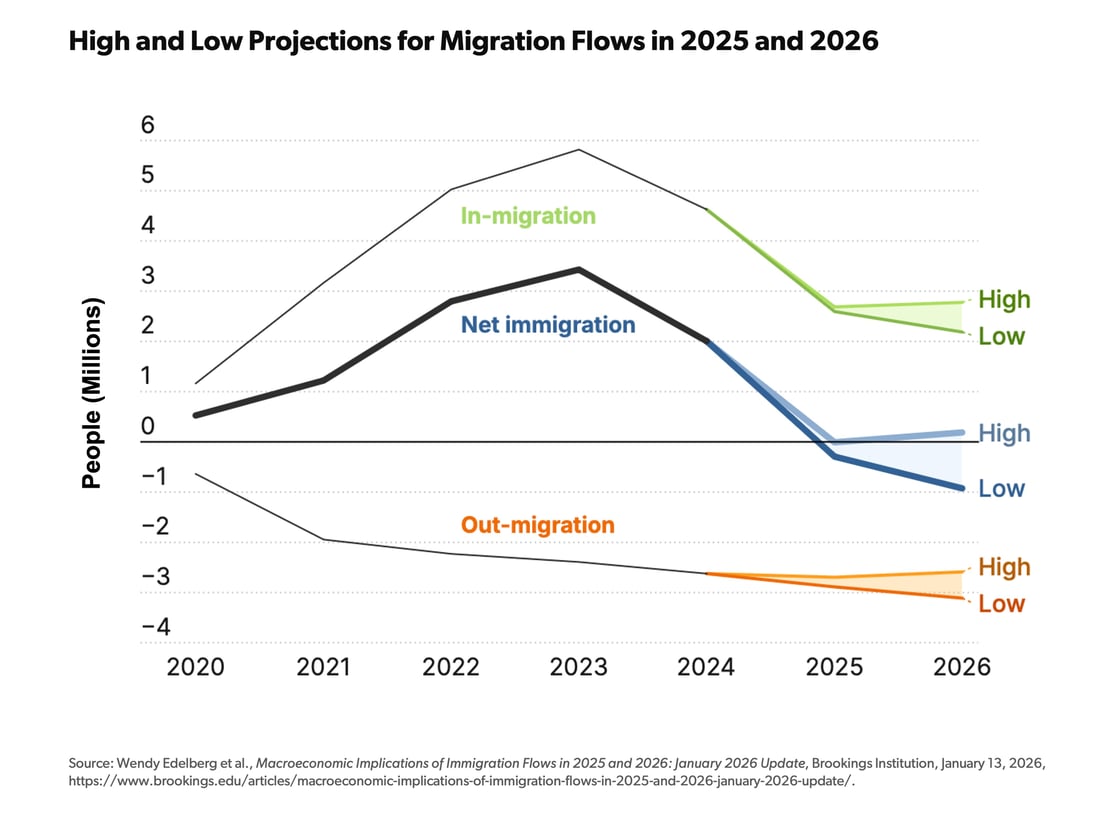
Topline: US immigration policy underwent dramatic changes throughout the second Trump administration’s first year. AEI’s Stan Veuger and the Brookings Institution’s Tara Watson and Wendy Edelberg deduce that for the first time in half a century, US net migration was likely close to zero or negative in 2025. They estimate that net migration ranged between −295,000 and −10,000 people and predict that restrictive policy and negative net migration will likely continue in 2026.
Deflated Migration: Although deportations and other outflows of immigrants received greater media attention, a slowdown in new arrivals due to the administration’s immigration policies—including changing humanitarian parole, suspending refugee programs, and reducing crossings over the southwest border—had a larger impact on the reduction in migration flows in the past year.
Macroeconomic Effects: Downward population pressures have important impacts on the US economy. In recent years, growth has been weak among the US-born working-age population, and growth in the labor force has heavily depended on immigration flows. Looking ahead to 2026, Veuger, Watson, and Edelberg expect employment growth to decline because of changes in immigration policy. They estimate that decreased immigration will reduce consumer spending by $60–$110 billion and have modest dampening effects on GDP across 2025 and 2026.
"Certain parts of the economy will see unexpectedly weak economic activity, such as businesses that serve part of the affected immigrant population. Such weakness is the new normal under current immigration policy, rather than weakness reflecting adverse business cycle conditions.” —Stan Veuger, Tara Watson, and Wendy Edelberg
Topline: The Education Department is implementing a new accountability system for higher education programs that depend on federal subsidies by assessing their graduates’ earnings potential. AEI’s Preston Cooper analyzes the degrees that will likely pass or fail the department’s new earnings test and the policy’s expected impact on students’ decisions about higher education.
What’s a Degree Worth? Currently, only about 5 percent of programs are likely to fail the earnings test. But during the 2024–25 academic year, 644,000 students enrolled in one of those failing programs using federal student aid. During the 2024–25 award year, $2.7 billion in federal loans was disbursed to students in failing programs. Much of that debt is unlikely to be repaid in full, given the low earnings of those programs’ graduates.
Taxpayer Costs: Cutting off programs that are unlikely to result in earnings strong enough to pay back the debt will help US taxpayers, and these programs’ loss of loan eligibility may push some students to choose higher-value ones. Most programs will likely pass the earnings test, but institutions with failing programs may need to start preparing for changes.
"While most programs are likely to pass the earnings test, institutions with failing programs may need to start preparing for the changes that are to come. Out of America’s 5,000 colleges and universities, nearly 2,000 have at least one failing program.” —Preston Cooper
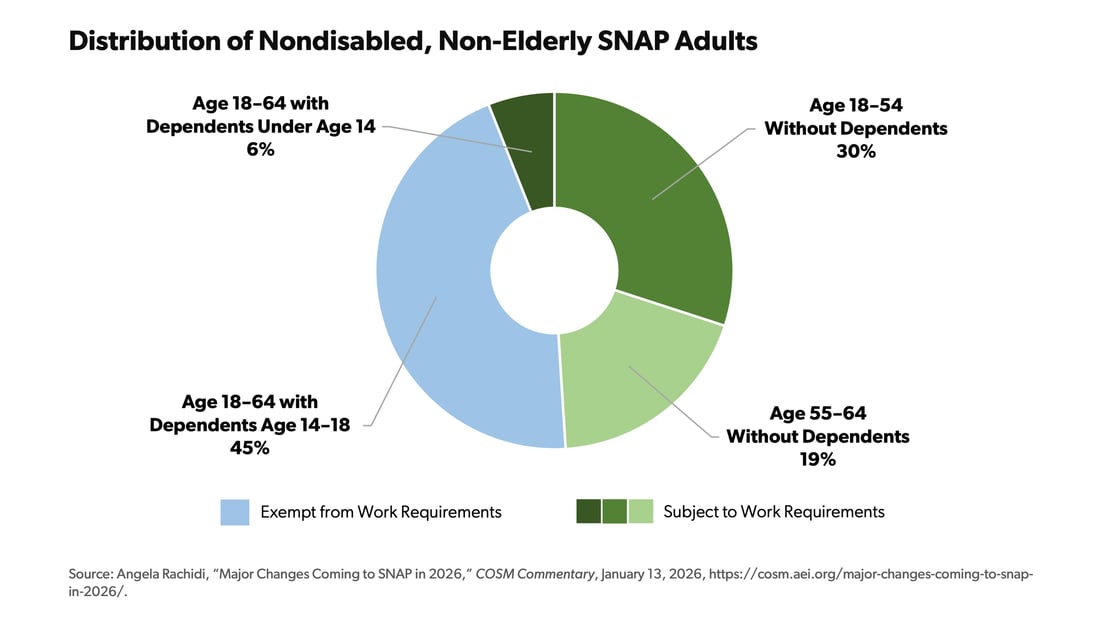
Topline: The Supplemental Nutrition Program (SNAP) serves 22 million low-income US households each month, helping more than one in eight Americans afford food for themselves and their families. Despite its importance, SNAP is plagued by significant flaws that make it inefficient and, in some cases, harmful to social mobility, writes AEI’s Angela Rachidi. However, recent congressional actions and executive-branch decisions have laid the foundation for changes in 2026.
SNAP Problems: Concerns over SNAP have centered on the program’s integrity, nutrition, employment, financial structure, and increasing costs. The One Big Beautiful Bill Act addressed several of these key issues, and the Trump administration is pursuing new policies designed to improve nutrition. In 2026, states and SNAP participants can expect changes in addressing payment errors and misuse, work requirements, and nutrition regulations.
Encouraging SNAP Efficiency: These changes will require a large administrative effort from states, including updates to eligibility and data systems, new staff training, and improved coordination between SNAP eligibility and workforce development programs. Nonetheless, these short-term burdens increase the likelihood of improved efficiency and effectiveness in the long term.
"The Supplemental Nutrition Assistance Program (SNAP, formerly called food stamps) is an important safety-net program that helps reduce hunger and decrease poverty among US households. At the same time, SNAP has significant flaws that make it inefficient, less effective than it could be, and in some cases harmful to upward mobility.” —Angela Rachidi

.jpeg?width=1120&upscale=true&name=02%20Cooper%20(1).jpeg)