|
How Trump's tariffs hurt his biggest supporters the most
A case study from West Virginia’s coal country
|


| |||||||||||||||


Mingo County, West Virginia once sat at the centre of America’s coal-fueled industrial boom. As mining grew in America’s Appalachian coalfields, trade unions became an essential part of everyday life. As night follows day, the Democratic Party then became dominant.
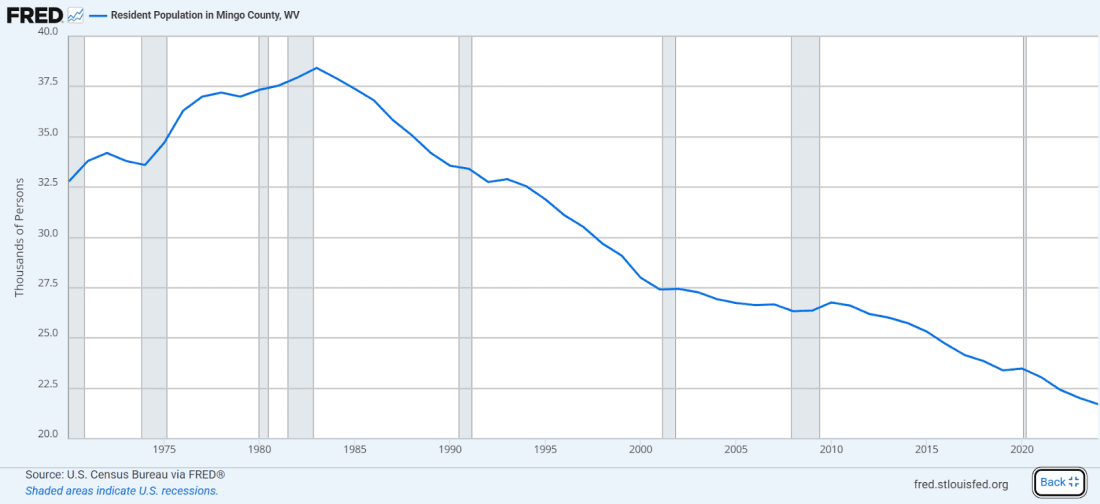
You wouldn’t recognise any of that today. Mingo’s population has dropped by around 50% since 1950. As coal mining jobs were eroded by automation, globalisation, and decarbonisation, people simply left.
The situation isn’t good for those who remained; life expectancy is among the worst in America at just 67.2 years, only 8.3% of residents have a university degree, and unemployment hovers between 6% and 7%, persistently above the national average. Walking around in Williamson, Mingo’s largest city, is an eerily quiet experience. The magnificent wooded hills surrounding the city contrast grimly to the lawyers’ offices, bars, and assorted clinics for ex-miners and recovering addicts that dominate its main street.
 |
Just as its economic reality is unrecognisable from decades gone by, so too is its politics. Since the late 1990s, the Democratic Party has collapsed in West Virginia along with coal mining and union membership. Mingo County was one of the most pro-Trump parts of the second most pro-Trump state, giving the President 83%, 85%, and 86% in the last three elections respectively.
Despite loyally voting for Democrats at all levels of government, working-class West Virginians always had a populist, socially conservative streak. Their move to the Republicans is Ground Zero for the realignment shaping modern Western democracies, in which cultural issues matter far more than economics.
West Virginia is particularly well suited to Trump’s message and political brand in particular. The state is one of America’s poorest; once a heavy industry powerhouse, globalisation and modernity have taken that economic status away. Left behind Mingo County is fertile ground for economically nationalist policies like tariffs.
Trump has spent his second presidency weaponizing tariff authority as a solution to almost every perceived problem. Throughout the Spring and Summer, the President's 'Liberation Day' tariffs imposed a whole host of dubiously calculated rates on almost every foreign country. Although a raft of carve-outs and exemptions mean that headline tariffs are misleading, Americans face effective tariffs of 16.8% (pre-substitution), the highest since 1935. The Supreme Court may imminently invalidate Trump's claims of unilateral tariff authority under the 1977 International Emergency Economic Powers Act. But even a thorough limitation of those powers would leave the effective pre-substitution rate at 9.3%, the highest since the late 1940s. Trump has also used tariffs as a foreign policy tool, from discouraging third countries evading sanctions on Russia to threatening new levies on NATO allies opposing his unhinged proposal to annex Greenland.
Now that Trump has fully embraced all of his worst instincts on trade, we’ll be able to see whether protectionism will bring the glory days back to America’s post-industrial regions. The reality is that it is those areas and the people within them will suffer acutely from new trade barriers.
Squeezed Incomes
The median household income in Mingo County is $39,527, just under $18,000 less than the state median and around half that of the US as a whole. In Williamson, it’s even lower at just over $24,000.
As Eamonn Butler explains in An Introduction to Taxation:
“Tariffs…raise the price of imported goods for every end customer, regardless of their means. In addition, some of the main targets for import tariffs are typically essentials such as food and clothing: since these already absorb a larger part of poorer households’ budgets, the extra tax falls most heavily on those least able to afford it.”
This is backed up by modelling from Yale’s Budget Lab, which shows the burden of new tariffs will disproportionately fall on lower-income earners. Households in the bottom earnings decile face a 2.4% hit to their post-tax-and-transfer income compared to 0.8% in the top decile. This is influenced by short-run average price hikes of 20% for clothes and leather products like shoes and bags, 14% for textiles, 17% for consumer electronics, 13% for motor vehicles, and 1.2% for food.
Budget Lab’s estimated $1,700 average household cost from new tariffs would further erode already low incomes in Mingo. Even more conservative estimates, like the Tax Foundation’s findings of an effective $1,500 tax hike per household would represent a significant hit. The Tax Foundation’s modelling does not include the costs of higher prices for substitute goods or reduced consumer choice.
Given that the median household incomes in Mingo County would sit around the third US income decile, they are likely to face a lower absolute burden but the proportionate hit would be higher. This is an even greater problem for the city of Williamson in particular, where median incomes place between the high second and low third deciles.
Taking Back Our Jobs
But could all this be offset by reshoring high-wage jobs, particularly in heavy industry? It seems unlikely. Weakening export demand, the prospect of retaliatory tariffs, lower GDP growth, and higher input costs are all ominous signs for employment and wages in places like Mingo.
While West Virginia’s coal mining output has shrunk significantly since its mid-20th Century peak, the sector still employs around 500 people in Mingo County according to the most recent data, providing some of its higher-paying opportunities. This is because what remains of the coal industry in the state has reoriented itself towards exports, particularly of its high quality metallurgical coal which is used as part of industrial production.
West Virginia coal producers have already warned about the negative impacts of new tariffs, particularly the prospect of retaliatory tariffs from the People’s Republic of China. Of the 11.6 million tonnes of coal exported from the United States to communist China in 2024, just over half originated in West Virginia. In an industry as export-oriented as modern American coal mining, there’s little prospect of new jobs in such an uncertain trade environment.
But could the new tariffs induce greater demand for US-produced coal to fuel new manufacturing in other reshored industries? That also appears unlikely. Budget Lab projects that new tariffs could boost headline US manufacturing activity by up by 2.9%, but that will be more than offset by declines elsewhere. These include construction and mining and extraction which are projected to shrink by 4.1% and 2%, respectively.
These projected declines can be attributed to overall economic contraction, with tariffs set to slow US GDP growth by around half-a-percent point per year, and weakening export demand. Mining companies would also suffer from the artificial reallocation of capital and labour to domestic industries that are made relatively more profitable by the tariffs.
To put the final nail in the coffin, many key inputs for domestic manufacturers, including metallurgical coal and coke, are exempt from the new tariffs anyway. Even if tariffs have their intended effect of onshoring some new manufacturing output, new demand for inputs like coal and coke would not necessarily deliver a windfall to domestic producers whose products would still be uncompetitive compared to imports.
Another large employer, the Walmart Supercenter based across the river in Kentucky, is likely to suffer from tariffs too. If demand contracts as a result of tariff-induced price hikes, Walmart’s already thin profit margins will take a hit, which could cause job losses or lost wage growth down the line. Other sectors employing Mingo residents including the local hospital, are also likely to face some degree of difficulty due to higher input costs.
In summary, the tariffs will disproportionately impact low earners, who in turn make up a disproportionate number of Mingo County residents. There is little hope of reshored heavy industry jobs coming back while those that remain are likely to lose more than they gain out of tariffs.
Mingo County is just one small, troubled corner of the United States but it speaks to a broader trend; the very people who make up the foundation of Trump’s movement, those who look to him and his ideas to help them the most, are likely to suffer most acutely from the real-world impacts of his policies.
There are solutions to the genuine problems facing Mingo County and places like it. But as is usually the case, they aren’t going to be found at the bottom of a bottle of economic nationalism.
You’re currently a free subscriber to Insider. For the full experience, upgrade your subscription.
Paid subscribers support the IEA's charitable mission and receive special invites to exclusive events, including the thought-provoking IEA Book Club.
We are offering all new subscribers a special offer. For a limited time only, you will receive 15% off and a complimentary copy of Dr Stephen Davies’ latest book, Apocalypse Next: The Economics of Global Catastrophic Risks.
| ||||||||||

