|
Goldstein For Congress - Please Subscribe and also visit us at www.goldsteinforcongress.com
Proposed Single-Payer Health Care in Connecticut
Why New York Walked Away — and Why Connecticut Cannot Ignore the Warning
|

| |||||||||||||||


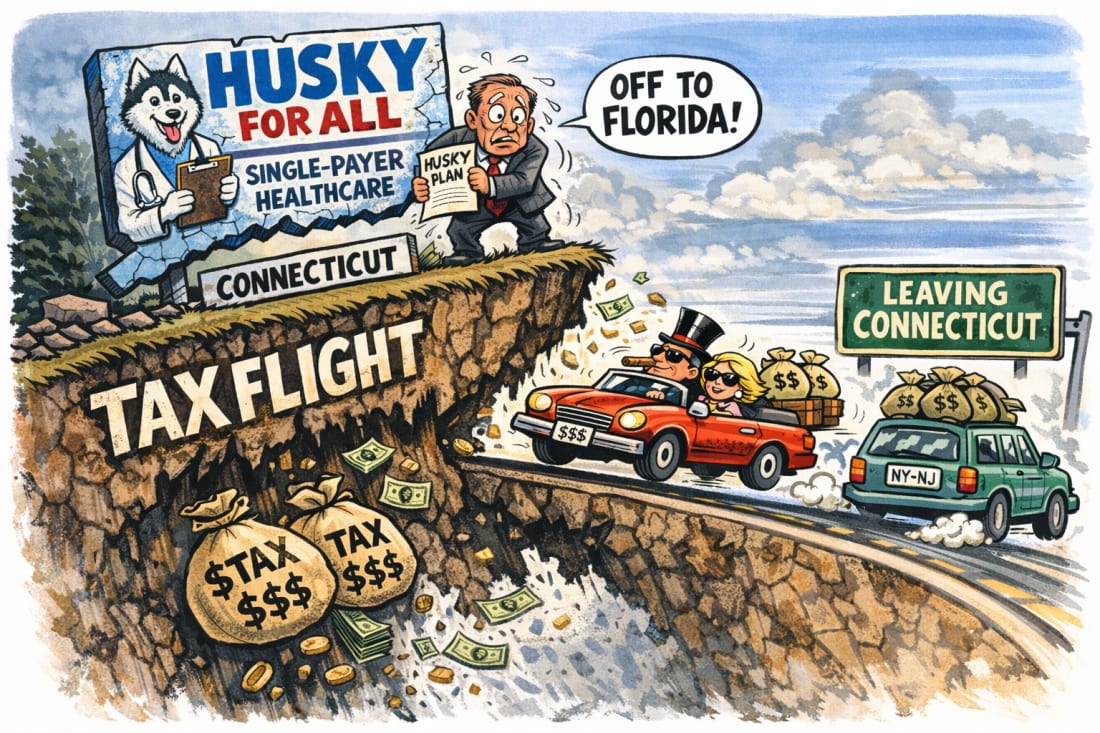 |
As the Connecticut General Assembly convenes for its regular February session, one proposal is almost certain to reappear: “HUSKY for All,” a single-payer, state-run universal health-care system.
This proposal has failed repeatedly in prior years. But following poor local election turnout and low-engagement special elections, the Democratic super-majority appears newly emboldened. Under the banner of “affordability,” single-payer health care is likely to return—without incorporating the hard fiscal lessons learned by states that studied it and ultimately rejected it, most notably New York.
That is not reform.
That is willful disregard of evidence.
Insanity as a Policy Method - The Connecticut Way
Connecticut has developed a pattern of watching progressive policy experiments fail elsewhere—particularly in New York and California—and then attempting to replicate them anyway, often without modification.
Single-payer health care is the latest and most dangerous example.
Despite years of economic modeling and clear warnings, Connecticut lawmakers continue to flirt with state takeover of the entire health-care system, as though the risks are hypothetical.
They are not.
What Single-Payer (“HUSKY for All”) Actually Does
Under the proposal:
The State of Connecticut becomes the sole health insurer
Medicare and Medicaid recipients are folded into a single state plan
Deductibles and copays are eliminated
Health-care costs become a direct obligation of the state budget
This creates unlimited demand with finite and inadequate revenue, while placing cost control in the hands of politicians and bureaucrats facing constant pressure from special interests.
The Core Economic Failure: Demand Without Discipline
When care becomes “free,” utilization rises sharply. That is not ideology—it is economics.
Without firm guardrails:
Costs escalate rapidly
Provider reimbursements are squeezed
Doctors and specialists leave the state
Hospital finances deteriorate
Wait times increase
Quality declines
The result is not universal care—it is rationed care.
Federal Waivers: Necessary, Risky, and Insufficient
To implement single-payer, Connecticut would require federal waivers allowing Medicare and Medicaid dollars to flow to the state.
Even if granted, those funds would fall dramatically short of covering total costs.
The gap must be filled by:
Massive payroll taxes
Major increases in state income taxes
Or both
What New York Learned (RAND Corporation Study)
New York commissioned the RAND Corporation to evaluate the New York Health Act—a proposal nearly identical to Connecticut’s.
RAND’s findings were decisive:
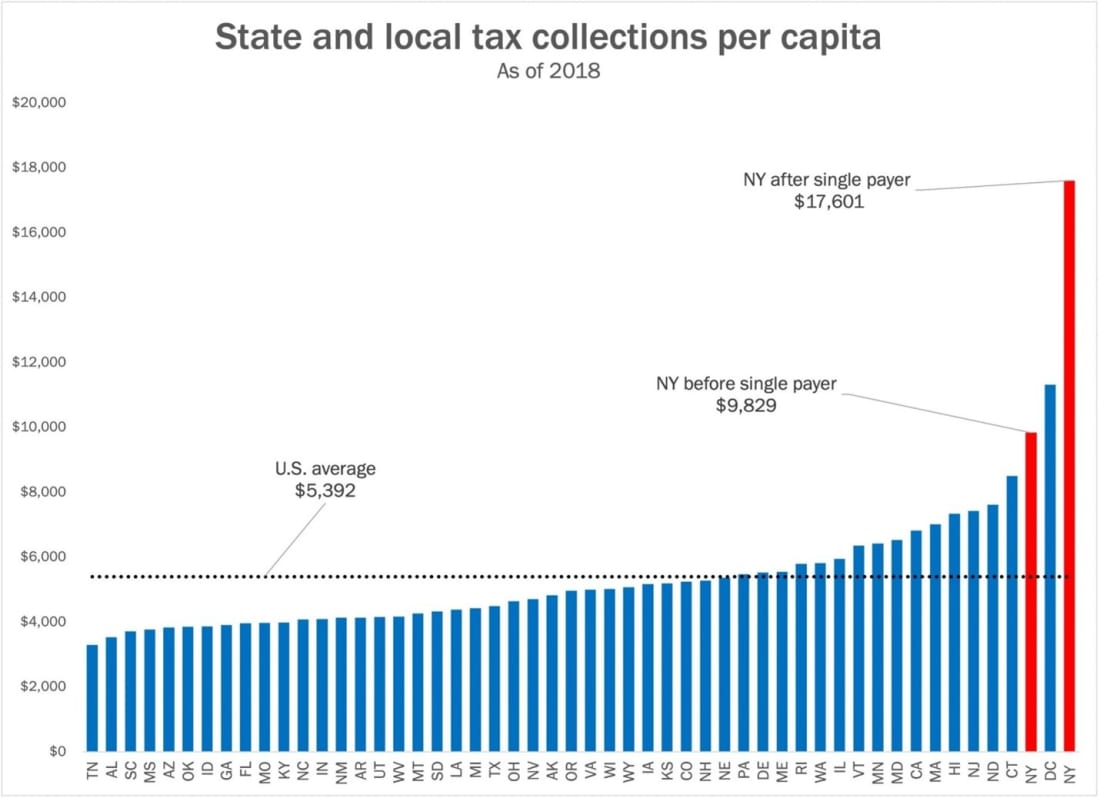
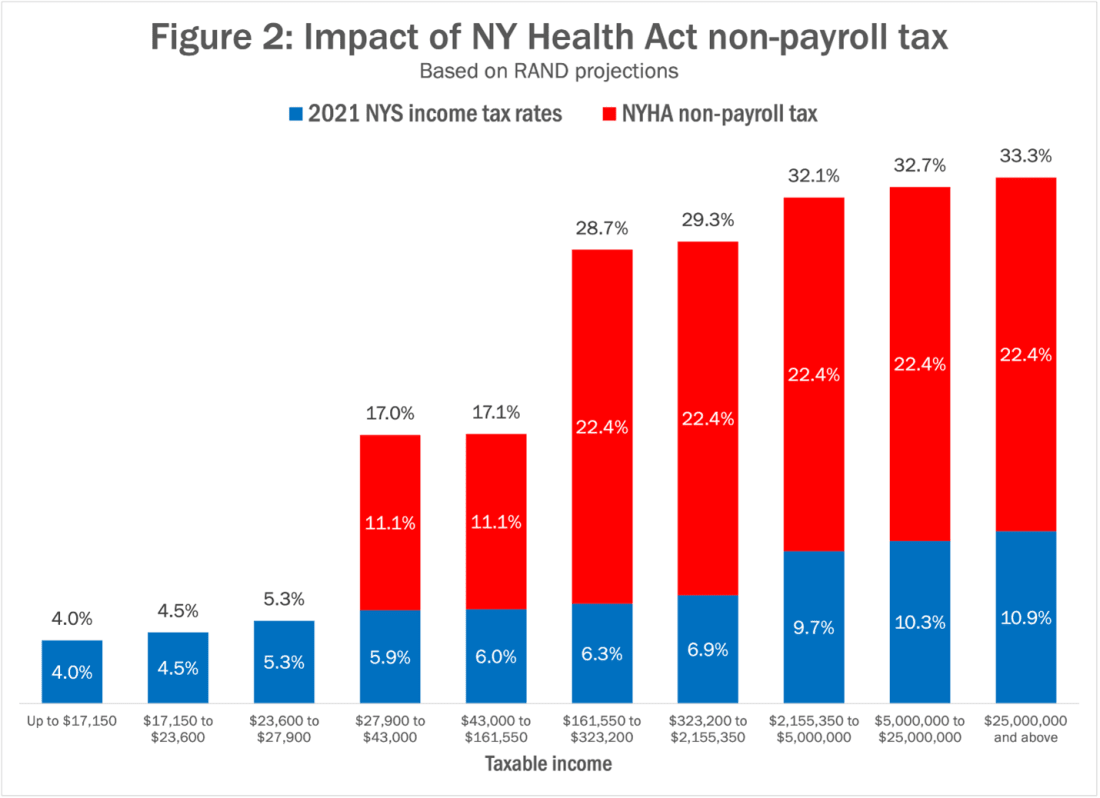
156% increase in total state tax revenue required
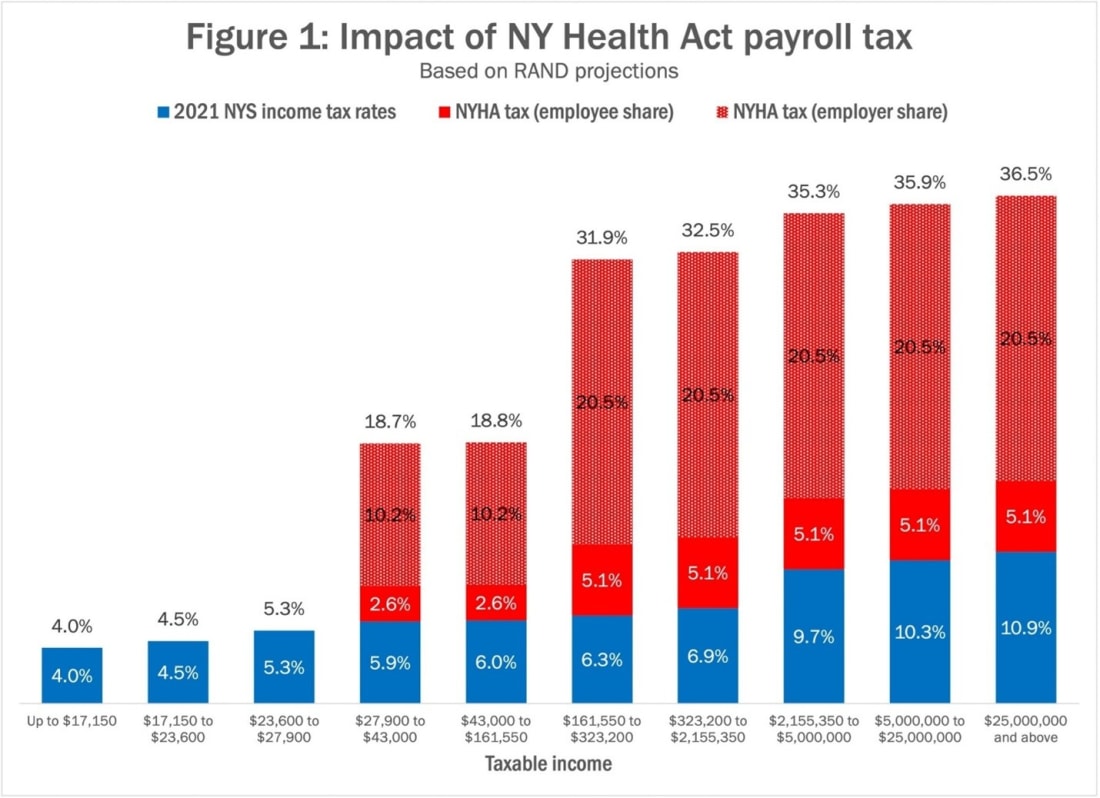
New payroll and income taxes imposed across nearly all income brackets
Effective state income-tax rates for high earners approaching or exceeding 30%, before federal taxes
RAND further warned that if even 0.5% of top earners left the state, the plan would collapse financially.
New York listened—and walked away.
Why Connecticut Is Even More Vulnerable Than New York
Connecticut’s problem is not just high taxes.
It is tax concentration.
Unlike New York, Connecticut relies on a small number of towns and taxpayers to fund state government. Any policy that materially increases the tax burden on these communities threatens the entire revenue system.
Top 10 Towns by Total State Income Taxes Paid
Greenwich: $916,372,895
Stamford: $406,126,633
Darien: $285,743,758
Westport: $264,713,486
Fairfield: $255,469,783
New Canaan: $230,056,400
West Hartford: $224,039,635
Norwalk: $180,453,967
Glastonbury: $153,488,988
Ridgefield: $130,184,495
Top 10 Towns by Income Tax Paid Per Capita
Greenwich: $14,431
Darien: $13,274
New Canaan: $11,165
Lyme: $10,108
Westport: $9,758
Weston: $6,285
Wilton: $6,251
Avon: $5,501
Woodbridge: $5,254
Ridgefield: $5,206
Top 10 Towns by Average Tax Paid Per Return
Greenwich: $34,971
Darien: $34,728
New Canaan: $28,880
Lyme: $25,536
Westport: $23,327
Weston: $16,854
Wilton: $15,722
Ridgefield: $12,731
Avon: $12,056
Woodbridge: $12,008
These towns represent the financial backbone of Connecticut state government
What Single-Payer Does to This Tax Base
Applying RAND’s New York modeling to Connecticut produces a stark conclusion:
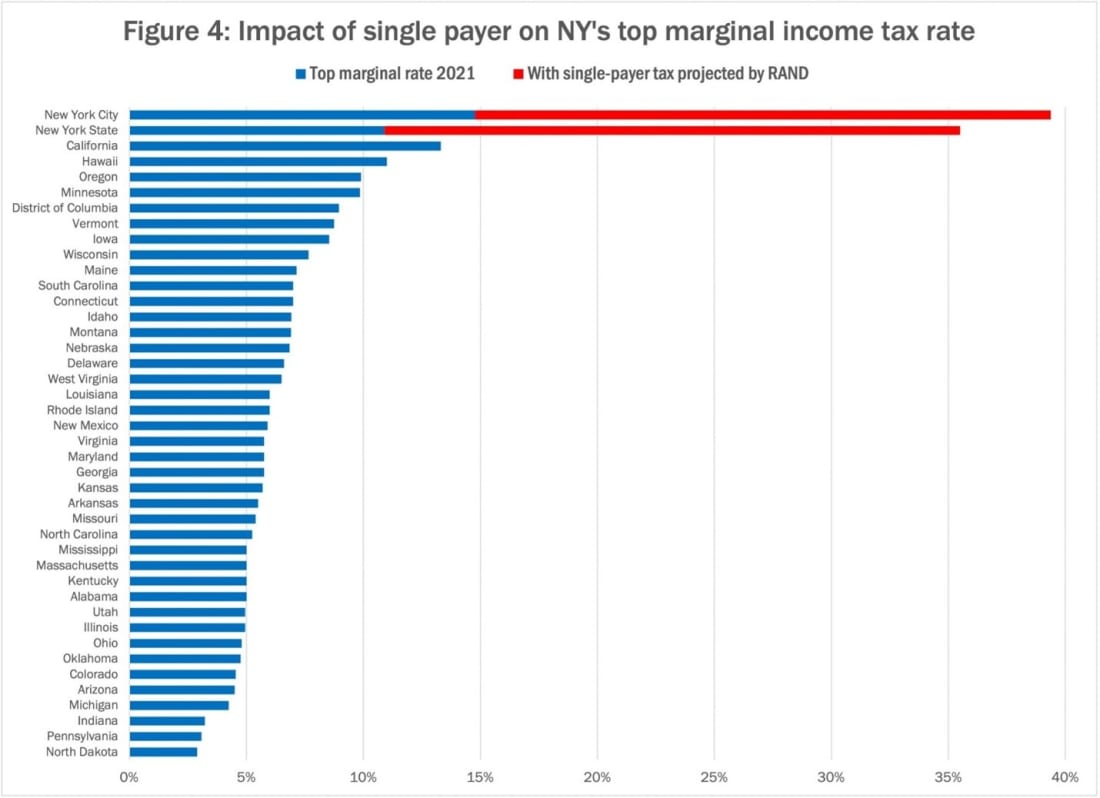
Effective state income-tax rates would double or triple for top earners
 |
New payroll taxes would be layered on top
 |
Per-capita state taxes in the highest-contributing towns would rise from $10,000–$15,000 to $30,000–$40,000
 |
Dual-income households would face $100,000–$120,000+ annually in state taxes alone
 |
These figures exclude federal taxes.
That level of taxation is not sustainable.
The Inevitable Outcome: Tax Flight and Revenue Collapse
Connecticut does not have a broad tax base to absorb this shock.
If even a small percentage of high-income households leave:
Income-tax receipts fall sharply
Remaining taxpayers face higher rates
More households leave
Property values decline
Municipal budgets deteriorate
The cycle accelerates
This is the same revenue death spiral RAND identified for New York—but faster and more severe due to Connecticut’s smaller, more concentrated base
Who Actually Benefits?
Retirees on Medicare with limited taxable income
Pensioners with low state-tax exposure
Who Are the Losers?
Middle-class and upper-middle-class workers—the backbone of Connecticut’s economy—pay more, often substantially more.
Other Fundamental Issues
Connecticut residents who work in New York and other states would not be subject to a Connecticut Payroll Tax.
Will out of state residents who work in Connecticut be covered?
People who now have employer funded health insurance would lose that benefit and have to pay higher taxes to pay for their health insurance and may not get a corresponding offset in their compensation
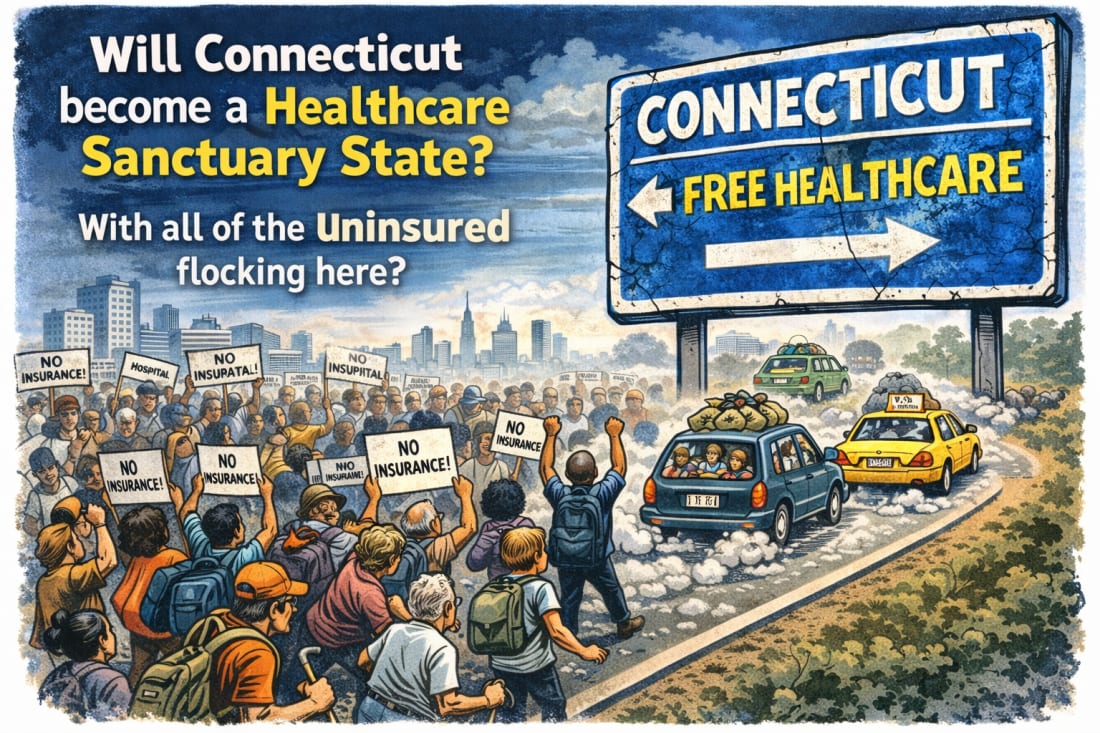
Will Connecticut become a healthcare Sanctuary State with all of the uninsured flocking here?
Would Other States Accept Husky for All when CT Residents travel or become snowbirds?
Conclusion: Math Wins. Always.
Single-payer health care is not merely expensive.
It is structurally incompatible with Connecticut’s tax reality.
A system that depends on tripling taxes on the very towns that fund the state is not compassionate.
It is reckless.
New York studied the numbers and walked away.
Connecticut should learn from that wisdom—before it is too late.
 | A guest post by
|
The Goldstein Substack is free today. But if you enjoyed this post, you can tell The Goldstein Substack that their writing is valuable by pledging a future subscription. You won't be charged unless they enable payments.
| ||||||||||

