|
 |
This content is available for free to all subscribers. But you really should consider a paid subscription. This unlocks our afternoon e-mails, our Saturday “What is Jon Reading” e-mail, and analysis on breaking news. Normally a subscription is a modest $7 a month or just $70 for the year.
California’s Homelessness Crisis, Part One: How This Problem Was Created by Progressives Who Now Demand We Trust Them to Fix It
Democrats have had full control of the state government for decades, and their policies have created California’s homelessness crisis.
|

| |||||||||||||||


 |
⏱️ 7 min read
California’s homelessness crisis is not merely severe—it is unmatched. More than 187,000 people are homeless in the state, representing roughly one-quarter of the entire homeless population in the United States, even though California has only about 12 percent of the nation’s population. Nearly two-thirds are unsheltered, the highest rate of any state.
A Crisis Owned by the Ruling Party
California’s homelessness crisis is no longer abstract or confined to isolated neighborhoods. It is visible across the state, from downtown corridors to suburban communities, public parks, and major transportation routes. Despite years of emergency declarations and record spending, the numbers remain stubbornly high and, in many regions, continue to rise.
This reality raises an unavoidable political question. Democrats have controlled California’s governorship, legislature, regulatory agencies, and most major city governments for decades, or longer. They set tax policy, housing rules, environmental mandates, and social service priorities. When a crisis worsens under long-term one-party rule, accountability becomes unavoidable.
These outcomes were not unforeseen side effects, but predictable tradeoffs accepted in pursuit of higher taxes, stricter regulation, and ideological priorities unrelated to keeping people housed. Instead, Californians are asked to accept that the same leadership class responsible for the current conditions is uniquely qualified to solve them, provided it is given more money, more authority, and more time.
Making Daily Life More Expensive
One of the most reliable ways to push people toward homelessness is to raise the cost of living faster than incomes can keep up. California’s policy environment does exactly that.
Taxes and fees reach into nearly every transaction. Fuel prices are driven higher by layered mandates designed to reduce carbon emissions, including costly cap-and-invest fees that are passed directly on to consumers. Utility bills are higher because of various fees added directly to monthly statements and significant hidden costs imposed by state mandates that make energy itself more expensive. Insurance, childcare, and healthcare costs are driven higher by regulatory requirements that compound across the economy.
Each policy is defended in isolation as compassionate or forward-thinking. Taken together, they steadily drain household budgets.
For families living paycheck to paycheck, there is no margin for error. A rent increase, job loss, or medical bill can quickly turn housing insecurity into homelessness. This is not a personal failure. It is the predictable outcome of public policy.
Regulation That Produces Scarcity
California’s housing shortage did not happen by accident. It is the foreseeable result of a regulatory regime that treats housing construction as a suspect activity requiring years of approvals, environmental review, and litigation exposure.
Projects that would be routine elsewhere can take close to a decade to complete, if they survive at all. Scarcity drives prices. Rising prices force people out. The relationship is straightforward.
Rather than removing barriers to construction, the state has leaned into government-managed housing programs that often cost hundreds of thousands of dollars per unit while delivering results far too slowly. Bureaucracy expands. Supply does not. This was not an unavoidable outcome, but the result of a deliberate preference for process, litigation, and government control over speed, scale, and affordability.
Democrats often frame this approach as the only humane option. Humanity without effectiveness, however, is not compassion. It is mismanagement.
Crowding Out Community Support
Before homelessness became a permanent government program, families, churches, and local charities formed the backbone of early intervention. These institutions provided shelter, counseling, and material support before people reached the point of living on the street.
Over time, those networks have been crowded out. Independent providers have become dependent on government grants that come with rigid conditions and compliance demands. Faith-based organizations face zoning and regulatory hurdles that discourage participation. Informal support systems have been replaced by professionalized bureaucracies.
When help becomes centralized, it loses flexibility and human connection. When that system fails, there is often nothing left underneath it.
The “No Consequences” Shift and the Loss of Leverage
Over time, Democratic lawmakers systematically reduced penalties for repeat offenses commonly associated with street drug addiction, including theft, shoplifting, and drug possession. These changes were driven by an ideological framework that rejects personal accountability in favor of treating criminal behavior primarily as a social condition.
Proposition 47 embodied that approach by reclassifying many theft and simple drug possession offenses, often under $950, to misdemeanors, including for repeat offenders. In doing so, it sharply reduced the leverage courts once had to steer offenders into drug court and mandatory treatment. The predictable result was fewer consequences, fewer interventions, and more addicts cycling between the streets and the justice system without ever being forced into recovery.
Proposition 36 emerged as a voter-driven correction, intended to restore accountability by pairing meaningful consequences with treatment. Yet when the state budget was adopted, Democratic leaders failed to provide new, dedicated funding necessary to implement the measure at scale, despite clear voter intent to restore enforcement leverage tied to treatment.
The Blind Spot at the Center of Power
The most striking feature of California’s homelessness debate is not a lack of compassion, but a lack of self-awareness. The same policymakers who insist that government must manage nearly every aspect of economic and social life rarely acknowledge that their own policies may be driving people into homelessness.
Failure is not treated as evidence of flawed assumptions. It is treated as proof that those assumptions have not been pursued aggressively enough. Programs expand. Spending grows. Accountability fades. The cycle repeats.
So, Does It Matter?
California’s homelessness crisis did not emerge organically. It was made worse, far worse, by decades of failed policy prescriptions advanced by progressive politicians who have governed the state without meaningful interruption. High taxes, endless fees, layered regulations, and hostility to accountability steadily eroded the stability that allows people to remain housed.
Yet there has been virtually no serious discussion among Democratic leaders about whether those policies were wrong. Instead of reconsidering the choices that made California the most expensive state in the nation to live in, they have doubled down, treating homelessness as a condition to manage rather than a problem to prevent.
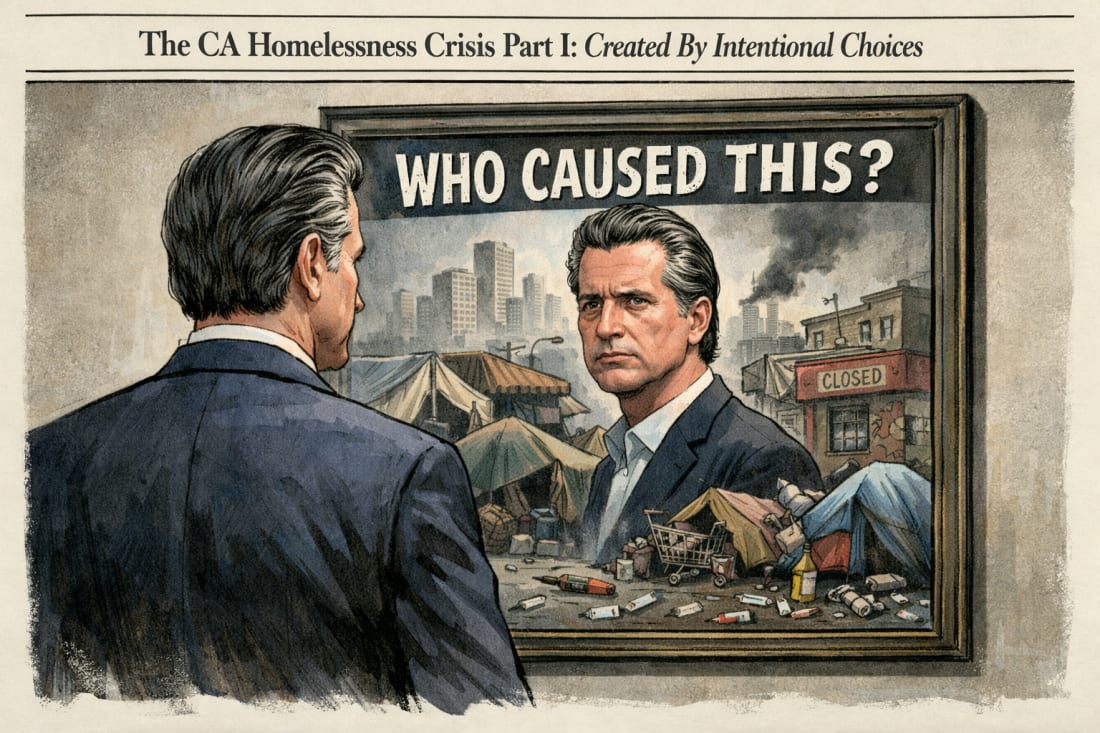
This crisis persists not because California lacks money or authority, but because the people in power refuse to abandon the policies that created it. The truth is that if they want to look for the cause of this state having the worst homelessness numbers in the country, they need to look in a mirror.
In Part Two, I will lay out a serious policy framework for reducing homelessness in California—one that focuses on prevention rather than permanent management. That means lowering the cost of living, restoring housing supply, reasserting public order, and rebuilding the private charitable safety net that progressive governance has steadily displaced.
You’re currently a free subscriber to So, Does It Matter? California Politics! For the full experience, upgrade your subscription. See how much more you get with an inexpensive, paid subscription, but clicking the button below! Support me in providing hard-hitting, clear-eyed analysis of California politics. I am beholding to no one, and sugar-coat nothing!
| ||||||||||

