
| From | Hudson in 5 <[email protected]> |
| Subject | China’s Arctic Push Threatens Greenland and North American Defense |
| Date | January 21, 2026 12:00 PM |
Links have been removed from this email. Learn more in the FAQ.
Links have been removed from this email. Learn more in the FAQ.
No images? Click here [link removed]
Hudson in 5
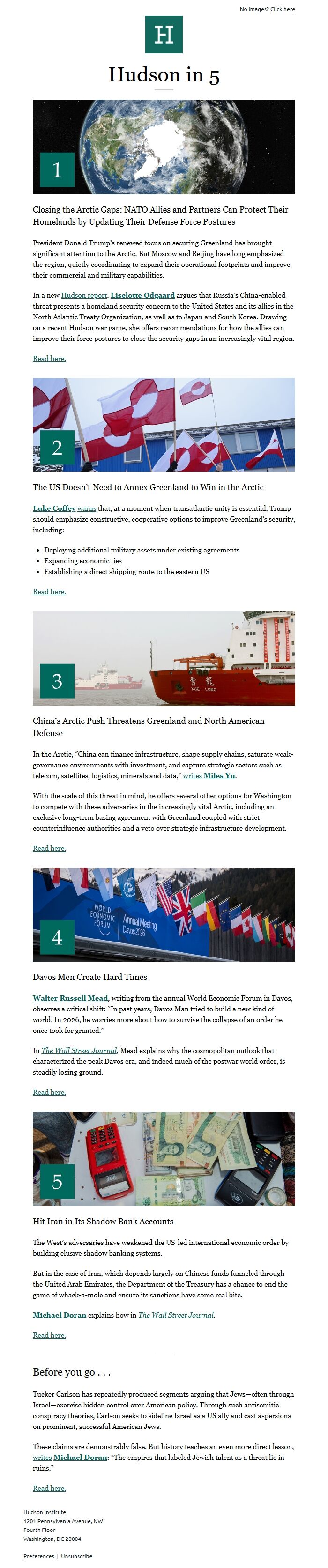
Closing the Arctic Gaps: NATO Allies and Partners Can Protect Their Homelands by Updating Their Defense Force Postures [[link removed]]
President Donald Trump’s renewed focus on securing Greenland has brought significant attention to the Arctic. But Moscow and Beijing have long emphasized the region, quietly coordinating to expand their operational footprints and improve their commercial and military capabilities.
In a new Hudson report [[link removed]], Liselotte Odgaard [[link removed]] argues that Russia’s China-enabled threat presents a homeland security concern to the United States and its allies in the North Atlantic Treaty Organization, as well as to Japan and South Korea. Drawing on a recent Hudson war game, she offers recommendations for how the allies can improve their force postures to close the security gaps in an increasingly vital region.
Read here. [[link removed]]
The US Doesn’t Need to Annex Greenland to Win in the Arctic [[link removed]]
Luke Coffey [[link removed]] warns [[link removed]] that, at a moment when transatlantic unity is essential, Trump should emphasize constructive, cooperative options to improve Greenland’s security, including:
Deploying additional military assets under existing agreementsExpanding economic tiesEstablishing a direct shipping route to the eastern US
Read here. [[link removed]]
China’s Arctic Push Threatens Greenland and North American Defense [[link removed]]
In the Arctic, “China can finance infrastructure, shape supply chains, saturate weak-governance environments with investment, and capture strategic sectors such as telecom, satellites, logistics, minerals and data,” writes [[link removed]] Miles Yu [[link removed]].
With the scale of this threat in mind, he offers several other options for Washington to compete with these adversaries in the increasingly vital Arctic, including an exclusive long-term basing agreement with Greenland coupled with strict counterinfluence authorities and a veto over strategic infrastructure development.
Read here. [[link removed]]
Davos Men Create Hard Times [[link removed]]
Walter Russell Mead [[link removed]], writing from the annual World Economic Forum in Davos, observes a critical shift: “In past years, Davos Man tried to build a new kind of world. In 2026, he worries more about how to survive the collapse of an order he once took for granted.”
In The Wall Street Journal [[link removed]], Mead explains why the cosmopolitan outlook that characterized the peak Davos era, and indeed much of the postwar world order, is steadily losing ground.
Read here. [[link removed]]
Hit Iran in Its Shadow Bank Accounts [[link removed]]
The West’s adversaries have weakened the US-led international economic order by building elusive shadow banking systems.
But in the case of Iran, which depends largely on Chinese funds funneled through the United Arab Emirates, the Department of the Treasury has a chance to end the game of whack-a-mole and ensure its sanctions have some real bite.
Michael Doran [[link removed]] explains how in The Wall Street Journal [[link removed]].
Read here. [[link removed]]
Before you go . . .
Tucker Carlson has repeatedly produced segments arguing that Jews—often through Israel—exercise hidden control over American policy. Through such antisemitic conspiracy theories, Carlson seeks to sideline Israel as a US ally and cast aspersions on prominent, successful American Jews.
These claims are demonstrably false. But history teaches an even more direct lesson, writes [[link removed]] Michael Doran [[link removed]]: “The empires that labeled Jewish talent as a threat lie in ruins.”
Read here. [[link removed]]
Hudson Institute
1201 Pennsylvania Avenue, NW
Fourth Floor
Washington, DC 20004
Preferences [link removed] | Unsubscribe [link removed]
Hudson in 5
Closing the Arctic Gaps: NATO Allies and Partners Can Protect Their Homelands by Updating Their Defense Force Postures [[link removed]]
President Donald Trump’s renewed focus on securing Greenland has brought significant attention to the Arctic. But Moscow and Beijing have long emphasized the region, quietly coordinating to expand their operational footprints and improve their commercial and military capabilities.
In a new Hudson report [[link removed]], Liselotte Odgaard [[link removed]] argues that Russia’s China-enabled threat presents a homeland security concern to the United States and its allies in the North Atlantic Treaty Organization, as well as to Japan and South Korea. Drawing on a recent Hudson war game, she offers recommendations for how the allies can improve their force postures to close the security gaps in an increasingly vital region.
Read here. [[link removed]]
The US Doesn’t Need to Annex Greenland to Win in the Arctic [[link removed]]
Luke Coffey [[link removed]] warns [[link removed]] that, at a moment when transatlantic unity is essential, Trump should emphasize constructive, cooperative options to improve Greenland’s security, including:
Deploying additional military assets under existing agreementsExpanding economic tiesEstablishing a direct shipping route to the eastern US
Read here. [[link removed]]
China’s Arctic Push Threatens Greenland and North American Defense [[link removed]]
In the Arctic, “China can finance infrastructure, shape supply chains, saturate weak-governance environments with investment, and capture strategic sectors such as telecom, satellites, logistics, minerals and data,” writes [[link removed]] Miles Yu [[link removed]].
With the scale of this threat in mind, he offers several other options for Washington to compete with these adversaries in the increasingly vital Arctic, including an exclusive long-term basing agreement with Greenland coupled with strict counterinfluence authorities and a veto over strategic infrastructure development.
Read here. [[link removed]]
Davos Men Create Hard Times [[link removed]]
Walter Russell Mead [[link removed]], writing from the annual World Economic Forum in Davos, observes a critical shift: “In past years, Davos Man tried to build a new kind of world. In 2026, he worries more about how to survive the collapse of an order he once took for granted.”
In The Wall Street Journal [[link removed]], Mead explains why the cosmopolitan outlook that characterized the peak Davos era, and indeed much of the postwar world order, is steadily losing ground.
Read here. [[link removed]]
Hit Iran in Its Shadow Bank Accounts [[link removed]]
The West’s adversaries have weakened the US-led international economic order by building elusive shadow banking systems.
But in the case of Iran, which depends largely on Chinese funds funneled through the United Arab Emirates, the Department of the Treasury has a chance to end the game of whack-a-mole and ensure its sanctions have some real bite.
Michael Doran [[link removed]] explains how in The Wall Street Journal [[link removed]].
Read here. [[link removed]]
Before you go . . .
Tucker Carlson has repeatedly produced segments arguing that Jews—often through Israel—exercise hidden control over American policy. Through such antisemitic conspiracy theories, Carlson seeks to sideline Israel as a US ally and cast aspersions on prominent, successful American Jews.
These claims are demonstrably false. But history teaches an even more direct lesson, writes [[link removed]] Michael Doran [[link removed]]: “The empires that labeled Jewish talent as a threat lie in ruins.”
Read here. [[link removed]]
Hudson Institute
1201 Pennsylvania Avenue, NW
Fourth Floor
Washington, DC 20004
Preferences [link removed] | Unsubscribe [link removed]
Message Analysis
- Sender: Hudson Institute
- Political Party: n/a
- Country: United States
- State/Locality: n/a
- Office: n/a
-
Email Providers:
- Campaign Monitor