
| From | Hudson Institute <[email protected]> |
| Subject | New Report: Fixing NATO’s Arctic Force Posture |
| Date | January 20, 2026 11:00 PM |
Links have been removed from this email. Learn more in the FAQ.
Links have been removed from this email. Learn more in the FAQ.
No images? Click here [link removed]
Closing the Arctic Gaps: NATO Allies and Partners Can Protect Their Homelands by Updating Their Defense Force Postures [[link removed]]
By Liselotte Odgaard [[link removed]]
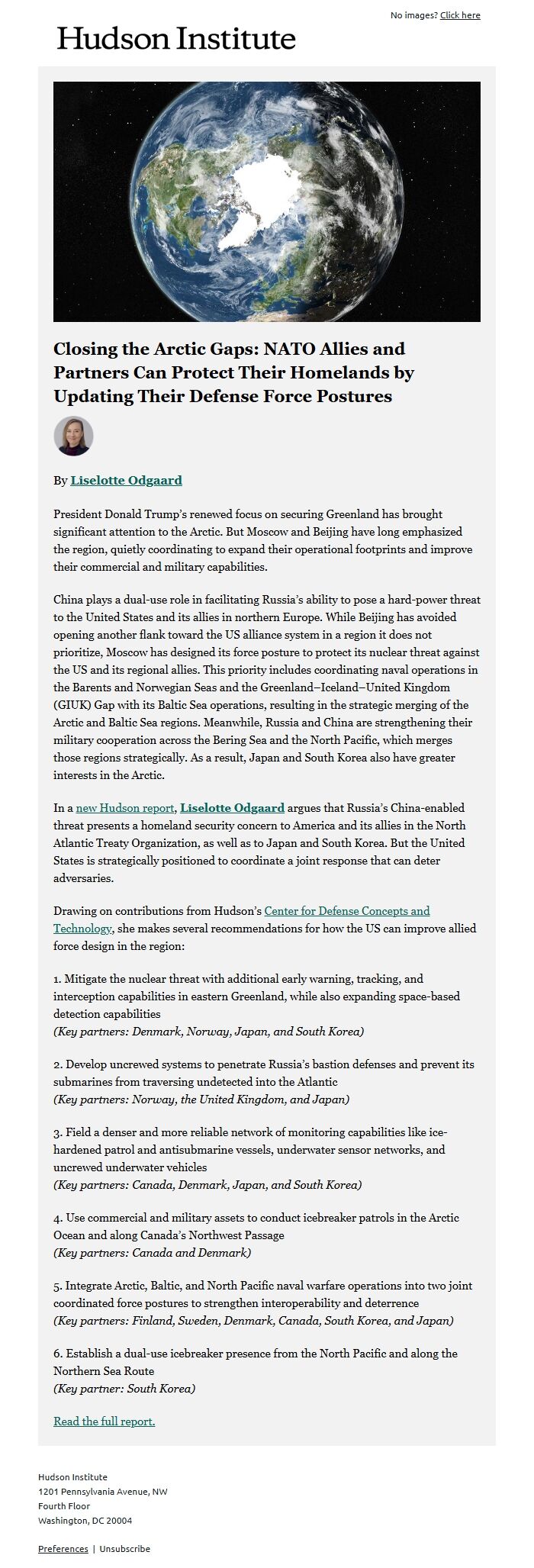
President Donald Trump’s renewed focus on securing Greenland has brought significant attention to the Arctic. But Moscow and Beijing have long emphasized the region, quietly coordinating to expand their operational footprints and improve their commercial and military capabilities.
China plays a dual-use role in facilitating Russia’s ability to pose a hard-power threat to the United States and its allies in northern Europe. While Beijing has avoided opening another flank toward the US alliance system in a region it does not prioritize, Moscow has designed its force posture to protect its nuclear threat against the US and its regional allies. This priority includes coordinating naval operations in the Barents and Norwegian Seas and the Greenland–Iceland–United Kingdom (GIUK) Gap with its Baltic Sea operations, resulting in the strategic merging of the Arctic and Baltic Sea regions. Meanwhile, Russia and China are strengthening their military cooperation across the Bering Sea and the North Pacific, which merges those regions strategically. As a result, Japan and South Korea also have greater interests in the Arctic.
In a new Hudson report [[link removed]], Liselotte Odgaard [[link removed]] argues that Russia’s China-enabled threat presents a homeland security concern to America and its allies in the North Atlantic Treaty Organization, as well as to Japan and South Korea. But the United States is strategically positioned to coordinate a joint response that can deter adversaries.
Drawing on contributions from Hudson’s Center for Defense Concepts and Technology [[link removed]], she makes several recommendations for how the US can improve allied force design in the region:
1. Mitigate the nuclear threat with additional early warning, tracking, and interception capabilities in eastern Greenland, while also expanding space-based detection capabilities
(Key partners: Denmark, Norway, Japan, and South Korea)
2. Develop uncrewed systems to penetrate Russia’s bastion defenses and prevent its submarines from traversing undetected into the Atlantic
(Key partners: Norway, the United Kingdom, and Japan)
3. Field a denser and more reliable network of monitoring capabilities like ice-hardened patrol and antisubmarine vessels, underwater sensor networks, and uncrewed underwater vehicles
(Key partners: Canada, Denmark, Japan, and South Korea)
4. Use commercial and military assets to conduct icebreaker patrols in the Arctic Ocean and along Canada’s Northwest Passage
(Key partners: Canada and Denmark)
5. Integrate Arctic, Baltic, and North Pacific naval warfare operations into two joint coordinated force postures to strengthen interoperability and deterrence
(Key partners: Finland, Sweden, Denmark, Canada, South Korea, and Japan)
6. Establish a dual-use icebreaker presence from the North Pacific and along the Northern Sea Route
(Key partner: South Korea)
Read the full report. [[link removed]]
Hudson Institute
1201 Pennsylvania Avenue, NW
Fourth Floor
Washington, DC 20004
Preferences [link removed] | Unsubscribe [link removed]
Closing the Arctic Gaps: NATO Allies and Partners Can Protect Their Homelands by Updating Their Defense Force Postures [[link removed]]
By Liselotte Odgaard [[link removed]]
President Donald Trump’s renewed focus on securing Greenland has brought significant attention to the Arctic. But Moscow and Beijing have long emphasized the region, quietly coordinating to expand their operational footprints and improve their commercial and military capabilities.
China plays a dual-use role in facilitating Russia’s ability to pose a hard-power threat to the United States and its allies in northern Europe. While Beijing has avoided opening another flank toward the US alliance system in a region it does not prioritize, Moscow has designed its force posture to protect its nuclear threat against the US and its regional allies. This priority includes coordinating naval operations in the Barents and Norwegian Seas and the Greenland–Iceland–United Kingdom (GIUK) Gap with its Baltic Sea operations, resulting in the strategic merging of the Arctic and Baltic Sea regions. Meanwhile, Russia and China are strengthening their military cooperation across the Bering Sea and the North Pacific, which merges those regions strategically. As a result, Japan and South Korea also have greater interests in the Arctic.
In a new Hudson report [[link removed]], Liselotte Odgaard [[link removed]] argues that Russia’s China-enabled threat presents a homeland security concern to America and its allies in the North Atlantic Treaty Organization, as well as to Japan and South Korea. But the United States is strategically positioned to coordinate a joint response that can deter adversaries.
Drawing on contributions from Hudson’s Center for Defense Concepts and Technology [[link removed]], she makes several recommendations for how the US can improve allied force design in the region:
1. Mitigate the nuclear threat with additional early warning, tracking, and interception capabilities in eastern Greenland, while also expanding space-based detection capabilities
(Key partners: Denmark, Norway, Japan, and South Korea)
2. Develop uncrewed systems to penetrate Russia’s bastion defenses and prevent its submarines from traversing undetected into the Atlantic
(Key partners: Norway, the United Kingdom, and Japan)
3. Field a denser and more reliable network of monitoring capabilities like ice-hardened patrol and antisubmarine vessels, underwater sensor networks, and uncrewed underwater vehicles
(Key partners: Canada, Denmark, Japan, and South Korea)
4. Use commercial and military assets to conduct icebreaker patrols in the Arctic Ocean and along Canada’s Northwest Passage
(Key partners: Canada and Denmark)
5. Integrate Arctic, Baltic, and North Pacific naval warfare operations into two joint coordinated force postures to strengthen interoperability and deterrence
(Key partners: Finland, Sweden, Denmark, Canada, South Korea, and Japan)
6. Establish a dual-use icebreaker presence from the North Pacific and along the Northern Sea Route
(Key partner: South Korea)
Read the full report. [[link removed]]
Hudson Institute
1201 Pennsylvania Avenue, NW
Fourth Floor
Washington, DC 20004
Preferences [link removed] | Unsubscribe [link removed]
Message Analysis
- Sender: Hudson Institute
- Political Party: n/a
- Country: United States
- State/Locality: n/a
- Office: n/a
-
Email Providers:
- Campaign Monitor