
Email
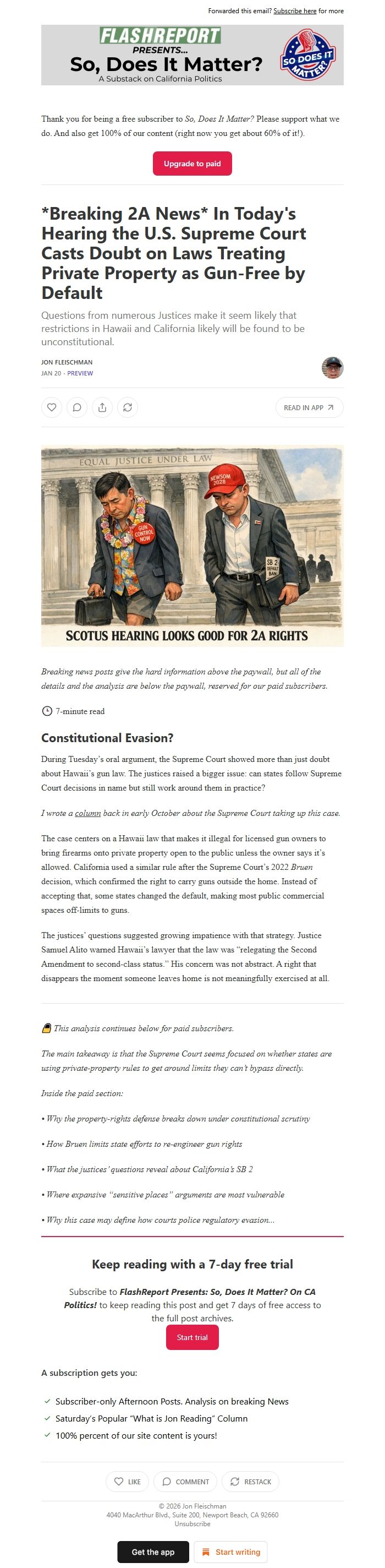
*Breaking 2A News* In Today's Hearing the U.S. Supreme Court Casts Doubt on Laws Treating Private Property as Gun-…
| From | FlashReport’s “So, Does It Matter?” <[email protected]> |
| Subject | *Breaking 2A News* In Today's Hearing the U.S. Supreme Court Casts Doubt on Laws Treating Private Property as Gun-… |
| Date | January 20, 2026 10:54 PM |
Links have been removed from this email. Learn more in the FAQ.
Links have been removed from this email. Learn more in the FAQ.
View this post on the web at [link removed]
Breaking news posts give the hard information above the paywall, but all of the details and the analysis are below the paywall, reserved for our paid subscribers.
🕒 7-minute read
Constitutional Evasion?
During Tuesday’s oral argument, the Supreme Court showed more than just doubt about Hawaii’s gun law. The justices raised a bigger issue: can states follow Supreme Court decisions in name but still work around them in practice?
I wrote a column [ [link removed] ] back in early October about the Supreme Court taking up this case.
The case centers on a Hawaii law that makes it illegal for licensed gun owners to bring firearms onto private property open to the public unless the owner says it’s allowed. California used a similar rule after the Supreme Court’s 2022 Bruen decision, which confirmed the right to carry guns outside the home. Instead of accepting that, some states changed the default, making most public commercial spaces off-limits to guns.
The justices’ questions suggested growing impatience with that strategy. Justice Samuel Alito warned Hawaii’s lawyer that the law was “relegating the Second Amendment to second-class status.” His concern was not abstract. A right that disappears the moment someone leaves home is not meaningfully exercised at all.
🔒 This analysis continues below for paid subscribers.
The main takeaway is that the Supreme Court seems focused on whether states are using private-property rules to get around limits they can’t bypass directly.
Inside the paid section:
• Why the property-rights defense breaks down under constitutional scrutiny
• How Bruen limits state efforts to re-engineer gun rights
• What the justices’ questions reveal about California’s SB 2
• Where expansive “sensitive places” arguments are most vulnerable
• Why this case may define how courts police regulatory evasion...
Unsubscribe [link removed]?
Breaking news posts give the hard information above the paywall, but all of the details and the analysis are below the paywall, reserved for our paid subscribers.
🕒 7-minute read
Constitutional Evasion?
During Tuesday’s oral argument, the Supreme Court showed more than just doubt about Hawaii’s gun law. The justices raised a bigger issue: can states follow Supreme Court decisions in name but still work around them in practice?
I wrote a column [ [link removed] ] back in early October about the Supreme Court taking up this case.
The case centers on a Hawaii law that makes it illegal for licensed gun owners to bring firearms onto private property open to the public unless the owner says it’s allowed. California used a similar rule after the Supreme Court’s 2022 Bruen decision, which confirmed the right to carry guns outside the home. Instead of accepting that, some states changed the default, making most public commercial spaces off-limits to guns.
The justices’ questions suggested growing impatience with that strategy. Justice Samuel Alito warned Hawaii’s lawyer that the law was “relegating the Second Amendment to second-class status.” His concern was not abstract. A right that disappears the moment someone leaves home is not meaningfully exercised at all.
🔒 This analysis continues below for paid subscribers.
The main takeaway is that the Supreme Court seems focused on whether states are using private-property rules to get around limits they can’t bypass directly.
Inside the paid section:
• Why the property-rights defense breaks down under constitutional scrutiny
• How Bruen limits state efforts to re-engineer gun rights
• What the justices’ questions reveal about California’s SB 2
• Where expansive “sensitive places” arguments are most vulnerable
• Why this case may define how courts police regulatory evasion...
Unsubscribe [link removed]?
Message Analysis
- Sender: n/a
- Political Party: n/a
- Country: n/a
- State/Locality: n/a
- Office: n/a