|
 |
A Tree, A Rope, America: Still Fighting For Dr. King's Dream
Why Trey Reed’s death forces America to reckon with its unfinished civil rights history
|


| |||||||||||||||


 |
 |
by Ellie Leonard, BAM Contributing Editor
I wrote this piece last fall in the wake of Trey Reed, found hanging from a tree at Delta State University in Mississippi. The story quietly went away, and we never found out if his death was investigated thoroughly or if the family had closure.
Trey’s story, and every story targeting people for race, ethnicity, culture, religion, and country of origin, before and since, is something we are supposed to learn from. All of us know Winston Churchill’s famous quote, “Those that fail to learn from history are doomed to repeat it,” but I often wonder what people learned from a history that may have benefitted them in the long run. Is it so much that we didn’t learn, or is it that we didn’t condemn it in the first place? Did white supremacists not learn? Did xenophobes and supporters of ICE on the streets of Minneapolis, ripping people from their cars, homes, and jobs, not learn? Or is it that they learned too much about their own power and influence? I don’t have the answer.
But for me, I knew that my power to be an ally, an activist, and a warrior for the people around me who continue to be targeted by Donald Trump’s white nationalist administration meant I needed to educate myself about the things I never learned in school. I needed to know about colonialism. I needed to understand the Native American boarding school system. I needed to learn about what really happened at Selma, and why, and the aftermath. It’s thousands of pages of history missed from my childhood education.
But I have time.
The following piece of history is an integral part of the Civil Rights Movement, and something most of us, in the North, at least, never learned in school. I hope it brings us one step closer to actual civil rights, human rights, and equality for all people.
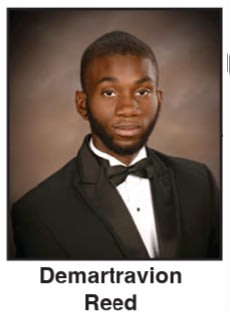
On September 15, 2025, Delta State University student Demartravion “Trey” Reed was discovered hanging from a tree near the pickleball courts on campus. While we don’t know the circumstances that led up to Trey’s death, we certainly shouldn’t be satisfied with “case closed” after decades of racial injustice that included over 4,000 lynchings of black men, women, and children, but also Mexicans, Italians, Chinese, and Native Americans.
The Panicked, Unpaid Writer is a reader-supported publication. To receive new posts and support my work, consider becoming a free or paid subscriber.
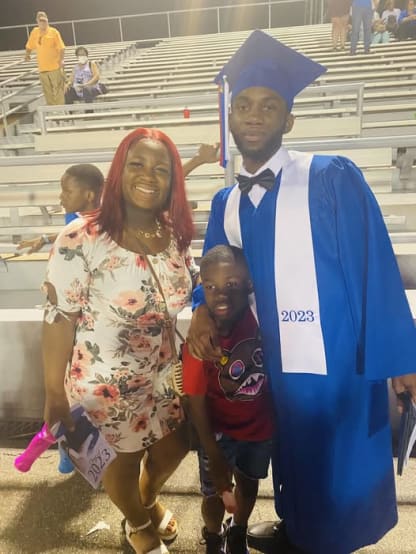
There is very little public information about Trey’s life prior to his death, other than he graduated from Grenada High School in Grenada, Mississippi, in 2023 with 235 of his classmates. He posted a picture of himself on his first day of college on August 20th, along with several quotes indicating relationship struggles.
“Lord protect the path I’m on & don’t let me quit for nothin.” - Trey Reed
“P R A Y, W A I T, & T R U S T.” - Trey Reed
 |
At this point, we don’t know what happened to Trey, but history doesn’t allow for complacency or obedience, not by the groups that were targeted, and (we hope) not by the groups who targeted them. We need to be asking questions about how this young man ended up hanging from a tree. In the meantime, the rest of us need to educate ourselves about the history of racial violence in the United States and the things we were never taught in school.
So today we’ll learn about the Tulsa Race Massacre, considered one of the worst incidents of racial violence in American history.
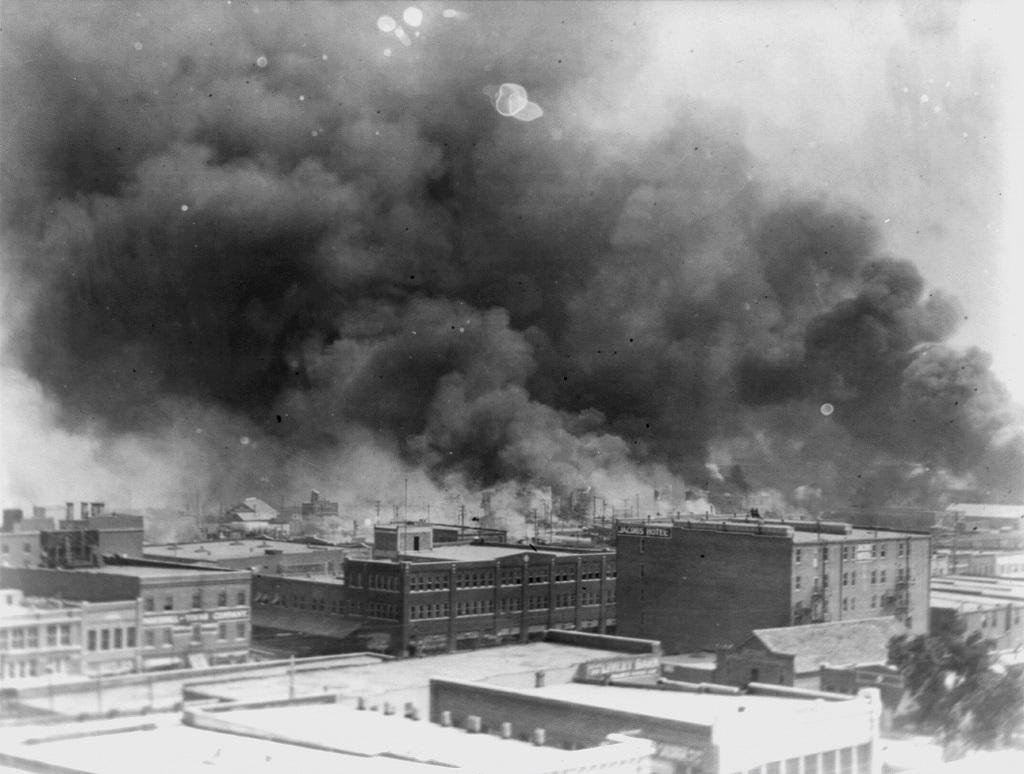 |
The Tulsa Race Massacre, or “race riot” took place between May 31st and June 1st, 1921, in the Greenwood District in Tulsa, Oklahoma, when white supremacist residents—some of whom worked for the police departments and city government—attacked black residents and destroyed their homes and businesses. When all was said and done, 36 people were dead, 800 were injured, 6000 black residents were displaced, and 35 square blocks were completely gone. A follow-up investigation in 2001 by the Tulsa Reparations Coalition estimated there could have been as many as 300 killed, due to hurried, undocumented burials.
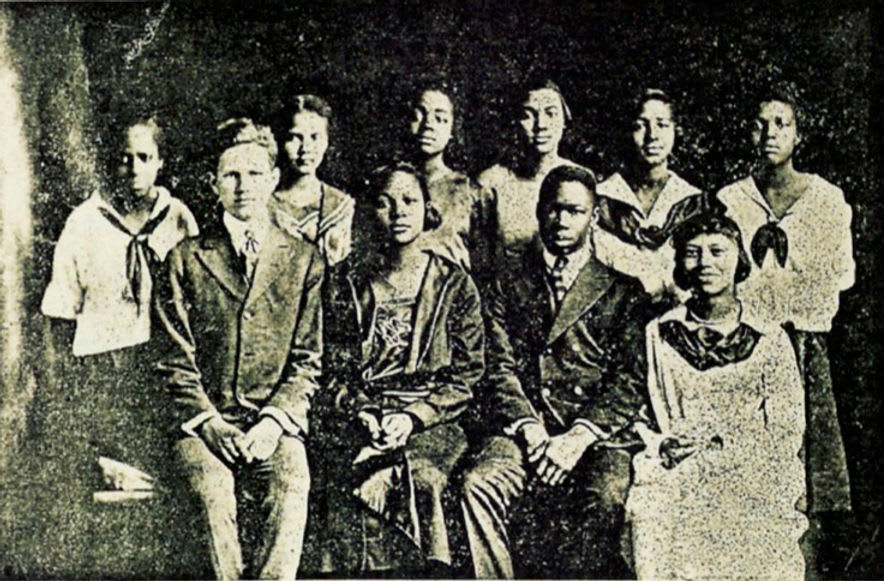 |
Like many tragic events in the history of racial injustice, the Tulsa Race Massacre began with the false accusation of a black man assaulting a white woman, in this case, 19-year-old Dick Rowland, a shoe shiner at the Main Street Shine Parlor, and 21-year-old elevator operator Sarah Page. When Rowland tripped entering the Drexel Building elevator to go up to use the segregated bathroom, a white store clerk reported the “attack” to authorities, crying rape. At the time, Tulsa was a Jim Crow city, and it was illegal for black residents to use white bathroom facilities. When Rowland tripped, he reached out and grabbed Page’s arm to steady himself. She screamed, and Rowland found himself cuffed and being led away by police officers.
 |
The Tulsa Tribune would later report that Rowland had torn Page’s clothes, and allegedly included the subtext “To Lynch Negro Tonight.” Rowland, however, was well-known by local officials, lawyers, and businessmen, from his work shining shoes, and most didn’t bat an eye.
“Why, I know that boy, and have known him a good while. That’s not in him.” - unknown customer
A mob of angry white men came to the courthouse, and rumors began to spread about a lynching. Sixty of Rowland’s supporters showed up, thinking he’d already been killed.
“I saw a car full of negroes driving through the streets with guns; I saw Bill McCullough and told him those negroes would cause trouble; McCullough tried to talk to them, and they got out and stood in single file. W. G. Daggs was killed near Boulder and Sixth street. I was under the impression that a man with authority could have stopped and disarmed them. I saw Chief of Police on south side of courthouse on top step, talking; I did not see any officer except the Chief; I walked in the court house and met McCullough in about 15 feet of his door; I told him these negroes were going to make trouble, and he said he had told them to go home; he went out and told the Whites to go home, and one said: “they said you told them to come up here.” McCullough said “I did not” and a negro said you did tell us to come.” - witness
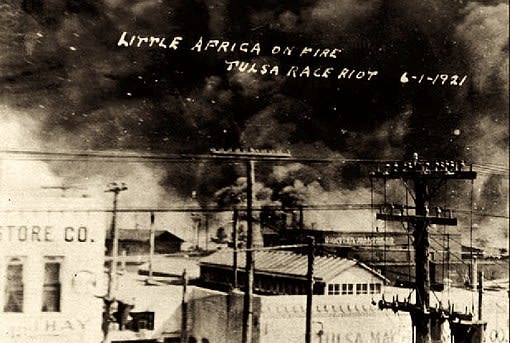
Sheriff McCullough promised to keep Rowland safe in jail from the now nearly 1000-person mob, and the black men turned to leave. He positioned six armed officers around the courthouse and shut down all the elevators, telling them to “shoot any intruders in sight.” But he couldn’t appease the angry mob outside, all white, and was “hooted down.” The crowd swelled to 2000. It wasn’t until an old white man approached O.B. Mann, a black World War I veteran, and tried to take his gun, that “all hell broke loose.” In all, 12 people were killed, 10 white and 2 black. News traveled quickly, and more white men showed up, chasing the black protestors back to Greenwood, where the mob started fires and even (allegedly) dropped firebombs from private airplanes owned by local residents.
 |
In the middle of the chaos, members of the mob were deputized by a police officer and instructed to “get a gun and get a nigger.” Tulsa’s co-founder and KKK member, W. Tate Brad,y participated as a night watchman. He’d previously led the Tulsa Outrage, which tarred and feathered members of the Industrial Workers of the World in World War I.
By the next morning, men lay dead, strewn about the streets, and the stores left standing had been looted. The Oklahoma National Guard imposed martial law, and the massacre came to an end. $2.25 million in real estate and personal property was gone, equivalent to nearly $41 million in 2025, and 10,000 black men, women, and children were homeless. In all, 1256 houses burned, destroying “Black Wall Street,” one of the wealthiest black communities in the United States. Some chose to leave, others to rebuild, but the city didn’t compensate them for their loss, and the story disappeared from the record books.
 |
It wouldn’t be until 2001 that the Oklahoma Commission to Study the Tulsa Race Riot of 1921 would publish its final report and recommend reparations to the descendants of the survivors. There is no written statement from Sarah Page, and she never pressed charges against Dick Rowland, whose case was dropped
 |
.
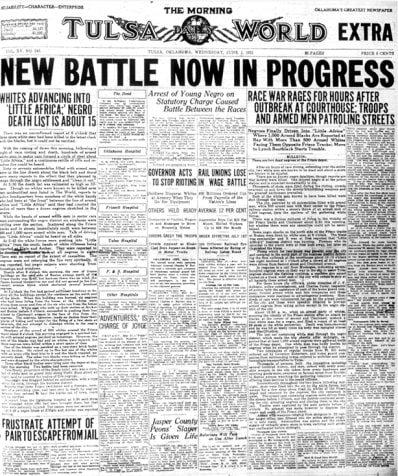 |
The Morning Tulsa Daily World listed the leader of the black rioters, Will Robinson, as “a dope peddler and all-around bad negro,” and said the rest of them were “former servicemen who had an exaggerated idea of their importance... They did not belong here, had no regular employment, and were simply a floating element with seemingly no ambition in life but to foment trouble.”
Starting in 2002, Oklahoma was required to teach students about the massacre, and in 2020 officially developed a curriculum based on the history. However, Project 2025 is going after any curriculum that covers Critical Race Theory (CRT), or the concept that racism is “deeply woven into the fabric of American institutions and policies,” and this likely will reverse any previous requirements to study Tulsa’s history of segregation and racism.
 |
These were the things I, at least, was not taught in 13 years of public school, and 4 years of higher education. But these are the stories that tell us to keep asking questions when a 21-year-old black man is found hanging from a tree in the State of Mississippi, which, according to the NAACP, held the record for the highest number of lynchings in any state from 1882 to 1968. It’s why we shouldn’t take “no” for an answer, why we shouldn’t believe in a “closed case” that took less than a day, and why we should demand that law enforcement be held accountable.
But sadly, the best-case scenario is that Trey was sad and didn’t ask for help. Is that something I hope for? Feels odd. But maybe so. Because so much of our life, our beliefs, our laws, social mores, dynamics, our love-thy-neighbors, has gone full-throttle in reverse since at least January 20th of this 2025.
And I hope to God this isn’t another sign of things to come.
 |
You're currently a free subscriber to Blue Amp Media. For the full experience, upgrade your subscription.
| ||||||||||

