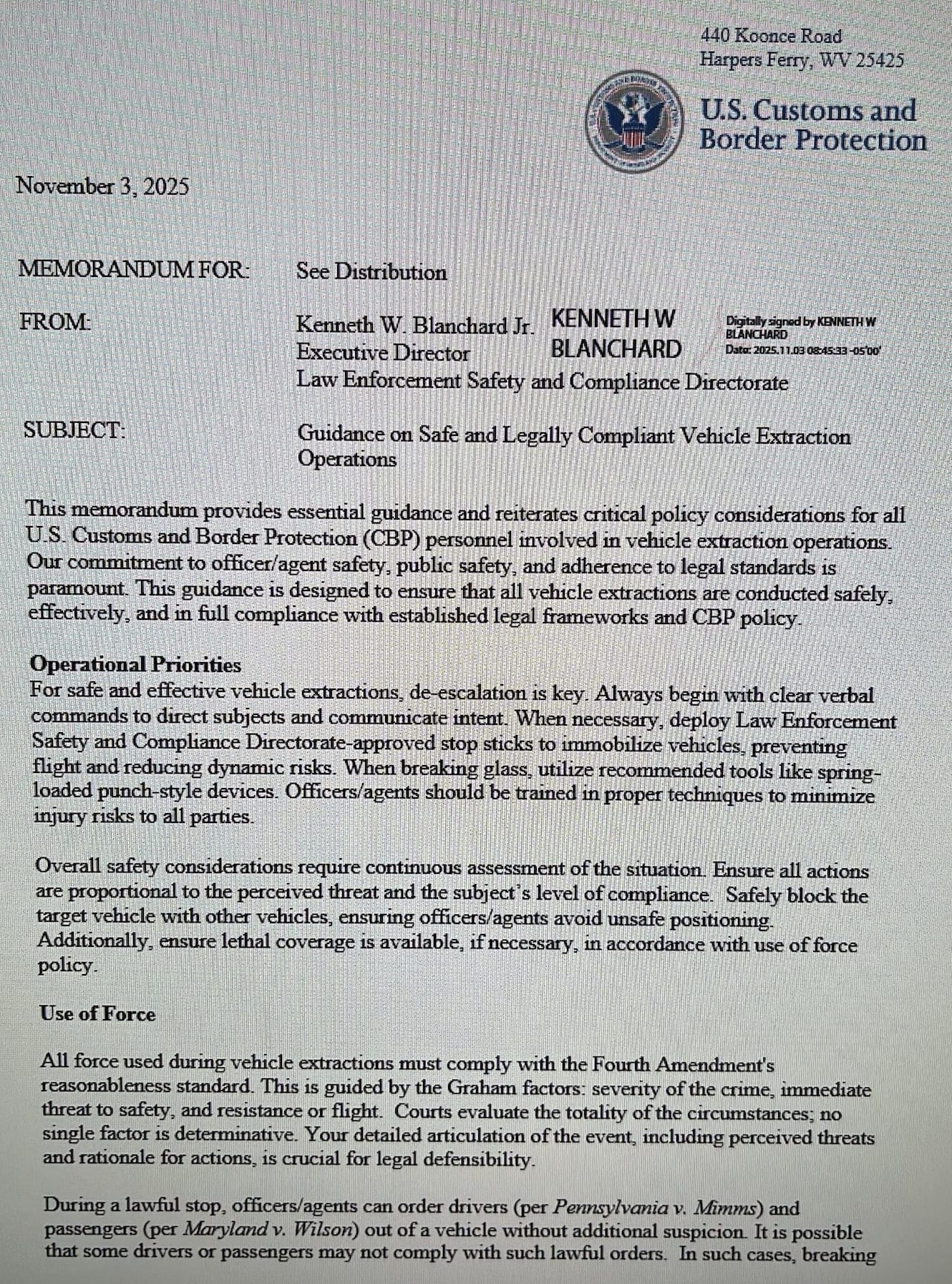
Weeks before an ICE agent shot Renee Good dead in Minneapolis, the Department of Homeland Security in Washington warned about the dangers of confronting suspects in vehicles, according to a November memo leaked to me.
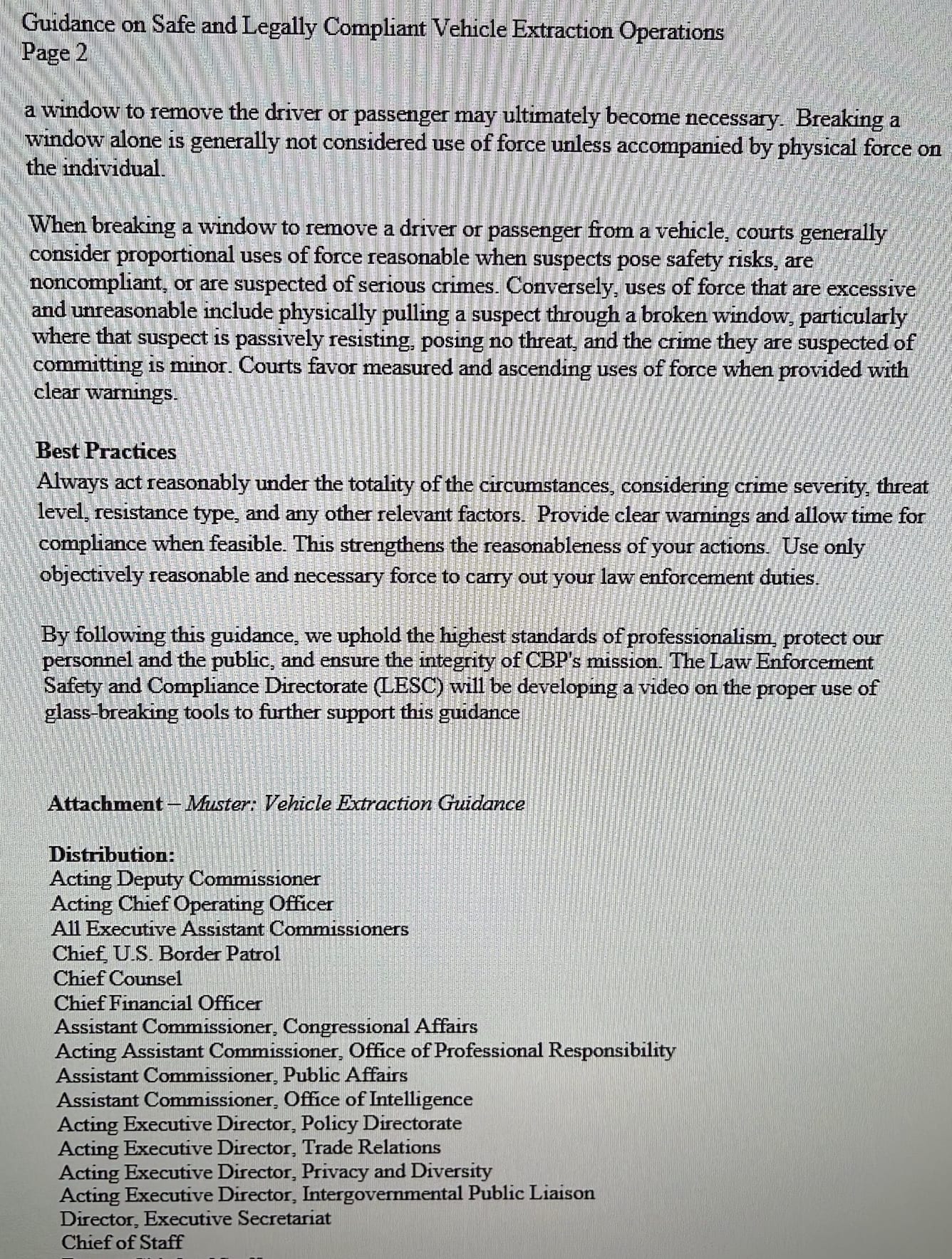
“For safe and effective vehicle extractions, de-escalation is key,” cautioned an internal Customs and Border Patrol guidance, signed by the head of the agency’s compliance directorate. Titled “Guidance on Safe and Legally Compliant Vehicle Extraction Operations,” the memo is referring to the same operation at the heart of the Renee Good killing: a vehicle extraction operation. That’s what the ICE agents were trying to carry out and why they approached her vehicle in the first place, with one agent even reaching through the window and grabbing the car door.
The term vehicle extraction normally refers to rescuing trapped occupants from a damaged vehicle. But DHS has its own belligerent definition: forcibly removing a suspect from their vehicle. To bolster its view that protestors are “weaponizing” vehicles, the Department has spun itself into crisis and confrontation mode, a contributing factor in Good’s death and the spate of other incidents where federal law enforcement agents and officers have attempted vehicle extractions.
(I’ve looked around and astoundingly, homeland security has no formal definition or policy for vehicle extraction. So much for “training” its officers on dangerous situations it might face. In her hasty press conference following Good’s death, Secretary Kristi Noem justified the shooting by claiming: “Our officer followed his training, did exactly what he’s been taught to do in that situation.”)
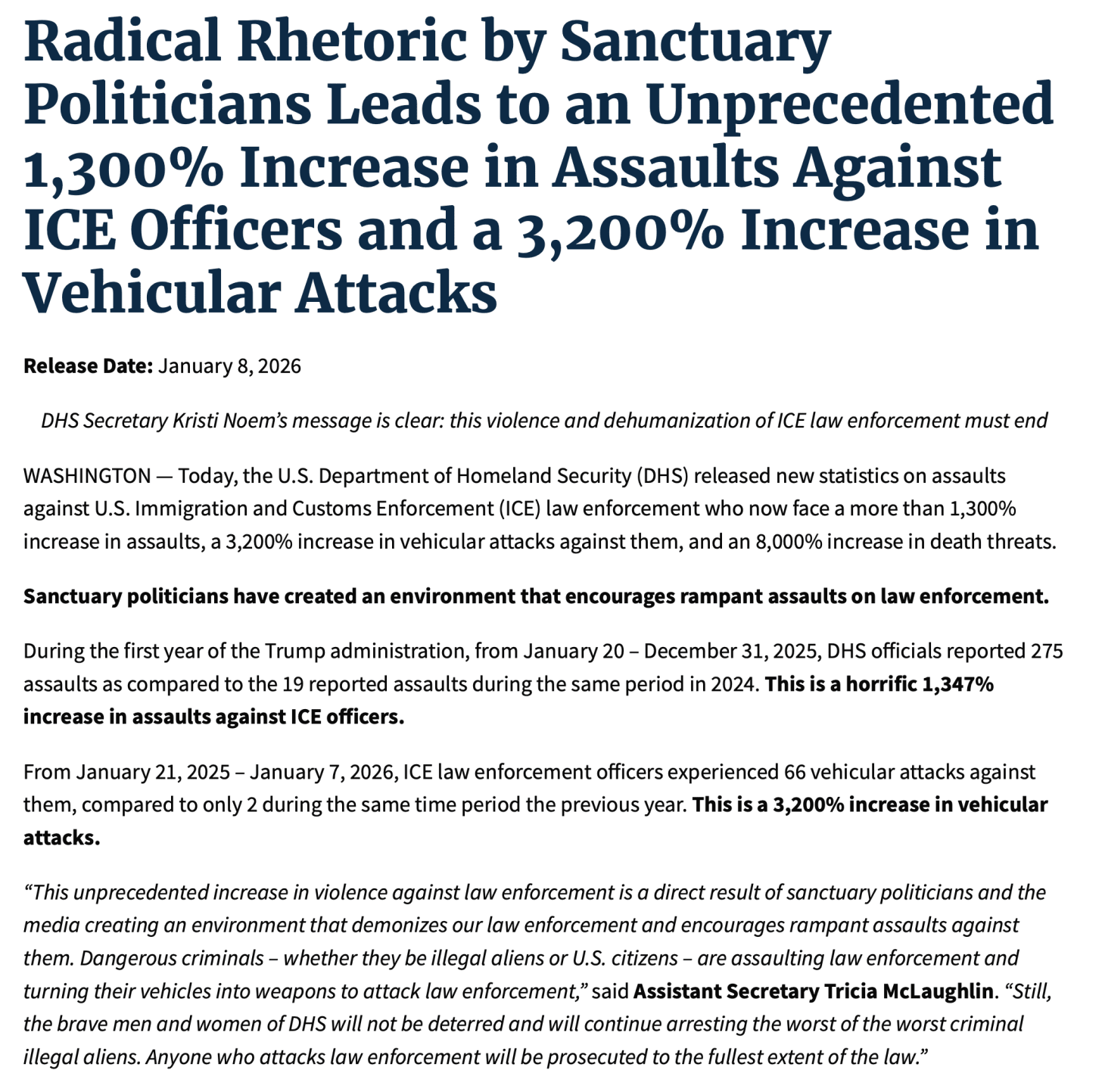
To understand homeland security’s frenzy about vehicles, one does not have to look very deep. Just a day after Good’s death, DHS shot off a fiery press release about the vehicle threat to its law enforcement officers. It alleges a “3,200% increase in vehicular attacks” over the past year.
“Dangerous criminals … are turning their vehicles into weapons to attack ICE and CBP,” declared another homeland security press release from late last year, adding that “DHS will not be deterred,” striking a defiant tone.
Despite this swaggering rhetoric, in private, sources tell me that immigration authorities have been worried for some time about officer and public safety in vehicle extractions and were aware that something like the Good shooting was likely to happen eventually. Done incorrectly, the leaked memo suggests, vehicle extractions are a dangerous practice.
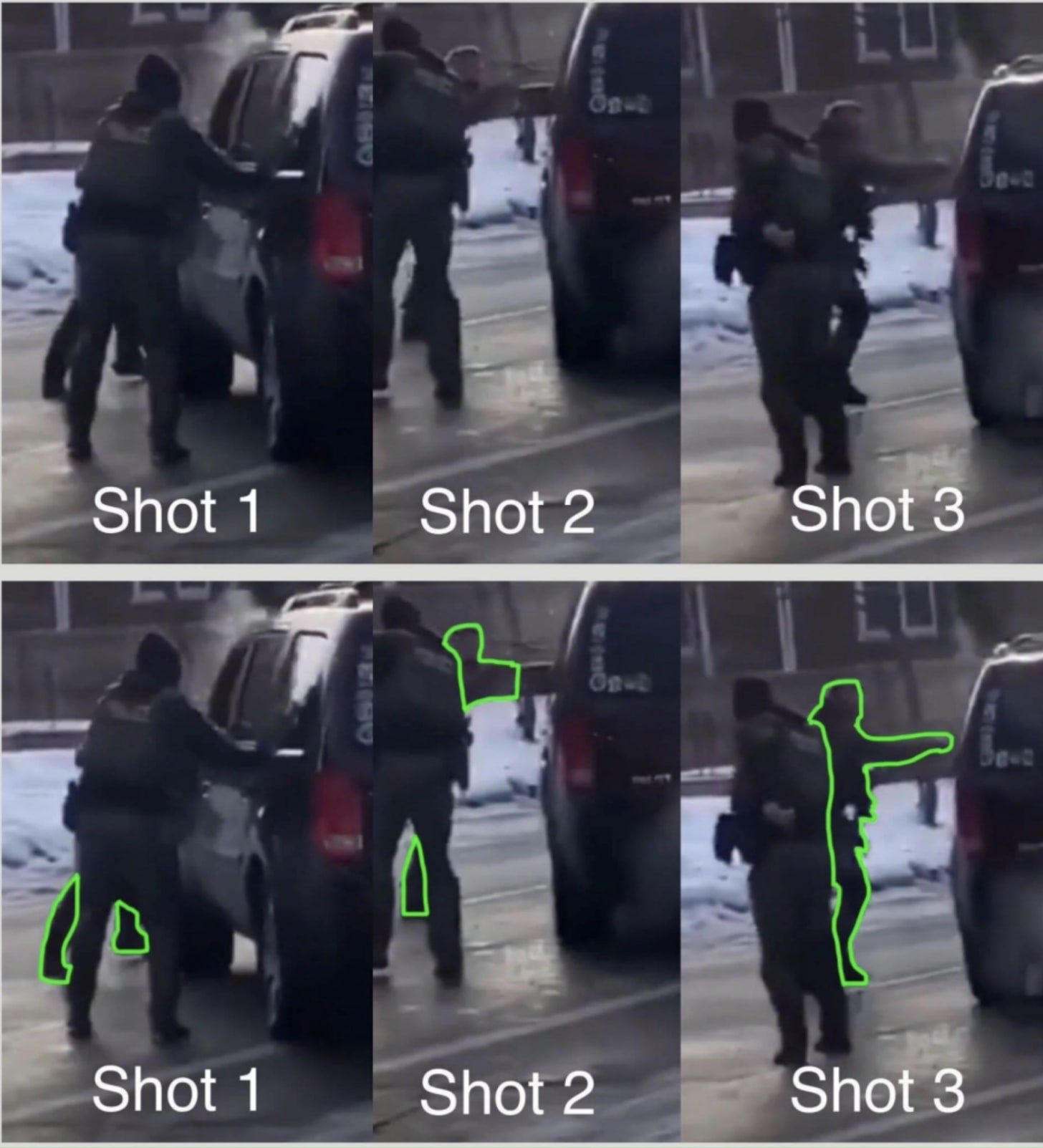
Had the ICE agent, Jonathan Ross, heeded this kind of advice, Good would still be alive today. The guidance specifically instructs officers to avoid “unsafe positioning” near other vehicles. Ross did not do this, having stepped out in front of Good’s car — the whole basis for the administration’s claims that he was acting in necessary self-defense. (See for yourself in the frames below, with Ross highlighted for visibility.)
ICE Agent Jonathan Ross highlighted
Now compare what Ross did to homeland security’s guidance memo, which instructs officers: “Safely block the target vehicle with other vehicles, ensuring officers/agents avoid unsafe positioning.”
That Ross did not heed this doesn’t mean he’ll be arrested or even found responsible. ICE’s use of force policy all but rubber stamps the killing, as I’ve written.
But instead of any sort of introspection about what went wrong here and how it can be prevented from happening again, homeland security political leadership is dumping rhetorical gasoline on the already combustible situation.
“These vehicle rammings are domestic acts of terrorism,” Noem said on the day of Good’s death.
Then a day after Good’s death, homeland’s assistant secretary Tricia McLaughlin issued a press release, blaming “sanctuary politicians” and “the media” for encouraging violent attacks on ICE.
“This unprecedented increase in violence against law enforcement is a direct result of sanctuary politicians and the media creating an environment that demonizes our law enforcement and encourages rampant assaults against them,” McLaughlin said.
Minneapolis Police Chief Brian O’Hara has a different view, that “in law enforcement, you know, we expect our officers to be training and trying to do everything they can to de-escalate situations and avoid the use of force and certainly avoid the use — the loss of human life whenever possible.”
More than training and guidance, though, the real problem is that ICE is acting like they’re at war because many of them have been told they are and believe it.
ICE is at war with America. So it any surprise they see cars as weapons?
Ken Klippenstein is an American journalist who previously worked at The Intercept before announcing his decision to go independent, believing the move necessary in order to report critically on national security. Soon after going independent, Klippenstein published the JD Vance Dossier, a hacked document numerous major media organizations — the very ecosystem he just left — refused to publish. Before The Intercept, Klippenstein was The Nation magazine's DC correspondent. He lives in Madison, Wisconsin.
KlipNews is an American news organization dedicated to revealing what the national security state is actually up to. Founded in 2024 by corporate media defectors Ken Klippenstein and William M. Arkin, KlipNews is a response to the utter failure of the major media to tell the truth about the national security state's creeping influence — even as it fails to make us any safer. Subscribe to get regular updates and to support the work of KlipNews.