
| From | Editors, Earth Island Journal <[email protected]> |
| Subject | Her Terrain |
| Date | January 17, 2026 12:45 AM |
Links have been removed from this email. Learn more in the FAQ.
Links have been removed from this email. Learn more in the FAQ.
An all-women ranger team is tackling poachers and patriarchy within Kenya’s Maasai community.
Is this email difficult to read? View in your web browser. ([link removed])
News of the world environment
NEWSLETTER | JANUARY 16, 2026
([link removed])
([link removed])
([link removed])
Her Terrain
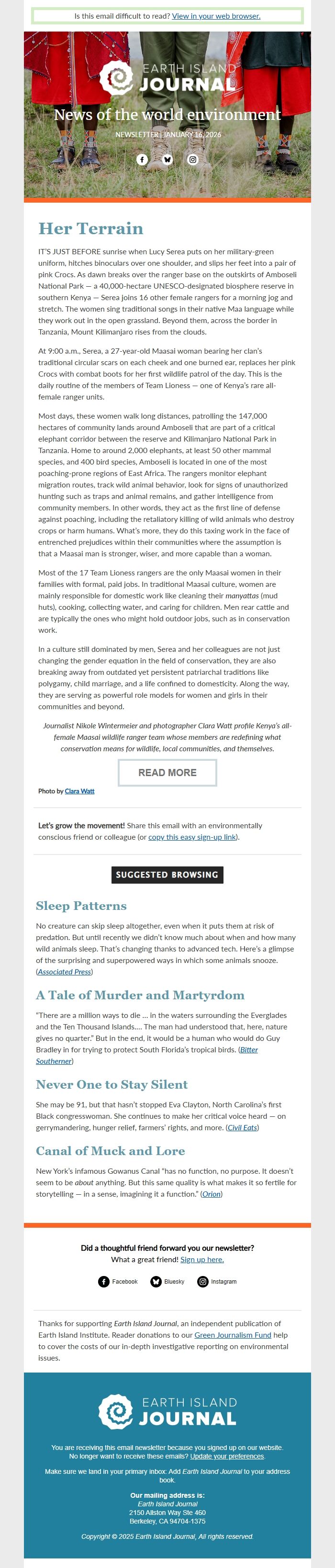
IT’S JUST BEFORE sunrise when Lucy Serea puts on her military-green uniform, hitches binoculars over one shoulder, and slips her feet into a pair of pink Crocs. As dawn breaks over the ranger base on the outskirts of Amboseli National Park — a 40,000-hectare UNESCO-designated biosphere reserve in southern Kenya — Serea joins 16 other female rangers for a morning jog and stretch. The women sing traditional songs in their native Maa language while they work out in the open grassland. Beyond them, across the border in Tanzania, Mount Kilimanjaro rises from the clouds.
At 9:00 a.m., Serea, a 27-year-old Maasai woman bearing her clan’s traditional circular scars on each cheek and one burned ear, replaces her pink Crocs with combat boots for her first wildlife patrol of the day. This is the daily routine of the members of Team Lioness — one of Kenya’s rare all-female ranger units.
Most days, these women walk long distances, patrolling the 147,000 hectares of community lands around Amboseli that are part of a critical elephant corridor between the reserve and Kilimanjaro National Park in Tanzania. Home to around 2,000 elephants, at least 50 other mammal species, and 400 bird species, Amboseli is located in one of the most poaching-prone regions of East Africa. The rangers monitor elephant migration routes, track wild animal behavior, look for signs of unauthorized hunting such as traps and animal remains, and gather intelligence from community members. In other words, they act as the first line of defense against poaching, including the retaliatory killing of wild animals who destroy crops or harm humans. What’s more, they do this taxing work in the face of entrenched prejudices within their communities where the assumption is that a Maasai man is stronger, wiser, and more capable than a woman.
Most of the 17 Team Lioness rangers are the only Maasai women in their families with formal, paid jobs. In traditional Maasai culture, women are mainly responsible for domestic work like cleaning their manyattas (mud huts), cooking, collecting water, and caring for children. Men rear cattle and are typically the ones who might hold outdoor jobs, such as in conservation work.
In a culture still dominated by men, Serea and her colleagues are not just changing the gender equation in the field of conservation, they are also breaking away from outdated yet persistent patriarchal traditions like polygamy, child marriage, and a life confined to domesticity. Along the way, they are serving as powerful role models for women and girls in their communities and beyond.
Journalist Nikole Wintermeier and photographer Clara Watt profile Kenya’s all-female Maasai wildlife ranger team whose members are redefining what conservation means for wildlife, local communities, and themselves.
READ MORE ([link removed])
Photo by Clara Watt ([link removed])
Let’s grow the movement! Share this email with an environmentally conscious friend or colleague (or copy this easy sign-up link ([link removed])).
SUGGESTED BROWSING ()
Sleep Patterns ([link removed])
No creature can skip sleep altogether, even when it puts them at risk of predation. But until recently we didn’t know much about when and how many wild animals sleep. That’s changing thanks to advanced tech. Here’s a glimpse of the surprising and superpowered ways in which some animals snooze. (Associated Press ([link removed]))
A Tale of Murder and Martyrdom ([link removed])
“There are a million ways to die … in the waters surrounding the Everglades and the Ten Thousand Islands.… The man had understood that, here, nature gives no quarter.” But in the end, it would be a human who would do Guy Bradley in for trying to protect South Florida’s tropical birds. (Bitter Southerner ([link removed]?))
Never One to Stay Silent ([link removed])
She may be 91, but that hasn’t stopped Eva Clayton, North Carolina’s first Black congresswoman. She continues to make her critical voice heard — on gerrymandering, hunger relief, farmers’ rights, and more. (Civil Eats ([link removed]))
Canal of Muck and Lore ([link removed])
New York’s infamous Gowanus Canal “has no function, no purpose. It doesn’t seem to be about anything. But this same quality is what makes it so fertile for storytelling — in a sense, imagining it a function.” (Orion ([link removed]))
Did a thoughtful friend forward you our newsletter?
What a great friend! Sign up here. ([link removed])
([link removed])
Facebook ([link removed])
([link removed])
Bluesky ([link removed])
([link removed])
Instagram ([link removed])
Thanks for supporting Earth Island Journal, an independent publication of Earth Island Institute. Reader donations to our Green Journalism Fund ([link removed]) help to cover the costs of our in-depth investigative reporting on environmental issues.
([link removed])
You are receiving this email newsletter because you signed up on our website.
No longer want to receive these emails? Update your preferences ([link removed]).
Make sure we land in your primary inbox: Add Earth Island Journal to your address book.
Our mailing address is:
Earth Island Journal
2150 Allston Way Ste 460
Berkeley, CA 94704-1375
Copyright © 2025 Earth Island Journal, All rights reserved.
Is this email difficult to read? View in your web browser. ([link removed])
News of the world environment
NEWSLETTER | JANUARY 16, 2026
([link removed])
([link removed])
([link removed])
Her Terrain
IT’S JUST BEFORE sunrise when Lucy Serea puts on her military-green uniform, hitches binoculars over one shoulder, and slips her feet into a pair of pink Crocs. As dawn breaks over the ranger base on the outskirts of Amboseli National Park — a 40,000-hectare UNESCO-designated biosphere reserve in southern Kenya — Serea joins 16 other female rangers for a morning jog and stretch. The women sing traditional songs in their native Maa language while they work out in the open grassland. Beyond them, across the border in Tanzania, Mount Kilimanjaro rises from the clouds.
At 9:00 a.m., Serea, a 27-year-old Maasai woman bearing her clan’s traditional circular scars on each cheek and one burned ear, replaces her pink Crocs with combat boots for her first wildlife patrol of the day. This is the daily routine of the members of Team Lioness — one of Kenya’s rare all-female ranger units.
Most days, these women walk long distances, patrolling the 147,000 hectares of community lands around Amboseli that are part of a critical elephant corridor between the reserve and Kilimanjaro National Park in Tanzania. Home to around 2,000 elephants, at least 50 other mammal species, and 400 bird species, Amboseli is located in one of the most poaching-prone regions of East Africa. The rangers monitor elephant migration routes, track wild animal behavior, look for signs of unauthorized hunting such as traps and animal remains, and gather intelligence from community members. In other words, they act as the first line of defense against poaching, including the retaliatory killing of wild animals who destroy crops or harm humans. What’s more, they do this taxing work in the face of entrenched prejudices within their communities where the assumption is that a Maasai man is stronger, wiser, and more capable than a woman.
Most of the 17 Team Lioness rangers are the only Maasai women in their families with formal, paid jobs. In traditional Maasai culture, women are mainly responsible for domestic work like cleaning their manyattas (mud huts), cooking, collecting water, and caring for children. Men rear cattle and are typically the ones who might hold outdoor jobs, such as in conservation work.
In a culture still dominated by men, Serea and her colleagues are not just changing the gender equation in the field of conservation, they are also breaking away from outdated yet persistent patriarchal traditions like polygamy, child marriage, and a life confined to domesticity. Along the way, they are serving as powerful role models for women and girls in their communities and beyond.
Journalist Nikole Wintermeier and photographer Clara Watt profile Kenya’s all-female Maasai wildlife ranger team whose members are redefining what conservation means for wildlife, local communities, and themselves.
READ MORE ([link removed])
Photo by Clara Watt ([link removed])
Let’s grow the movement! Share this email with an environmentally conscious friend or colleague (or copy this easy sign-up link ([link removed])).
SUGGESTED BROWSING ()
Sleep Patterns ([link removed])
No creature can skip sleep altogether, even when it puts them at risk of predation. But until recently we didn’t know much about when and how many wild animals sleep. That’s changing thanks to advanced tech. Here’s a glimpse of the surprising and superpowered ways in which some animals snooze. (Associated Press ([link removed]))
A Tale of Murder and Martyrdom ([link removed])
“There are a million ways to die … in the waters surrounding the Everglades and the Ten Thousand Islands.… The man had understood that, here, nature gives no quarter.” But in the end, it would be a human who would do Guy Bradley in for trying to protect South Florida’s tropical birds. (Bitter Southerner ([link removed]?))
Never One to Stay Silent ([link removed])
She may be 91, but that hasn’t stopped Eva Clayton, North Carolina’s first Black congresswoman. She continues to make her critical voice heard — on gerrymandering, hunger relief, farmers’ rights, and more. (Civil Eats ([link removed]))
Canal of Muck and Lore ([link removed])
New York’s infamous Gowanus Canal “has no function, no purpose. It doesn’t seem to be about anything. But this same quality is what makes it so fertile for storytelling — in a sense, imagining it a function.” (Orion ([link removed]))
Did a thoughtful friend forward you our newsletter?
What a great friend! Sign up here. ([link removed])
([link removed])
Facebook ([link removed])
([link removed])
Bluesky ([link removed])
([link removed])
Instagram ([link removed])
Thanks for supporting Earth Island Journal, an independent publication of Earth Island Institute. Reader donations to our Green Journalism Fund ([link removed]) help to cover the costs of our in-depth investigative reporting on environmental issues.
([link removed])
You are receiving this email newsletter because you signed up on our website.
No longer want to receive these emails? Update your preferences ([link removed]).
Make sure we land in your primary inbox: Add Earth Island Journal to your address book.
Our mailing address is:
Earth Island Journal
2150 Allston Way Ste 460
Berkeley, CA 94704-1375
Copyright © 2025 Earth Island Journal, All rights reserved.
Message Analysis
- Sender: Earth Island
- Political Party: n/a
- Country: United States
- State/Locality: n/a
- Office: n/a