
| From | Dr. Joe Sakran <[email protected]> |
| Subject | If we lose the commitment to treat the injured, we lose something essential. |
| Date | January 16, 2026 8:30 PM |
Links have been removed from this email. Learn more in the FAQ.
Links have been removed from this email. Learn more in the FAQ.
Friend, [[link removed]]
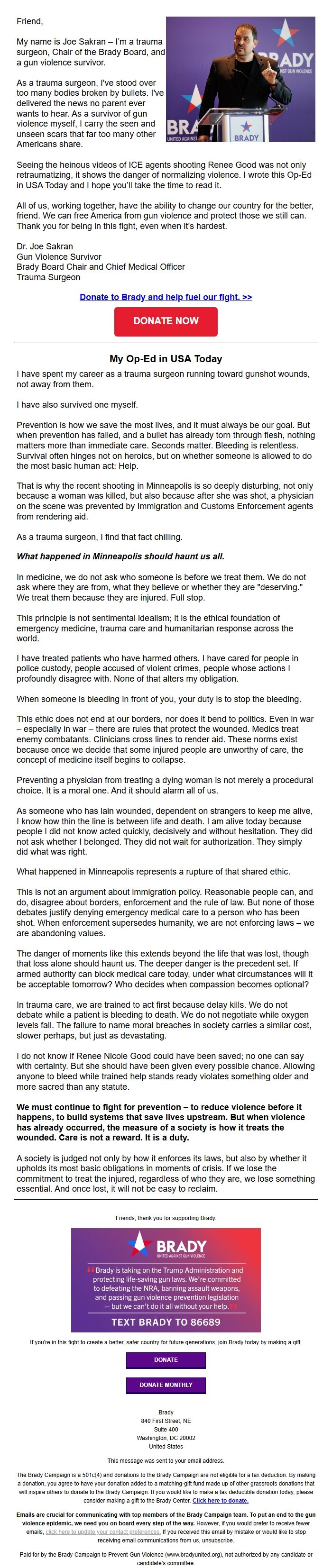
My name is Joe Sakran – I’m a trauma surgeon, Chair of the Brady Board, and a gun violence survivor.
As a trauma surgeon, I've stood over too many bodies broken by bullets. I've delivered the news no parent ever wants to hear. As a survivor of gun violence myself, I carry the seen and unseen scars that far too many other Americans share.
Seeing the heinous videos of ICE agents shooting Renee Good was not only retraumatizing, it shows the danger of normalizing violence. I wrote this Op-Ed in USA Today and I hope you’ll take the time to read it.
All of us, working together, have the ability to change our country for the better, friend. We can free America from gun violence and protect those we still can. Thank you for being in this fight, even when it’s hardest.
Dr. Joe Sakran
Gun Violence Survivor
Brady Board Chair and Chief Medical Officer
Trauma Surgeon
Donate to Brady and help fuel our fight. >> [[link removed]]
DONATE NOW [[link removed]]
My Op-Ed in USA Today
I have spent my career as a trauma surgeon running toward gunshot wounds, not away from them.
I have also survived one myself.
Prevention is how we save the most lives, and it must always be our goal. But when prevention has failed, and a bullet has already torn through flesh, nothing matters more than immediate care. Seconds matter. Bleeding is relentless. Survival often hinges not on heroics, but on whether someone is allowed to do the most basic human act: Help.
That is why the recent shooting in Minneapolis is so deeply disturbing, not only because a woman was killed, but also because after she was shot, a physician on the scene was prevented by Immigration and Customs Enforcement agents from rendering aid.
As a trauma surgeon, I find that fact chilling.
What happened in Minneapolis should haunt us all.
In medicine, we do not ask who someone is before we treat them. We do not ask where they are from, what they believe or whether they are "deserving." We treat them because they are injured. Full stop.
This principle is not sentimental idealism; it is the ethical foundation of emergency medicine, trauma care and humanitarian response across the world.
I have treated patients who have harmed others. I have cared for people in police custody, people accused of violent crimes, people whose actions I profoundly disagree with. None of that alters my obligation.
When someone is bleeding in front of you, your duty is to stop the bleeding.
This ethic does not end at our borders, nor does it bend to politics. Even in war – especially in war – there are rules that protect the wounded. Medics treat enemy combatants. Clinicians cross lines to render aid. These norms exist because once we decide that some injured people are unworthy of care, the concept of medicine itself begins to collapse.
Preventing a physician from treating a dying woman is not merely a procedural choice. It is a moral one. And it should alarm all of us.
As someone who has lain wounded, dependent on strangers to keep me alive, I know how thin the line is between life and death. I am alive today because people I did not know acted quickly, decisively and without hesitation. They did not ask whether I belonged. They did not wait for authorization. They simply did what was right.
What happened in Minneapolis represents a rupture of that shared ethic.
This is not an argument about immigration policy. Reasonable people can, and do, disagree about borders, enforcement and the rule of law. But none of those debates justify denying emergency medical care to a person who has been shot. When enforcement supersedes humanity, we are not enforcing laws ‒ we are abandoning values.
The danger of moments like this extends beyond the life that was lost, though that loss alone should haunt us. The deeper danger is the precedent set. If armed authority can block medical care today, under what circumstances will it be acceptable tomorrow? Who decides when compassion becomes optional?
In trauma care, we are trained to act first because delay kills. We do not debate while a patient is bleeding to death. We do not negotiate while oxygen levels fall. The failure to name moral breaches in society carries a similar cost, slower perhaps, but just as devastating.
I do not know if Renee Nicole Good could have been saved; no one can say with certainty. But she should have been given every possible chance. Allowing anyone to bleed while trained help stands ready violates something older and more sacred than any statute.
We must continue to fight for prevention – to reduce violence before it happens, to build systems that save lives upstream. But when violence has already occurred, the measure of a society is how it treats the wounded. Care is not a reward. It is a duty.
A society is judged not only by how it enforces its laws, but also by whether it upholds its most basic obligations in moments of crisis. If we lose the commitment to treat the injured, regardless of who they are, we lose something essential. And once lost, it will not be easy to reclaim.
[[link removed]] Friends, thank you for supporting Brady. [[link removed]]
# [#]If you're in this fight to create a better, safer country for future generations, join Brady today by making a gift.
DONATE [[link removed]]
DONATE MONTHLY [[link removed]]
Brady
840 First Street, NE
Suite 400
Washington, DC 20002
United States
This message was sent to your email address.
The Brady Campaign is a 501c(4) and donations to the Brady Campaign are not eligible for a tax deduction. By making a donation, you agree to have your donation added to a matching-gift fund made up of other grassroots donations that will inspire others to donate to the Brady Campaign. If you would like to make a tax deductible donation today, please consider making a gift to the Brady Center. Click here to donate. [[link removed]]
Emails are crucial for communicating with top members of the Brady Campaign team. To put an end to the gun violence epidemic, we need you on board every step of the way. However, if you would prefer to receive fewer emails, click here to update your contact preferences. [[link removed]] If you received this email by mistake or would like to stop receiving email communications from us, unsubscribe: [link removed] .
Paid for by the Brady Campaign to Prevent Gun Violence (www.bradyunited.org), not authorized by any candidate or candidate’s committee.
My name is Joe Sakran – I’m a trauma surgeon, Chair of the Brady Board, and a gun violence survivor.
As a trauma surgeon, I've stood over too many bodies broken by bullets. I've delivered the news no parent ever wants to hear. As a survivor of gun violence myself, I carry the seen and unseen scars that far too many other Americans share.
Seeing the heinous videos of ICE agents shooting Renee Good was not only retraumatizing, it shows the danger of normalizing violence. I wrote this Op-Ed in USA Today and I hope you’ll take the time to read it.
All of us, working together, have the ability to change our country for the better, friend. We can free America from gun violence and protect those we still can. Thank you for being in this fight, even when it’s hardest.
Dr. Joe Sakran
Gun Violence Survivor
Brady Board Chair and Chief Medical Officer
Trauma Surgeon
Donate to Brady and help fuel our fight. >> [[link removed]]
DONATE NOW [[link removed]]
My Op-Ed in USA Today
I have spent my career as a trauma surgeon running toward gunshot wounds, not away from them.
I have also survived one myself.
Prevention is how we save the most lives, and it must always be our goal. But when prevention has failed, and a bullet has already torn through flesh, nothing matters more than immediate care. Seconds matter. Bleeding is relentless. Survival often hinges not on heroics, but on whether someone is allowed to do the most basic human act: Help.
That is why the recent shooting in Minneapolis is so deeply disturbing, not only because a woman was killed, but also because after she was shot, a physician on the scene was prevented by Immigration and Customs Enforcement agents from rendering aid.
As a trauma surgeon, I find that fact chilling.
What happened in Minneapolis should haunt us all.
In medicine, we do not ask who someone is before we treat them. We do not ask where they are from, what they believe or whether they are "deserving." We treat them because they are injured. Full stop.
This principle is not sentimental idealism; it is the ethical foundation of emergency medicine, trauma care and humanitarian response across the world.
I have treated patients who have harmed others. I have cared for people in police custody, people accused of violent crimes, people whose actions I profoundly disagree with. None of that alters my obligation.
When someone is bleeding in front of you, your duty is to stop the bleeding.
This ethic does not end at our borders, nor does it bend to politics. Even in war – especially in war – there are rules that protect the wounded. Medics treat enemy combatants. Clinicians cross lines to render aid. These norms exist because once we decide that some injured people are unworthy of care, the concept of medicine itself begins to collapse.
Preventing a physician from treating a dying woman is not merely a procedural choice. It is a moral one. And it should alarm all of us.
As someone who has lain wounded, dependent on strangers to keep me alive, I know how thin the line is between life and death. I am alive today because people I did not know acted quickly, decisively and without hesitation. They did not ask whether I belonged. They did not wait for authorization. They simply did what was right.
What happened in Minneapolis represents a rupture of that shared ethic.
This is not an argument about immigration policy. Reasonable people can, and do, disagree about borders, enforcement and the rule of law. But none of those debates justify denying emergency medical care to a person who has been shot. When enforcement supersedes humanity, we are not enforcing laws ‒ we are abandoning values.
The danger of moments like this extends beyond the life that was lost, though that loss alone should haunt us. The deeper danger is the precedent set. If armed authority can block medical care today, under what circumstances will it be acceptable tomorrow? Who decides when compassion becomes optional?
In trauma care, we are trained to act first because delay kills. We do not debate while a patient is bleeding to death. We do not negotiate while oxygen levels fall. The failure to name moral breaches in society carries a similar cost, slower perhaps, but just as devastating.
I do not know if Renee Nicole Good could have been saved; no one can say with certainty. But she should have been given every possible chance. Allowing anyone to bleed while trained help stands ready violates something older and more sacred than any statute.
We must continue to fight for prevention – to reduce violence before it happens, to build systems that save lives upstream. But when violence has already occurred, the measure of a society is how it treats the wounded. Care is not a reward. It is a duty.
A society is judged not only by how it enforces its laws, but also by whether it upholds its most basic obligations in moments of crisis. If we lose the commitment to treat the injured, regardless of who they are, we lose something essential. And once lost, it will not be easy to reclaim.
[[link removed]] Friends, thank you for supporting Brady. [[link removed]]
# [#]If you're in this fight to create a better, safer country for future generations, join Brady today by making a gift.
DONATE [[link removed]]
DONATE MONTHLY [[link removed]]
Brady
840 First Street, NE
Suite 400
Washington, DC 20002
United States
This message was sent to your email address.
The Brady Campaign is a 501c(4) and donations to the Brady Campaign are not eligible for a tax deduction. By making a donation, you agree to have your donation added to a matching-gift fund made up of other grassroots donations that will inspire others to donate to the Brady Campaign. If you would like to make a tax deductible donation today, please consider making a gift to the Brady Center. Click here to donate. [[link removed]]
Emails are crucial for communicating with top members of the Brady Campaign team. To put an end to the gun violence epidemic, we need you on board every step of the way. However, if you would prefer to receive fewer emails, click here to update your contact preferences. [[link removed]] If you received this email by mistake or would like to stop receiving email communications from us, unsubscribe: [link removed] .
Paid for by the Brady Campaign to Prevent Gun Violence (www.bradyunited.org), not authorized by any candidate or candidate’s committee.
Message Analysis
- Sender: Brady Campaign
- Political Party: n/a
- Country: United States
- State/Locality: n/a
- Office: n/a