The administration was not acting merely as an amicus, but as a plaintiff seeking to undo the California map. Most importantly, the ruling means the new map — one that will yield five additional Democratic congressional seats — will take effect in 2026. While Donald Trump may have little interest in whether congressional candidates have an easy path to challenge voting laws, he is deeply invested in Republicans gaining an advantage through partisan gerrymandering.
Only a few hours later, more bad news arrived for Dhillon. An Oregon federal judge tentatively granted a motion to dismiss the DOJ’s lawsuit seeking to compel access to the state’s unredacted voter registration records.
Obtaining unredacted state voter files has been the centerpiece of Dhillon’s anti-voting agenda. Under her leadership, the Voting Rights Section has sued 23 states and the District of Columbia for this sensitive voter data. Her name appears on these case filings, and she regularly boasts about her commitment to obtaining these records in all 50 states.
This news had to sting. But it paled in comparison to what a federal judge in California delivered the next day.
On Thursday afternoon, 81-year-old federal Judge David Carter not only dismissed the DOJ’s lawsuit seeking California’s voter information but excoriated the department for “threaten[ing] the right to vote, which is the cornerstone of American democracy.”
“The taking of democracy does not occur in one fell swoop; it is chipped away piece by piece until there is nothing left,” Judge Carter wrote. “The case before the Court is one of these cuts that imperils all Americans.”
By the end of the opinion, it was obvious not only that the DOJ was going to lose the case in blistering fashion, but that it would be barred from attempting to reframe its complaint. Unless his ruling is reversed on appeal, the judge made clear he was done hearing from the DOJ on this matter.
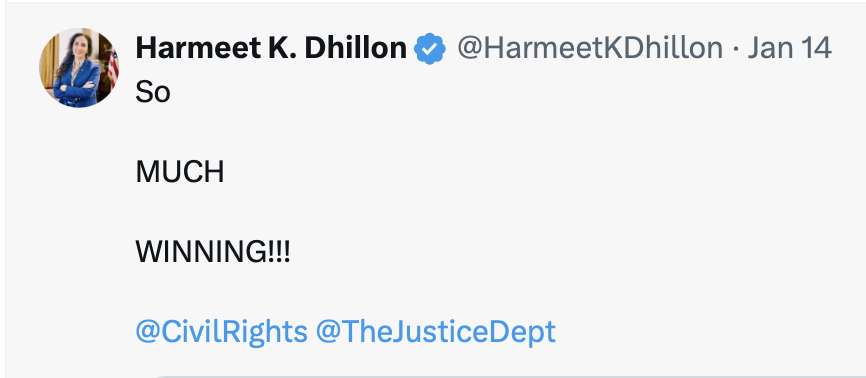
As the week comes to an end, Dhillon’s social media post looks comical. Democrats have gained five seats and, courtesy of the Supreme Court, have more opportunities to challenge restrictive voting laws in court. Most importantly, in the first two of the 24 cases the DOJ has brought to obtain voter file data, it has lost in dramatic fashion.
This does not mean we should take our own victory lap. Republicans continue to press forward with their gerrymandering. Florida is the next major state to watch. We are still awaiting the Supreme Court’s ruling on the Louisiana redistricting case — in which the fate of the Voting Rights Act hangs in the balance. The Court is also set to hear another critical election case involving mail-in voting later this spring.
And we must not forget, the battle over voter data privacy is far from over. While we have won the first two cases at the trial court level, more than 20 others remain. Dhillon’s DOJ will almost certainly appeal its defeats, setting the stage for the courts of appeals — and perhaps even the U.S. Supreme Court — to weigh in.
But for now, in a week when so many other aspects of democracy are under attack, it is worth celebrating our victories. As Dhillon would say: SO MUCH WINNING!!!




.png?height=50&upscale=true&name=Bluesky_Logo-grey%20(2).png)


