
Email
NEWS RELEASE: Snowmobile Riders: Stay On Marked Trails, Off Closed Trails
| From | Wisconsin Department of Natural Resources <[email protected]> |
| Subject | NEWS RELEASE: Snowmobile Riders: Stay On Marked Trails, Off Closed Trails |
| Date | January 16, 2026 3:03 PM |
Links have been removed from this email. Learn more in the FAQ.
Links have been removed from this email. Learn more in the FAQ.
DNR News Release Header Image [ [link removed] ]
*FOR IMMEDIATE RELEASE: *Jan. 16, 2026
*Contact: *DNR Office of Communications
[email protected] <%[email protected]>
Snowmobile Riders: Stay On Marked Trails, Off Closed Trails
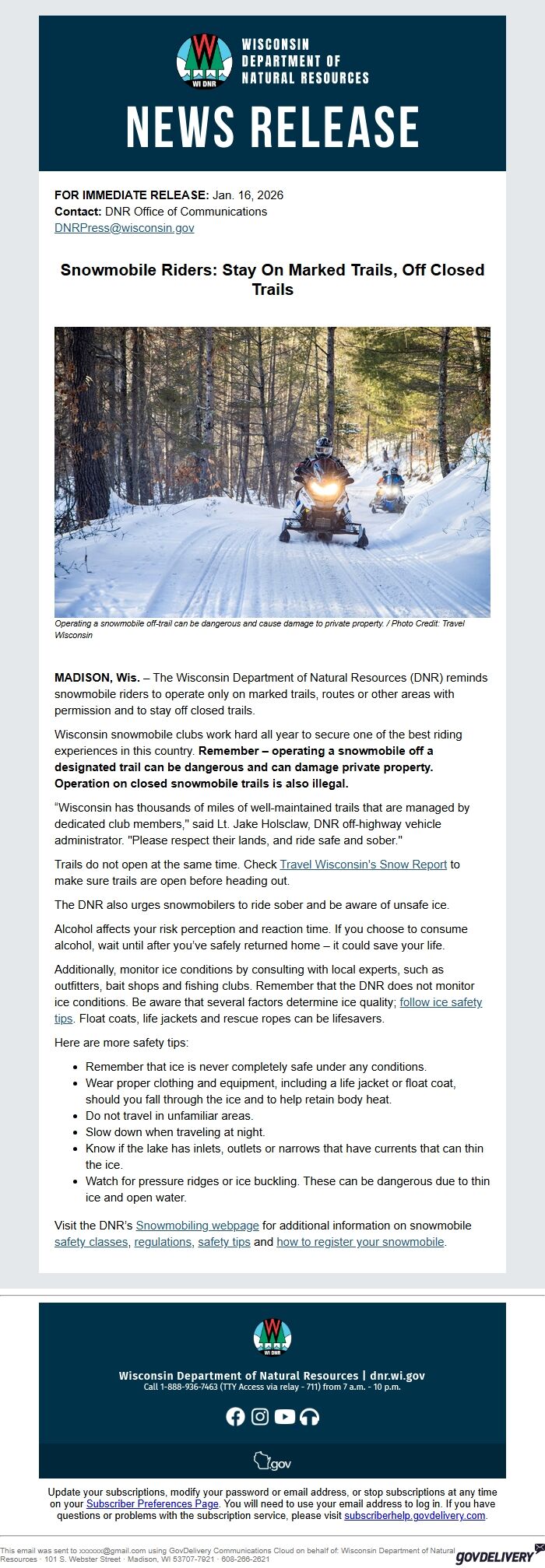
three individuals riding snowmobiles on a snowy trail through a forest.
Operating a snowmobile off-trail can be dangerous and cause damage to private property. / Photo Credit: Travel Wisconsin
*
MADISON, Wis.* – The Wisconsin Department of Natural Resources (DNR) reminds snowmobile riders to operate only on marked trails, routes or other areas with permission and to stay off closed trails.
Wisconsin snowmobile clubs work hard all year to secure one of the best riding experiences in this country. *Remember – operating a snowmobile off a designated trail can be dangerous and can damage private property. Operation on closed snowmobile trails is also illegal.*
“Wisconsin has thousands of miles of well-maintained trails that are managed by dedicated club members," said Lt. Jake Holsclaw, DNR off-highway vehicle administrator. "Please respect their lands, and ride safe and sober."
Trails do not open at the same time. Check Travel Wisconsin's Snow Report [ [link removed] ] to make sure trails are open before heading out.
The DNR also urges snowmobilers to ride sober and be aware of unsafe ice.
Alcohol affects your risk perception and reaction time. If you choose to consume alcohol, wait until after you’ve safely returned home – it could save your life.
Additionally, monitor ice conditions by consulting with local experts, such as outfitters, bait shops and fishing clubs. Remember that the DNR does not monitor ice conditions. Be aware that several factors determine ice quality; follow ice safety tips [ [link removed] ]. Float coats, life jackets and rescue ropes can be lifesavers.
Here are more safety tips:
* Remember that ice is never completely safe under any conditions.
* Wear proper clothing and equipment, including a life jacket or float coat, should you fall through the ice and to help retain body heat.
* Do not travel in unfamiliar areas.
* Slow down when traveling at night.
* Know if the lake has inlets, outlets or narrows that have currents that can thin the ice.
* Watch for pressure ridges or ice buckling. These can be dangerous due to thin ice and open water.
Visit the DNR’s Snowmobiling webpage [ [link removed] ] for additional information on snowmobile safety classes [ [link removed] ], regulations [ [link removed] ], safety tips [ [link removed] ] and how to register your snowmobile [ [link removed] ].
________________________________________________________________________
[ [link removed] ]
[ [link removed] ]
[ [link removed] ] [ [link removed] ] [ [link removed] ] [ [link removed] ]
[ [link removed] ] Update your subscriptions, modify your password or email address, or stop subscriptions at any time on your Subscriber Preferences Page [ [link removed] ]. You will need to use your email address to log in. If you have questions or problems with the subscription service, please visit subscriberhelp.govdelivery.com [ [link removed] ].
________________________________________________________________________
This email was sent to [email protected] using GovDelivery Communications Cloud on behalf of: Wisconsin Department of Natural Resources · 101 S. Webster Street · Madison, WI 53707-7921 · 608-266-2621 GovDelivery logo [ [link removed] ]
body .abe-column-block { min-height: 5px; } table.gd_combo_table img {margin-left:10px; margin-right:10px;} table.gd_combo_table div.govd_image_display img, table.gd_combo_table td.gd_combo_image_cell img {margin-left:0px; margin-right:0px;} table.govd_hr {min-width: 100%;} p, li, h1, h2, h3 { overflow-wrap: normal; word-wrap: normal; word-break: keep-all; -moz-hyphens: none; -ms-hyphens: none; -webkit-hyphens: none; hyphens: none; mso-hyphenate: none; }
*FOR IMMEDIATE RELEASE: *Jan. 16, 2026
*Contact: *DNR Office of Communications
[email protected] <%[email protected]>
Snowmobile Riders: Stay On Marked Trails, Off Closed Trails
three individuals riding snowmobiles on a snowy trail through a forest.
Operating a snowmobile off-trail can be dangerous and cause damage to private property. / Photo Credit: Travel Wisconsin
*
MADISON, Wis.* – The Wisconsin Department of Natural Resources (DNR) reminds snowmobile riders to operate only on marked trails, routes or other areas with permission and to stay off closed trails.
Wisconsin snowmobile clubs work hard all year to secure one of the best riding experiences in this country. *Remember – operating a snowmobile off a designated trail can be dangerous and can damage private property. Operation on closed snowmobile trails is also illegal.*
“Wisconsin has thousands of miles of well-maintained trails that are managed by dedicated club members," said Lt. Jake Holsclaw, DNR off-highway vehicle administrator. "Please respect their lands, and ride safe and sober."
Trails do not open at the same time. Check Travel Wisconsin's Snow Report [ [link removed] ] to make sure trails are open before heading out.
The DNR also urges snowmobilers to ride sober and be aware of unsafe ice.
Alcohol affects your risk perception and reaction time. If you choose to consume alcohol, wait until after you’ve safely returned home – it could save your life.
Additionally, monitor ice conditions by consulting with local experts, such as outfitters, bait shops and fishing clubs. Remember that the DNR does not monitor ice conditions. Be aware that several factors determine ice quality; follow ice safety tips [ [link removed] ]. Float coats, life jackets and rescue ropes can be lifesavers.
Here are more safety tips:
* Remember that ice is never completely safe under any conditions.
* Wear proper clothing and equipment, including a life jacket or float coat, should you fall through the ice and to help retain body heat.
* Do not travel in unfamiliar areas.
* Slow down when traveling at night.
* Know if the lake has inlets, outlets or narrows that have currents that can thin the ice.
* Watch for pressure ridges or ice buckling. These can be dangerous due to thin ice and open water.
Visit the DNR’s Snowmobiling webpage [ [link removed] ] for additional information on snowmobile safety classes [ [link removed] ], regulations [ [link removed] ], safety tips [ [link removed] ] and how to register your snowmobile [ [link removed] ].
________________________________________________________________________
[ [link removed] ]
[ [link removed] ]
[ [link removed] ] [ [link removed] ] [ [link removed] ] [ [link removed] ]
[ [link removed] ] Update your subscriptions, modify your password or email address, or stop subscriptions at any time on your Subscriber Preferences Page [ [link removed] ]. You will need to use your email address to log in. If you have questions or problems with the subscription service, please visit subscriberhelp.govdelivery.com [ [link removed] ].
________________________________________________________________________
This email was sent to [email protected] using GovDelivery Communications Cloud on behalf of: Wisconsin Department of Natural Resources · 101 S. Webster Street · Madison, WI 53707-7921 · 608-266-2621 GovDelivery logo [ [link removed] ]
body .abe-column-block { min-height: 5px; } table.gd_combo_table img {margin-left:10px; margin-right:10px;} table.gd_combo_table div.govd_image_display img, table.gd_combo_table td.gd_combo_image_cell img {margin-left:0px; margin-right:0px;} table.govd_hr {min-width: 100%;} p, li, h1, h2, h3 { overflow-wrap: normal; word-wrap: normal; word-break: keep-all; -moz-hyphens: none; -ms-hyphens: none; -webkit-hyphens: none; hyphens: none; mso-hyphenate: none; }
Message Analysis
- Sender: Wisconsin Department of Natural Resources
- Political Party: n/a
- Country: United States
- State/Locality: Wisconsin
- Office: n/a
-
Email Providers:
- govDelivery