Impacts are minimal in comparison to what might have occurred |
By Mike Nichols & Mark Lisheron
|
Seldom if ever conceded by many critics of the planned $15 billion 672-acre data center under way in Port Washington is the fact that something was inevitably going to be built there and almost invariably would have resulted in what developers and planners sometimes call “more intensive uses.”
That is, far more water pulled out of Lake Michigan, far more traffic, potentially an enormous influx of expensive students in the local schools if the development had been residential or created tens of thousands of jobs.
What’s being built there is “clean, pretty buildings, doesn’t have the noise, smells, semi-trucks, not a ton, going in and out,” said Tricia Braun, executive director of the Wisconsin Data Center Coalition. Braun was careful not to disparage any sort of other manufacturing development in what is still a big manufacturing state but stressed that the data center will have “minimal impacts.” |
From history to poverty to treating kids like wildlife, errors compound |
Bungling facts is bad enough. The harm’s far greater when you’re paid by taxpayers to profess them at Wisconsin’s flagship state university.
A case in point: A University of Wisconsin-Madison professor of education policy revealed a grave misunderstanding of school choice as practiced here — and in the process slandered the Wisconsinites who educate more than 60,000 children.
Assistant Professor Christopher Saldaña was speaking last month on a panel, “Preserving Rural School Districts from the Threat of Vouchers.” It was a webinar for a group run by unions and school boards, called Wisconsin Public Education Network, that’s fervently opposed to any options not controlled by unions and school boards, so you wouldn’t expect the panelists to say nice things about competition. |
|
|
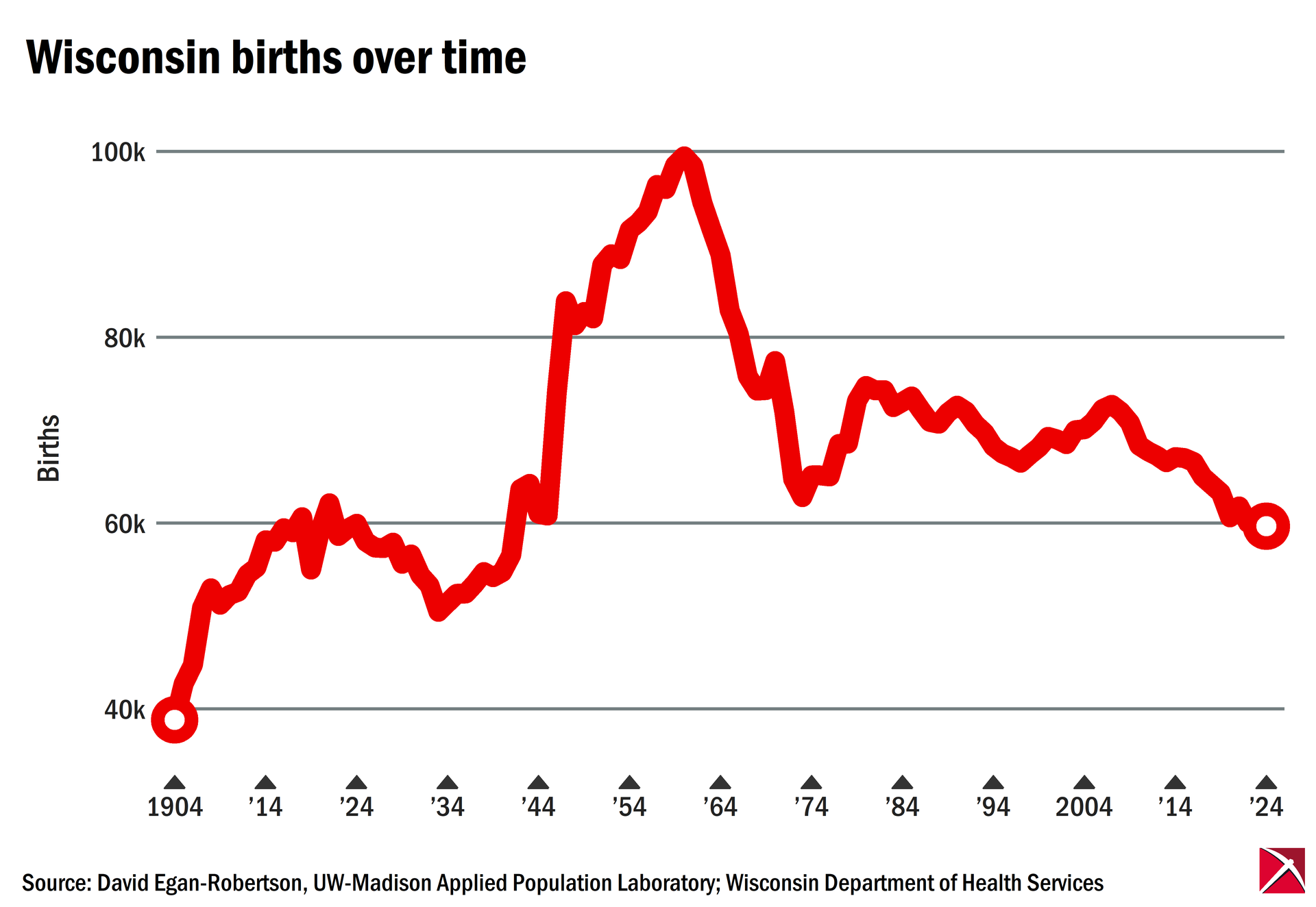
The number of babies born in Wisconsin has declined to its lowest level since 1941, according to data from the Wisconsin Department of Health Services.
Figures provided by David Egan-Robertson at the University of Wisconsin Applied Population Lab show that a total of 59,675 babies were born in Wisconsin in 2024, the most recent year for which data are available. The figures are drawn from the Wisconsin Department of Health Services and its predecessor agencies. That total represents a slight decline of 64 births from the year prior, and a decrease of 13,082, or 18 percent, from the recent peak of 72,757 births in 2007.
|
|
|
There’s been a dramatic decrease in pregnancies and births among one particular subset of Wisconsin females that should get more attention — and praise. Births to teenage girls in the Badger State have plummeted. |
| |
|
The Badger Institute is proud to welcome Riley Swedberg as its Operations Associate. |
|
|
Riley is a graduate of Grand Canyon University, where she earned a degree in State and Local Public Policy with a Pre-Law emphasis. Previously, Riley served as a Government Relations Assistant at Grand Canyon University. She has also gained federal and nonprofit experience through internships with the U.S. House of Representatives and the Clare Boothe Luce Center for Conservative Women. While at GCU, Riley founded and served as President of the Young Women for America chapter on campus and later served as Chairman of the Canyon Civic Institute, where she helped promote civic engagement and policy education among students.
|
| |
|
Weekly survey: Green Bay Packers’ coach Matt LaFleur should be...
|
|
|
Previous survey question: |
Invest in the Badger Institute |
|
|
|
The Badger Institute has long been at the forefront of the fight for school choice, right to work, welfare reform, tax restructuring, limited government, civil society and so much more. If you appreciate the Institute’s legacy and want to support free markets, opportunity and prosperity, please consider donating today. Your support will help the Institute continue to advocate for conservative principles now and in generations to come.
|
|
|
The Institute never has, and never will, accept government funding. We gratefully welcome your online donation or email Mike Nichols, President. The Badger Institute is a 501(c)(3) tax-exempt nonprofit organization funded solely by the generosity of foundations, companies and individuals. |
|
|
Badger Institute
700 W. Virginia St., Suite 301
Milwaukee, WI 53204 |
|
|
|