|
Britain Prosecuted these Beagle Rescuers. Here's How They Won in Court.
The simple playbook that changed the verdict: Ethics. Stories. Hope.
|

| |||||||||||||||


 |
They wanted his blood.
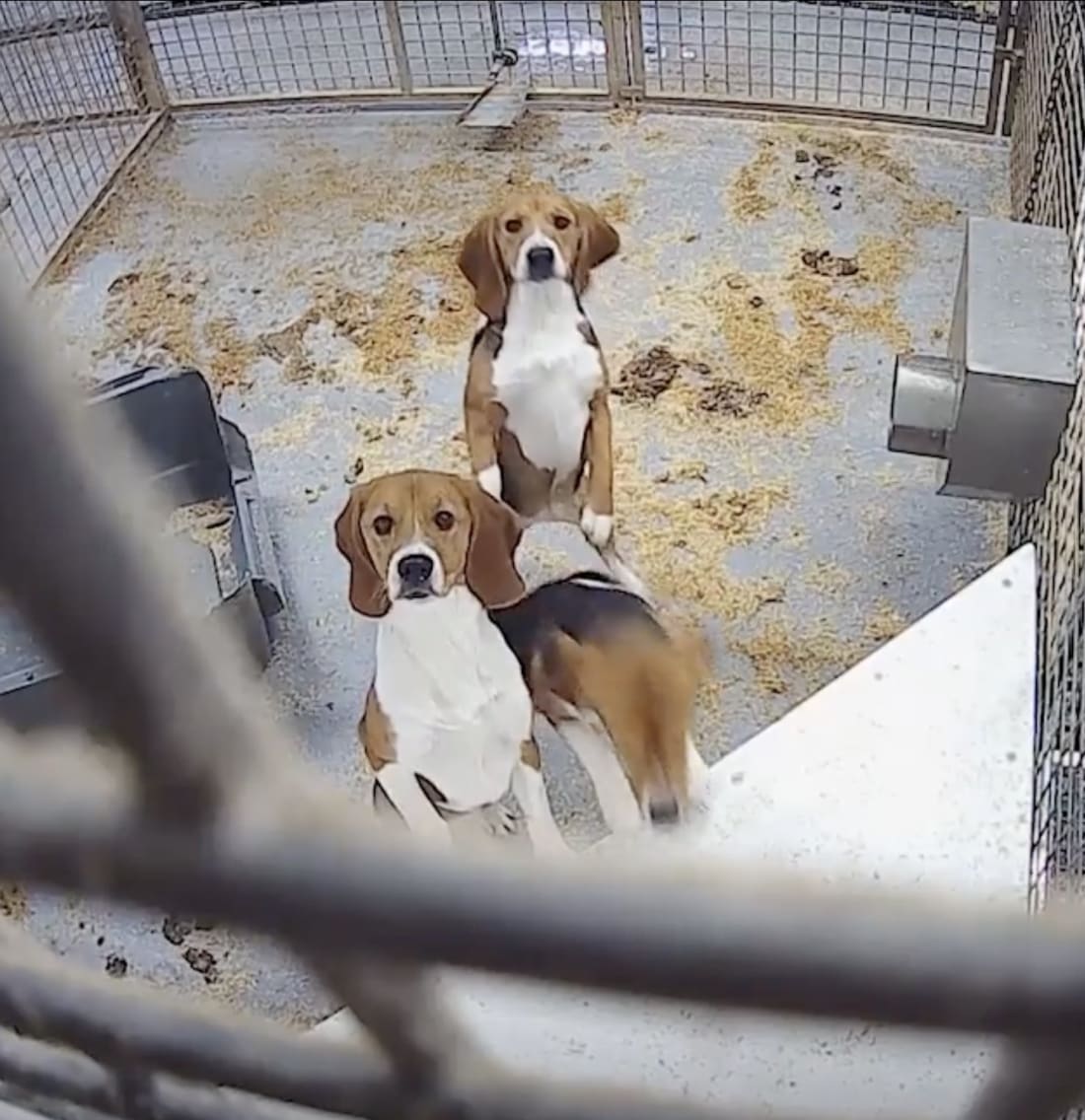
The little beagle—identified only by a serial code, #0M21029—did not know why. But every week, the vivisectors at MBR Acres would drag him from his cage to drain blood for their experiments. #0M21029 was feeling anemic and light-headed. The site of the blood draw, next to his front paw, was painful, bruised, and red. And they had already taken 2.6 liters (around 6 pounds) of his blood this year, an astonishing amount for a dog weighing less than 15 pounds. If they took much more blood, #0M21029 would die. Indeed, that was the fate of hundreds of the other beagles at MBR. Broken down from years of abuse, they were drained of their blood entirely by a stab to the heart then sold off for their organs and body parts. MBR’s customers had one demand for this grisly harvest:
“Must be fresh.”
This might sound like the script for a horror movie. But everything I write above is real. These details, including the amount of blood and the stab to the heart, are taken directly from documents obtained by animal advocates about the torture of dogs at MBR Acres in Cambridge, UK. #0M21029’s story is so shocking that it might be hard to believe, if we didn’t have the documents to prove it to be true. But there is one other truth that I did not yet share.
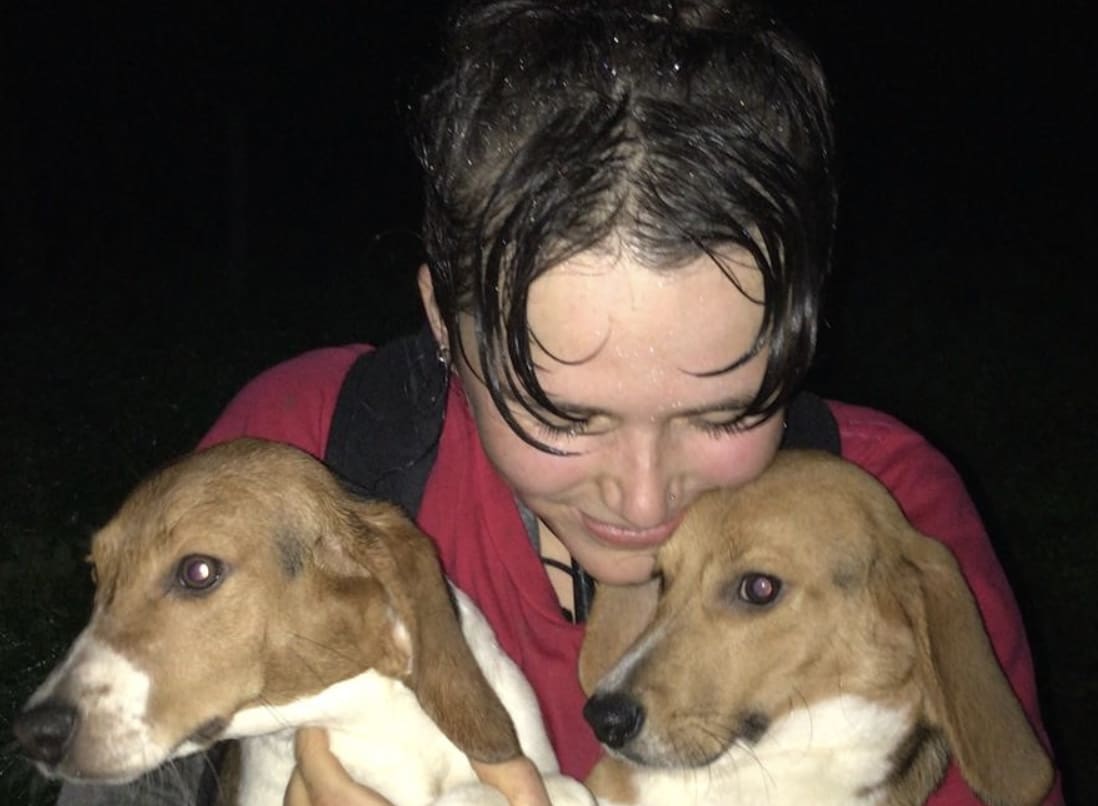
#0M21029 did not die. On a cold winter morning, just days before Christmas, #0M21029 was saved.
The Trials of the Beagle Rescuers
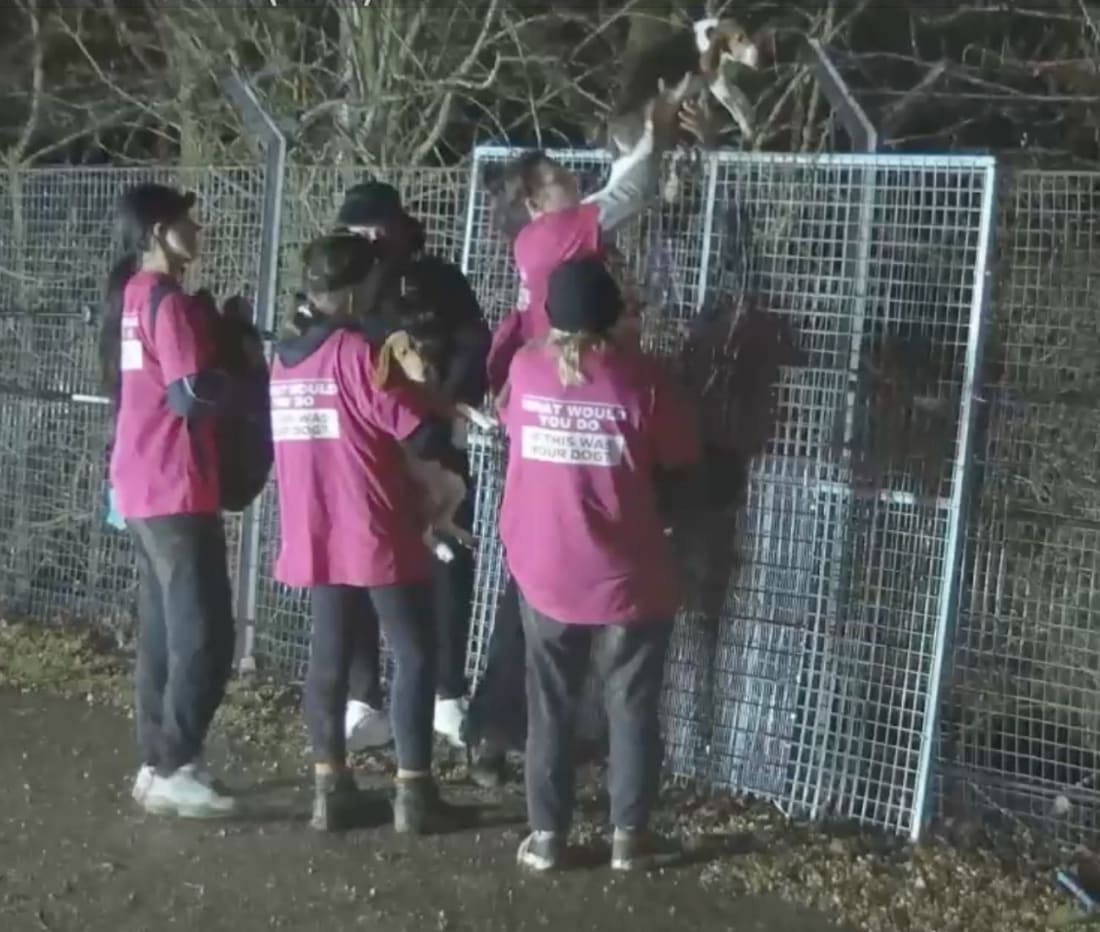
Early in the morning on December 20, 2022, dozens of animal activists with Animal Rising rushed into MBR Acres, using angle grinders to cut holes in the fences and crowbars to pry open the doors. Their immediate mission was simple: Rescue as many puppies as you can. But their t-shirts displayed a second and perhaps more important goal: Put animal testing on trial.
Starting a few weeks ago, they got their wish. The British government brought the first in a series of five trials against animal advocates for taking part in the 2022 beagle rescue. If convicted, the activists, including my wife Rose, face up to 10 years in prison. And the first trial did not go well, ending in a conviction after less than 4 hours of deliberation by the jury.
It was not a fair fight. The judge ruled before trial that “no defendant may give evidence of the conditions” at MBR. So the jury did not hear the story of #0M21029, or the thousands of other dogs subjected to torture. In contrast, the vivisectors were not only allowed to tell their story; it was endorsed by the judge. The judge asserted there have been “no concerns” raised in animal welfare inspections at MBR, and falsely told the jury that MBR’s facility was entirely legal. No dissent was allowed in court. These biased rulings, plus the defendants’ overconfidence¹, led to a shockingly quick guilty verdict.
 |
It was a moment of somber reflection for all those who believe in the right to rescue. For years, I have been asking people to risk their freedom to save animals. Critics have accused me of endangering people by making those asks. With the beagle rescue conviction, and Zoe’s conviction just a few months ago, would the critics be proven right?
Not so fast. The second trial ended on Monday, and the jury’s verdict was even faster than the first: not guilty in less than 2 hours! The facts were the same. The judge and prosecutor were the same, too. So how did the second set of beagle rescuers win? I have been closely following the trials from London. I attended the closing argument on Monday and witnessed the verdict live in court. And here are three key lessons I’m taking from the case.
Ethics, not Facts
In the first trial, the defendants focused on attacking the science of vivisection. But those factual arguments fell flat. One member of the jury, a researcher at Cambridge University, noticeably shook his head in disagreement when the defendants tried to make the factual case against animal experiments.
This is partly because the case against vivisection, scientifically, is more complicated than animal advocates are often willing to admit.² There is a deeper problem however: activists are often wary of making the ethical case for change. Poisoned by distrust of religion, and lacking an alternative moral framework, many choose to avoid moral claims entirely and focus instead on science and facts. Whether on climate change, plant-based eating, or animal testing, this seems the safer route.
That is a mistake. Morality is among the most powerful forces in human history; indeed, moral thinking is a human instinct. Anthony Appiah at Princeton examined instances through history of great social change and found that moral arguments, not facts, were central to them all. And, as America’s leading progressive political commentator (and long-time vegan) Ezra Klein noted just a few days ago, the world is “hungry for moral leadership.”
The defense learned this lesson in the second trial. Louisa Hillwood, a physiotherapist in London, was the first rescuer who took the stand. And she proceeded to make a powerful moral case.
“For these puppies, it was life and death,” she said. “I had no choice. No one was helping them. I had to do something.”
Louisa’s statement did not challenge the science. Indeed, it barely engages with facts at all. Instead, Louisa made a simple and powerful moral case: when animals are hurting, I have to help. That ethical claim carried the day.
Stories, not Arguments
But aren’t people tired of moral lectures? This brings me to the second key point. Not all moral claims are created equal. And effective moral claims are stories, not arguments.
Consider Louisa again. The puppies were in danger, and I had to help. It was a story, not a lecture. And when her attorney continued the story by playing video footage of a rescued puppy in Louisa’s arms, licking her on the face, multiple jurors began to quietly cry.
 |
This was a marked contrast from the first trial, where there were a number of defendants who argued with great intelligence, including one of the leaders of Animal Rising, Ben Newman. But their testimony was focused on argument, not stories. Ben made solid philosophical points. He presented accurate factual arguments. But the only story he told was one where he and his brother accidentally struck a dog while golfing. That’s hardly a story to inspire.
In contrast, the second trial was filled with stories like this one, told by defendant Tom Cusick, who represented himself at trial:
In September 2022, just a few months before this rescue took place, I went to central Ukraine to help out at a sanctuary where they were rescuing all kinds of animals from the front lines. There was a dog here called Jonny, and his story really stood out to me, Jonny had been shot 6 times in the spine by Russian soldiers and then crawled for miles from the Russian front lines to the Ukrainian front lines and then he eventually ended up at this sanctuary. Jonny was paralyzed from the waist down and had very little use of his back legs, we eventually got him a wheelchair and he absolutely loved it. He would tear up and down the road by the sanctuary when we took them out for a walk.
This story has nothing to do with legal argument. It has barely anything to do with the case at all. But it is a gripping, moral story and one with a clear hero. Who would imprison a man who rescues crippled dogs from war zones? After the verdict, one of the members of the jury—a grizzled, middle-aged man with a beard—approached Tom and shook his hand, thanking him for his courageous acts. Stories, not arguments, inspired him to acquit.
Hope, not Anger
But there was a final key element in the second trial: hope.
The animal rights movement is one filled with anger—and we felt this vividly at trial. In his closing argument, the prosecutor outrageously compared the dogs at MBR to a “can of baked beans.” You may not like how they are treated, he said, but that is the law.
I thought of #0M21029 when he said these words. I thought of the cold concrete on which he had lived his entire life. I thought of the cage bars that separated him from a loving family. I thought of him hooked up to a machine, and bled to death for MBR Acres to harvest his organs in an experiment.
My mind nearly broke with rage.
But this was not the message that the defense brought to the jury. These were some of defendant Tom Cusick’s final words to the jury:
No dog deserves to live in this place, this place you have seen in the videos, this place where they are kept in cages with no bedding, the only enrichment is a ball hanging from a chain, and they are left covered in their own excrement. For some of these puppies this is their whole lives until they are bled to death, and for others it is where they wait before they are sent to off to labs to undergo unjust and cruel tests. For me this was an immediate threat, the dogs were living in those conditions, they were going to be killed.
The prosecution called these puppies “property like a can of baked beans.” I strongly disagree with this statement. Their lives hold so much more value than a can of baked beans. I believe that all dogs deserve the chance to grow old with a loving family and because of my actions there are now 18 beagle puppies who have been given this chance.
The prosecution claims that I was a part of some highly organised military style operation. The truth is really a lot simpler. What I really am is just a person who loves animals and is willing to go to lengths to helps them, whether that means traveling to Ukraine to rescue dogs from war or just feeding the pigeons down by the canal. Everything I did that night I did honestly in line with my beliefs that these dogs deserved better and I am incredibly proud of what I did that night.
I closed my eyes and thought of #0M21029 again when Tom spoke these words. I thought of #0M21029 running in his backyard enjoying the fresh air and sunlight. I thought of #0M21029 cozying up to his family—giving them kisses on the face, and begging them for pets on the head in return. And I even thought of #0M21029 crying in the middle of the night, scarred by nightmares inflicted on him by MBR, but then healed by these words from his adopted mom and dad, “Max, we love you. You’re safe.”
I burst into tears. He is not #0M21029. He never was. He is Max. And with his rescue the defendants did more than save one life. They gave the jury—and the world—hope that we can save them all.
 |
Other stuff
Act on your hope by joining this Saturday’s legal briefing at 1 pm ET on the planned rescue at Ridglan Farms. Tom Cusick from the recent MBR trial will be joining us, as will my former co-defendant and DxE co-founder Priya Sawhney. We will be discussing what the MBR verdict means for the future of open rescue and the fight against vivisection—and prepare you for action at Ridglan Farms.
Ridglan called the FBI on me. And that’s great. If you missed the news, Ridglan Farms put out a press statement indicating that they are trying to convince the FBI to stop us from rescuing the beagles. My commentary is here, but the TL;DR is that this only helps us, as the attention and drama from the FBI will put pressure on both the industry and government to release the dogs.
I was on the Our Hen House podcast last week, talking about rescue, religion, and animal rights. Mariann Sullivan is a legend in the movement and always such a joy to speak to, but I had no idea that she had such a keen interest in religion.
I’m looking for places to speak about the Ridglan rescue effort! I’m particularly interested in churches and universities. Get in touch if you have a space, online or in person, that you think I should consider!
That’s all for now! Until next time.
One defendant told me that he was certain that the verdict would come back not guilty.
Animal experimentation has led to some genuine breakthroughs, for example regarding the use of insulin to treat diabetes.
Thank you for reading The Simple Heart! To help us reach more people, become a donor today.
| ||||||||||

