 A heat map showing Director Nguyễn's community visits.
Those visits wouldn’t have been possible without the incredible support behind the scenes. Every dot on this map reflects effort from agency employees — preparing materials, coordinating logistics, and traveling alongside me. I couldn’t have done it without them.
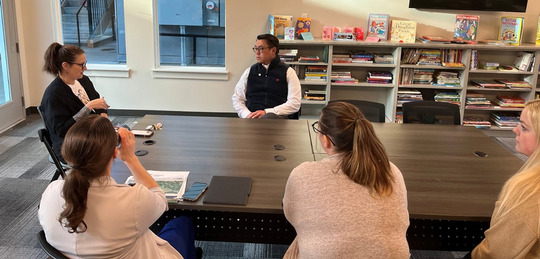 Director Nguyễn meets with community providers in Snohomish County.
 Improving efficiency, embracing innovation
Commerce has expanded considerably in recent years. The State Legislature entrusted the agency with numerous programs and projects, resulting in a substantial increase in its budget and workforce. Since 2020, the agency has nearly tripled, with an annual budget reflecting this growth.
This increase in responsibility meant Commerce needed to take new and innovative approaches to its work. Many of these changes, such as more in-house research, phasing out low-impact processes, and reducing redundancies, will not be visible to the public. This kind of public stewardship is not flashy, but it is essential, grounded in honesty, integrity, and accountability.
Most Commerce employees work from home all or most of the time, and so Commerce is moving to a smaller space in Olympia. It also consolidated the Seattle office space and closed the Kennewick satellite office. This will save the state more than $500,000 every year.
I am proud that Commerce is building a culture of innovation. Government should be cautious, but not so cautious that it impedes progress and new ideas.
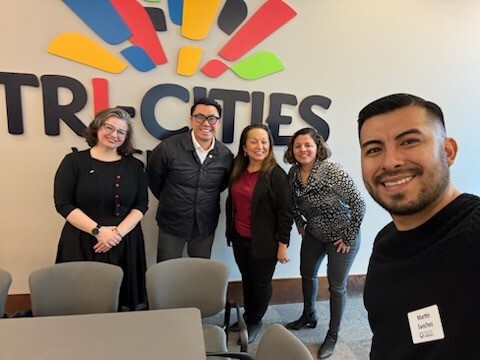
Photo: Director Nguyễn visits with staff in the Tri-Cities
|
Equity in contracting
Ensuring all communities, particularly marginalized and underserved communities, have support and transparent access to the same information is a cornerstone of equity. A key step in that direction was creating a dedicated Contracting and Compliance Division. It shouldn’t matter if an organization has three employees or 300, or if it’s located in downtown Seattle or Grand Coulee — everyone should be able to navigate Commerce’s contracting procedures. The new Division will help with that goal.
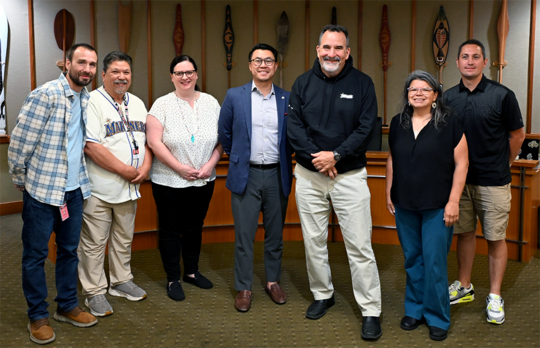 The Suquamish Tribe MOU signing ceremony.
Commerce now has 13 signed Memorandums of Understanding (MOUs) with Washington tribes, which streamline contracting processes and honor data sovereignty for tribal nations.
The agency is improving its community compensation process and embedding and simplifying language access support in much of its work.
For the first time, Commerce documented its internal contract dispute resolution process to ensure it consistently addresses concerns brought under the dispute clauses in many of its contracts in a timely and fair manner.
By integrating equity and environmental justice into its operations, Commerce is laying the groundwork for a more inclusive and sustainable future.
Supporting Commerce employees
Commerce can’t embed equity into its external processes, without embracing these principles internally. I've led with the principle that, if we don’t have our own house in order, how can we lead with equity in the communities we serve?
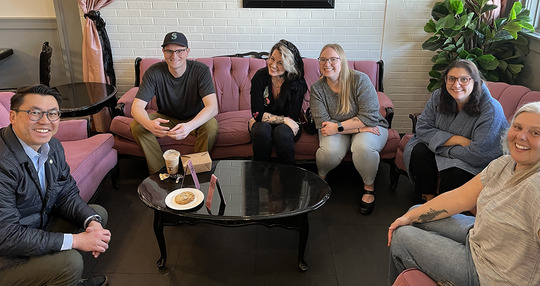 Director Nguyễn visits with Commerce employees in Bellingham.
Commerce hired a new People and Culture Manager in Human Resources, who will help set processes that will care for employees throughout their entire journey, ensuring equity is embedded at every stage. And Commerce is developing initiatives that promote diversity, inclusion, and social justice throughout the organization, ensuring fair access to opportunities and resources for all employees.
The agency is embracing employee development and growth in other ways too, with a supervisor mentorship program and the first agency cohort for the University of Washington’s Evans School of Public Policy and Governance Leading Public Innovation certificate program.
These are just a few of the things I’m proud of this past year. This work continues Commerce’s powerful trajectory toward a more efficient, connected, and just organization. I thank Commerce employees for walking with me on this mission, and I know they will keep up the great work!
Community stewardship across industries
Communities usually know what they need
That’s why the Governor’s Strategic Reserve Fund (SRF), which is administered by Commerce, goes directly to local communities to support economic development. This fall, the SRF made more than $1 million in investments in Yakima, Clallam, Spokane, and Snohomish counties. That was met with more than $140 million in other investments to help four businesses expand operations here in Washington. These awards will support agriculture, timber and aerospace — foundational Washington industries.
Those industries are also innovating. Director Nguyễn and other Commerce employees joined the launch for the Cascadia Sustainable Aviation Accelerator in January in Everett. Sustainable aviation fuel is a ready-to-use fuel that works in today’s aircraft and can reduce lifecycle carbon emissions by up to 80% compared to conventional jet fuel. With strong agricultural resources, clean energy, and an established aviation ecosystem, the region could produce up to 1 billion gallons of sustainable aviation fuel each year.
Children need a safe place to learn
Child care is a vital part of community infrastructure. Without it, parents can’t work or go to school, and whole communities suffer. Commerce invested $680,000 in Child Care Partnership Grants (CCPG) to 13 local organizations to expand child care in communities across the state. Funding will support community-driven planning, pre-design work, and strategies that build local child care capacity and develop solutions to meet community needs. The program is a unique public-private partnership, and this year’s awards were funded with investments by Ballmer Group and the Bezos Family Foundation.
Many of this year’s grantees are in rural and underserved counties. With a $69,000 award, Pomeroy Community Connection (PCC) is developing rural Garfield County's only current licensed center and creating pathways for locals to enter the early learning workforce. Read more about how Commerce supports child care.
Credit should be available to everyone
The Equitable Access to Credit (EAC) Program awarded $5.6 million to 11 Community Development Financial Institutions (CDFIs) for technical assistance services, small business training, loans and investments to borrowers who might not be eligible for traditional bank loans. Those underserved borrowers might have no or low credit, and are typically people with disabilities, people of color, and people from extremely rural areas.
The EAC program expands access to credit, which helps more communities thrive. Read more about this year’s awards.
Open funding opportunities
Commerce currently has more than $45 million in funding available, in addition to open requests for proposals for a variety of other funding types with different cost limits.
Explore Contracting with Commerce to view more opportunities.
Here are some highlights:
Jobs at Commerce
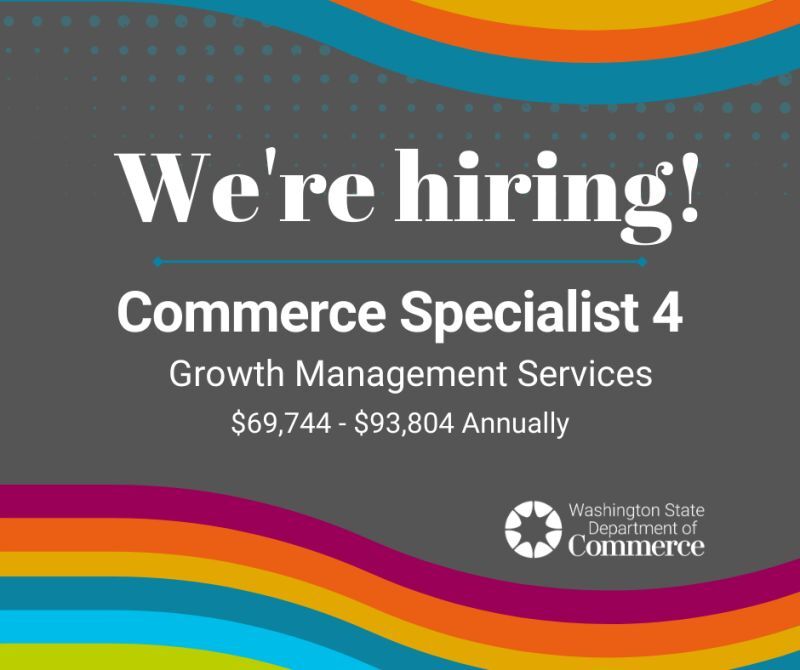 Commerce is hiring a specialist to serve as the statewide technical expert for the Connecting Housing to Infrastructure Program (CHIP).
In this role, you will work directly with local governments and utilities to optimize water, sewer, and stormwater projects that pave the way for new housing development.
Salary: $69,744 - $93,804 annually
Location: Anywhere in Washington
Closes: Apply by Thursday, Jan. 22!
View the position online
View all jobs at Commerce
Resources for you
Commerce website
Jobs at Commerce
Community Engagement and Outreach
Public Records Request
Access the Contract Portal
Legislative resources
Agency contact information
|