Conservation Officer Cadet Academy
By KATIE GERVASI
Communications specialist, Law Enforcement Division
Michigan Department of Natural Resources
When most people envision spending several days in northern Michigan during July, it includes fishing, boating, campfires, exploring a favorite beach or maybe an off-road vehicle trail.
A group of 19 individuals – who hope to one day become a conservation officer – did just that, but as part of a weeklong job interview with a structured twist.
The Michigan Department of Natural Resources hosted its first Conservation Officer Cadet Academy, a free career exploration opportunity, July 6-11 at the DNR’s Ralph A. MacMullan Center in Roscommon.
“The purpose of the CO Cadet Academy is to give cadets a weeklong glimpse into what our traditional training academy looks like,” said Conservation Officer Brad Bellville, who helped organize the Cadet Academy. “This is a great opportunity for individuals who are too young to start the CO hiring process. By the end of the week, they should know if this is the correct career choice for them.”
All costs, including lodging, meals and activity supplies, were covered by the DNR, through the Michigan Coronavirus State and Local Fiscal Recovery Funding Program, awarded by the U.S. Department of Treasury and administered by the Michigan Commission on Law Enforcement Standards.
Cadets were responsible for their own transportation to and from the RAM Center.
Conservation Officer Training Academy
Conservation officers have a unique role in law enforcement. They have the same credentials as city and county officers and Michigan State Police troopers, but COs receive additional training specific to enforcing the laws and rules governing use and enjoyment of natural resources. They spend most of their time patrolling outside, where people recreate.
And yes, COs can give you a speeding ticket.
The CO Training Academy is an intense, structured academy that lasts an average of 23-26 weeks, where recruits complete training that certifies them as law enforcement officers in Michigan. Additionally, recruits learn the rules, regulations and enforcement specific to the DNR.
|
Recruits check in at the CO Training Academy on Sunday and stay through Thursday or Friday. The first portion of the academy takes place in Lansing at the Michigan State Police Training Academy facility, then moves to the RAM Center for advanced natural resource training.
Cadet Academy
“Our training academy is extremely difficult for someone who isn’t prepared for it,” said CO Tim Rosochacki, who helped with Cadet Academy. “The Cadet Academy will help prepare someone by giving them things to focus on and work toward if they want to become a CO.”
The Cadet Academy also helps DNR Law Enforcement Division staff evaluate the cadets.
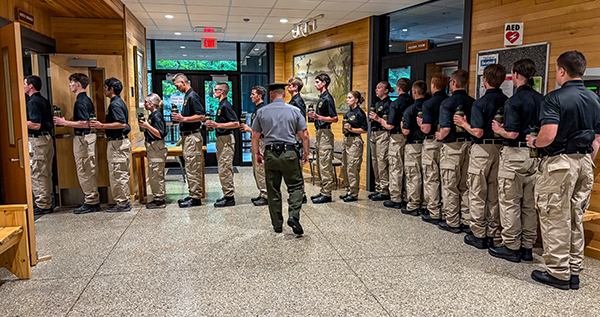
Cadets arrived at the RAM Center at 6 p.m. They were introduced to the staff, instructed to change into their uniforms, learned the expected behavior and conduct for the week and given a tour of the property.
“Immediately, it was head forward, walking in step,” said Jack Byrne, a 21-year-old senior at Western Michigan University in Kalamazoo who is originally from Naperville, Illinois. “It was very strict and stern, but that’s part of the job. Law enforcement must show excellence and professionalism so the community can count on us.”
Each day of Cadet Academy was structured similar to the CO Training Academy.
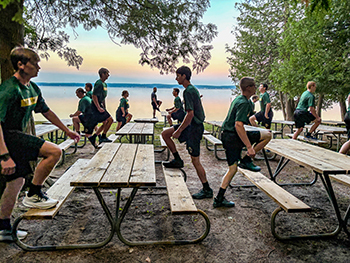
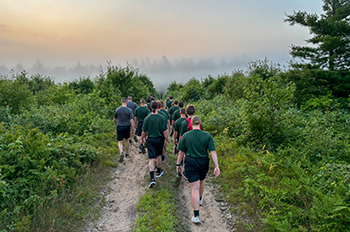
“Two cadets share a room and will be roommates for the week,” Byrne described. “Wake-up call is at 5:30 a.m., physical training is at 6 a.m. followed by chow. After that, we went to the classroom for several hours of lessons.”
Cadets spent most of the morning in the classroom and were outside for the rest of the day. Classroom lessons included the history of conservation officers, conservation law, preparing for patrol, and fish and game rules and regulations.
|
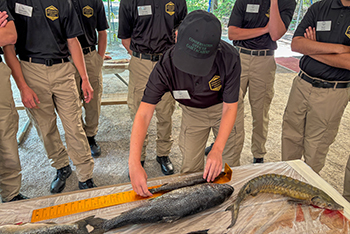
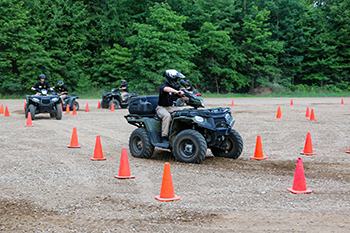
Hands-on lessons included fish and waterfowl identification, trapping enforcement, off-road vehicle and marine training, search and rescue, first aid, big and small game enforcement, big game necropsies and introduction to survival tactics.
Additionally, cadets earned their boater and off-road vehicle safety certificates during the academy.
“We were outside a lot, getting hands-on experience, which was really nice not being stuck in a classroom all day,” said Haley Scott, a 21-year-old from Niles, Michigan who is a senior at Western Michigan University. “One day we did fish identification, getting to touch, feel and really see the difference between all the fish species. We worked through a deer poaching crime scene, seeing what that looks like and how COs investigate.”
Evenings included team-building exercises.
“My favorite part of the Cadet Academy was building camaraderie with other cadets,” Byrne said. “After dinner we returned to our barracks to study. We could sit down and have more time to learn about each other, why each person is here and why they want to become a CO.”
Cadets also spent time learning from staff with the other DNR divisions, such as Wildlife, Fisheries, Forest Resources, and Parks and Recreation.
“We brought in the other divisions from the DNR to explain who they are and what they do and how all the divisions work together under one big umbrella,” Bellville said.
Conclusions
Based on feedback COs received from cadets, the Cadet Academy helped people arrive at one of three conclusions:
- They can’t wait to apply to become a CO.
- They are interested in pursuing a different DNR career that they learned about during the Cadet Academy.
- A career in law enforcement or the DNR isn’t for them.
“This is a strict academy, it’s not a summer camp,” Byrne said. “You’re here to learn, excel and grow.”
|
After all, this is also an opportunity for staff with the DNR Law Enforcement Division to evaluate individuals who will likely be future applicants.
“We kept reminding cadets that they were on a weeklong interview,” Rosochacki said. “The academy served its purpose and helped some cadets walk away eager to apply as a CO, or made others realize this wasn’t for them, which is OK.”
Both Byrne and Scott hope this is only the beginning.
“Cadet Academy made me consider a lot of factors – the week was tough, I haven’t experienced anything like this in my life before,” Byrne said.
Bellville, who was also a staff instructor at the most recent CO Training Academy that graduated 15 new probationary conservation officers on July 3, said that physical training is often one of the top hurdles people face in the academy.
“Physical training was the most challenging part of the Cadet Academy for most,” Bellville said. “However, for the cadets serious about becoming a CO, it helped them realize how they need to improve before they apply to the CO Training Academy.”
To become a law enforcement officer in Michigan, all applicants must successfully pass the Michigan Commission on Law Enforcement Standards physical fitness test.
“I’m 100% focused on preparing myself, whether its physical training, studying laws and regulations within the DNR, all to help prepare me to become a CO,” Byrne said.
Scott is also using her experience from the Cadet Academy to recognize her strengths and areas to improve before she plans to apply for the next CO Training Academy.
“Cadet Academy helped me learn areas I can improve,” Scott said. “I’m not a big hunter, especially waterfowl, so waterfowl identification was an eye opener to me. I am an avid angler, so that was nice to see what topics I know.”
The application process for the 2026 Cadet Academy will soon be available on the DNR website. Anyone interested in becoming a CO is encouraged to begin researching the career.
“I recommend Cadet Academy to anyone serious about becoming a CO,” Scott said. “Cadet Academy made me love the job even more – getting to see what COs do and how they handle themselves in situations, it’s everything that I could ask for in a career.
“Going to physical training in the morning, yes that’s tough, and the recruit school is super tough, but once you graduate, you have your whole career ahead of you. It’s just a small part in a rewarding career.”
To learn more about the CO hiring process or Cadet Academy, visit Michigan.gov/dnr/managing-resources/laws/hiring.
The 2025 Michigan DNR Conservation Officer Cadet Academy was supported by Michigan’s Coronavirus State and Local Fiscal Recovery Funding Program # FRF5311, awarded by the U.S. Department of Treasury, and administered by the Michigan Commission on Law Enforcement Standards (the Commission). Points of view or opinions contained within this document do not necessarily represent the official position or policies of the U.S. Department of Treasury or the Commission.
Check out previous Showcasing the DNR stories in our archive at Michigan.gov/DNRStories. To subscribe to upcoming Showcasing articles, sign up for free email delivery at Michigan.gov/DNREmail.
|
Note to editors: Contact: John Pepin, Showcasing the DNR series editor, 906-226-1352. Accompanying photos and a text-only version of this story are available below for download. Caption information follows. Credit Michigan Department of Natural Resources, unless otherwise noted.
Text-only version of this story.
Fish: Cadets spent time learning about Michigan’s different species through a fish identification lesson.
Hike: Cadets went on a trail hike for morning physical training.
Marching: Cadets were expected to march in unison during their time at the academy. This teaches teamwork and discipline.
ORV: All cadets earned their off-road vehicle and marine safety certificates during the academy.
PT: One of the most challenging parts of the Cadet Academy and conservation officer Training Academy is the morning physical training.
|