Expert analysis made easy. Breaking down the news with data, charts, and maps.
Edited by Brady Africk and Lexi Baker
Happy Thursday! In today’s newsletter, we examine the protests in Iran, President Trump’s housing proposals, and a conservative defense of the filibuster.
Don’t forget—subscribe and send DataPoints to a friend!
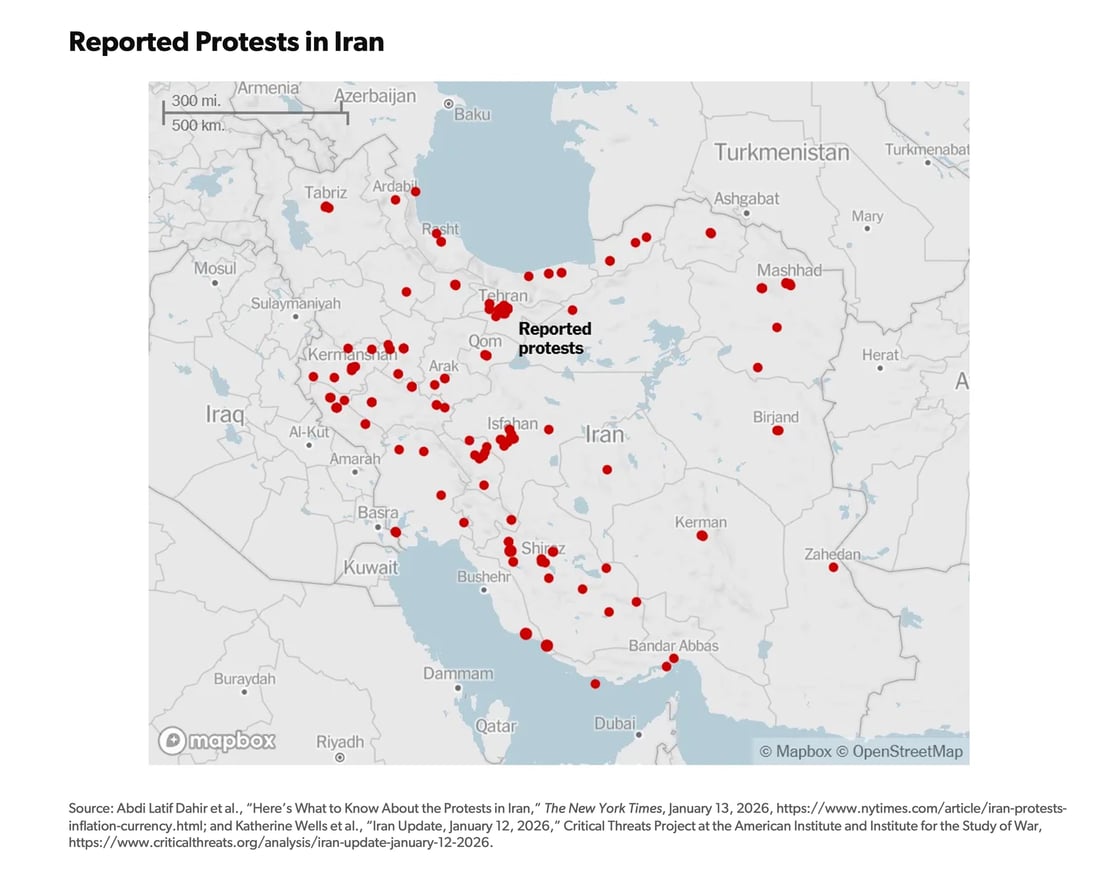
Topline: On January 12, 14 protests were reported across six Iranian provinces—a precipitous drop from January 8, when 156 protests took place in 27 provinces, according to AEI’s Critical Threats Project and the Institute for the Study of War. Analysts at AEI caution, however, that the actual number of protests is probably higher than what can be recorded.
Internet Shutdown: The Iranian regime cut off internet access on January 8, making it more difficult to track what’s happening on the ground. The shutdown likely explains at least part of the drop in reported protests—though the crackdown itself may also have had some effect.
Increased Enforcement: Reports from media linked to the Iranian Armed Forces General Staff say Iran’s regime deployed more military forces and specialized units on January 12 in response to protests. This suggests that the regime is taking the protests seriously and that there are more of them than have been recorded.
"The Iranian regime has historically struggled to suppress unrest in less populated and rural areas more than in urban areas and it would therefore be surprising if protests continued to take place in large cities and not in smaller towns and villages. Iranians are also likely able to access tools like Starlink satellites more readily in urban areas and use these tools to share videos of protests with foreign media.”
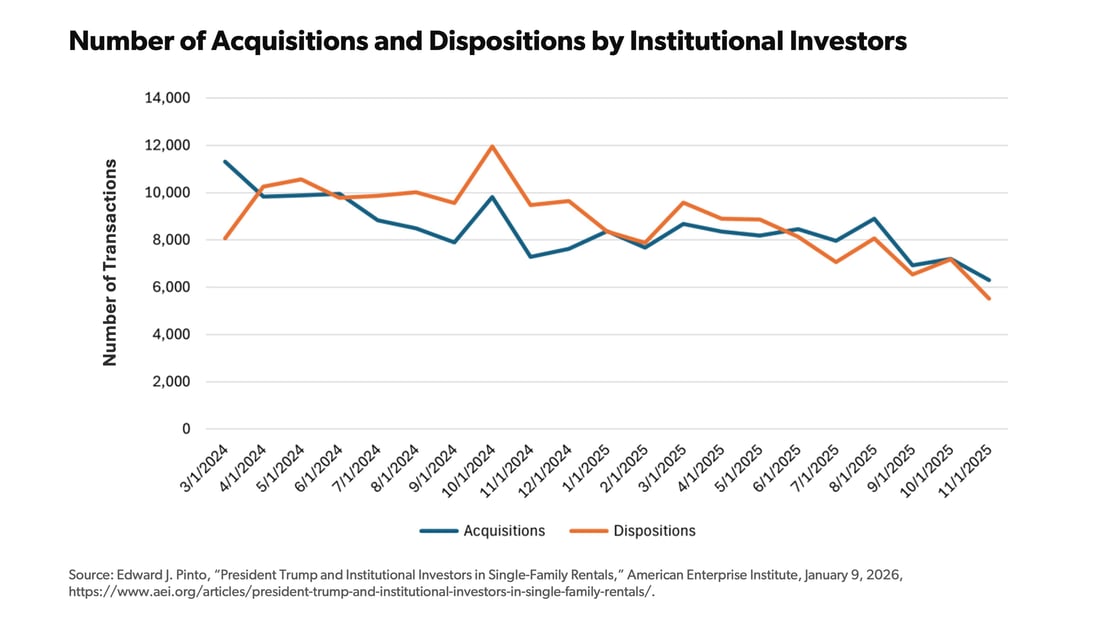
Topline: Recent analysis of the housing market indicates that institutional investors own just 1 percent of single-family homes. AEI’s Edward J. Pinto warns that President Trump's recent proposal to ban these investors carries significant risk and little upside for a housing market laden with affordability and supply constraints.
A Drop in the Bucket: Since March 2024, institutional investors have acquired 178,000 rental homes and sold 185,000—a net portfolio decline of 7,000 homes. Over the same period, acquisitions from these investors made up less than 2 percent of single-family home sales.
Unintended Consequences: If the ban applies to both new and existing homes, it could significantly reduce the housing supply by slowing new construction and prompting institutional investors to hold onto existing homes rather than selling them. If new construction is exempt, investors may concentrate their demand in that segment—potentially crowding out individual buyers or distorting builders’ incentives.
"At the heart of the affordability crisis is a chronic and severe housing shortage. This shortage is no accident—it is the result of irresistible force meeting an immovable object. The immovable object has become many of the 33,000 state and local jurisdictions issuing land use regulations—keeping supply tight and prices high. The irresistible force is the federal government’s demand stoking efforts to make homes ‘affordable’ with leverage and credit easing during good times and bad.” —Edward J. Pinto
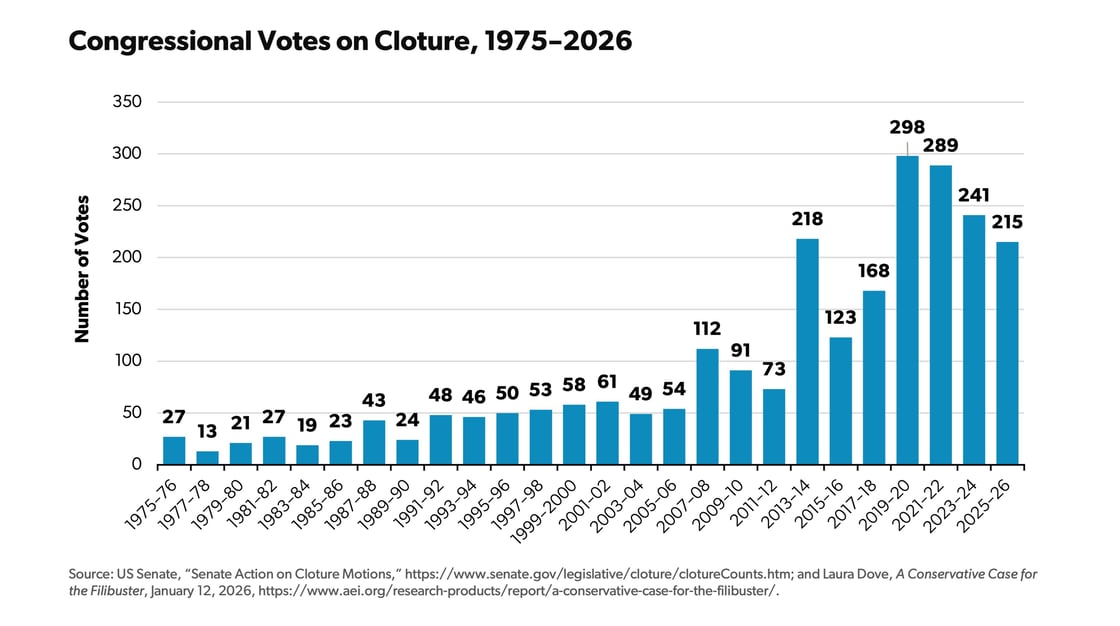
Topline: In recent years, the Senate has voted on cloture—a motion to end debate—more frequently than at any other point in its history. Despite this trend, and amid conservative calls to weaken or abolish the filibuster, AEI’s Laura Dove argues that the motion’s preservation is foundational to constitutional order and in the nation’s long-term interest.
In Practice: The filibuster was designed to protect liberty through deliberation and debate while discouraging political impulses and efficiency. In practice, this has allowed policymakers to form coalitions around nonpartisan regional and economic interests, including agriculture policy, nutrition programs, and infrastructure needs.
The Biden Administration: Speaking in favor of the filibuster, Senator Mitch McConnell (R-KY) has pointed to its key role during the Biden administration. The filibuster blocked the federalization of election law, the restructuring of the Supreme Court, and statehood for Puerto Rico and the District of Columbia.
"Against this backdrop, the filibuster is not an outdated relic or an antidemocratic tool but an essential safeguard. It forces substantive engagement, slows the rush to extremes, and helps ensure that laws enacted in moments of crisis or passion do not destabilize the country in the long term. Republicans should defend the filibuster not out of nostalgia, fear, or inertia but because it remains vital to the constitutional order and is a deeply conservative tool.”