|
About two dozen second graders sat on the carpet at the front of Jacquelyn Anthony’s classroom, reviewing how to make tens. “Two needs eight!” the students yelled out together. “Six needs four!”
“The numbers may get a little trickier,” Anthony told them next. “But remember, the numbers we need to make 10 are still there.” The students then turned confidently to bigger calculations: Forty-six needs four ones to make a new number divisible by 10; 128 needs two to make 13 tens.
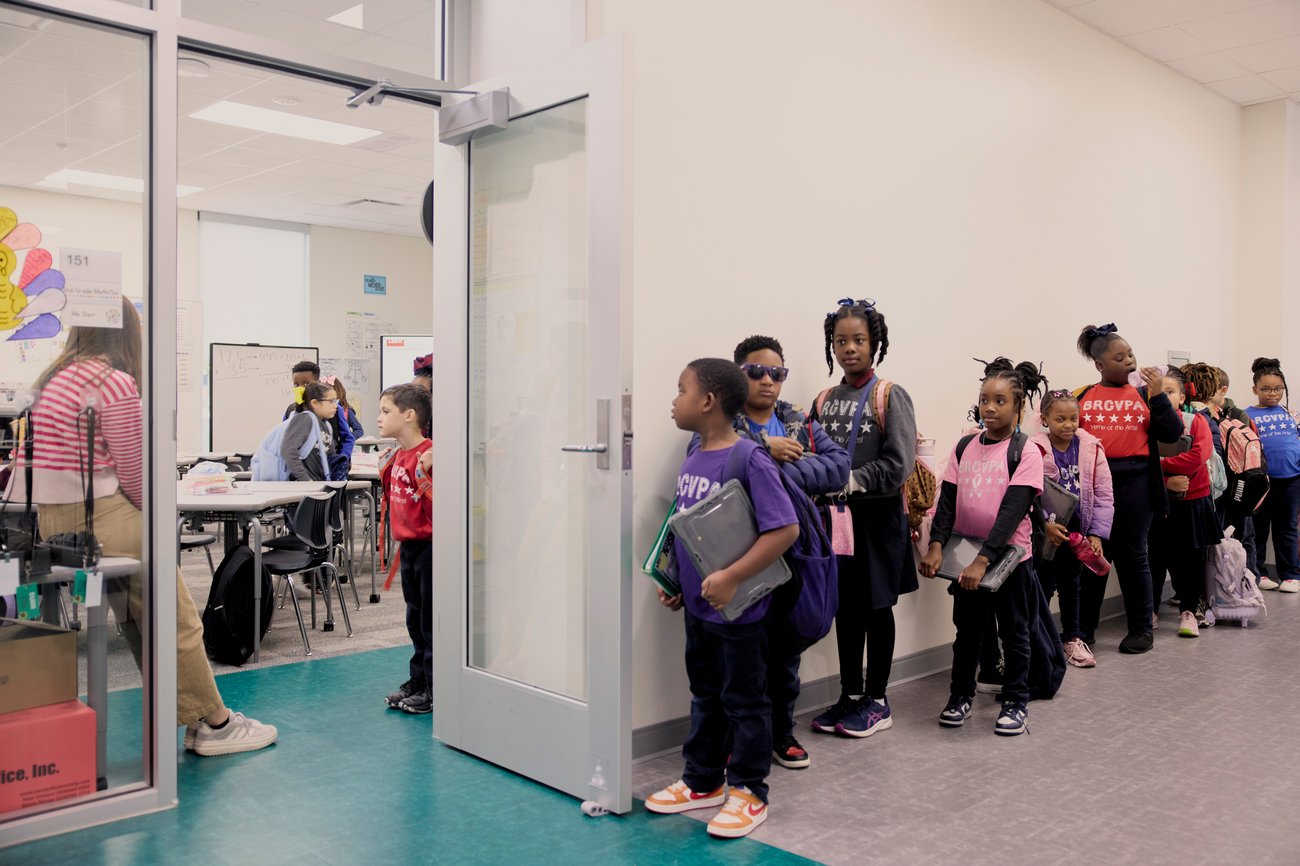
At the end of the hour, the second graders slung on their backpacks, gathered their Chromebooks and lined up at the door before heading to English and social studies class across the hall. While most schools wait until middle school to transition students from one class to another, kids at Louisiana’s Baton Rouge Center for Visual and Performing Arts do so starting at age 6 or 7. It’s part of a strategy known as departmentalizing, or platooning.
Anthony, rather than teaching all four core subjects, specializes in math. The school’s new facility, built in 2025, was designed with departmentalizing in mind: The classrooms have huge glass windows, so teachers can see their next class preparing to line up in the hallway.
“Teaching today is so different than it was a long time ago, and there are so many demands on them. And the demand to be an expert in your content area is very high,” said Sydney Hebert, magnet site coordinator for the art-focused public school in the East Baton Rouge Parish school district. “We want to make sure that our teachers are experts in what they’re teaching so that they can do a good job of teaching it to the kids.”
As schools contend with a decades-long slump in math scores — exacerbated by the pandemic — some are turning to this classroom strategy even for very young students. In recent years, more elementary schools have opted to departmentalize some grade levels in an attempt to boost academic achievement.
|