
| From | Wayne Pacelle <[email protected]> |
| Subject | The business case for ending animal testing is here |
| Date | January 11, 2026 3:13 PM |
Links have been removed from this email. Learn more in the FAQ.
Links have been removed from this email. Learn more in the FAQ.
͏ ͏ ͏ ͏ ͏ ͏ ͏ ͏ ͏ ͏ ͏ ͏ ͏ ͏ ͏ ͏ ͏ ͏ ͏ ͏ ͏ ͏ ͏ ͏ ͏ ͏ ͏ ͏ ͏ ͏ ͏ ͏ ͏ ͏ ͏ ͏ ͏ ͏ ͏ ͏ ͏ ͏ ͏ ͏ ͏ ͏ ͏ ͏ ͏ ͏ ͏ ͏ ͏ ͏ ͏ ͏ ͏ ͏ ͏ ͏ ͏ ͏ ͏ ͏ ͏ ͏ ͏ ͏ ͏ ͏ ͏ ͏ ͏ ͏ ͏ ͏ ͏ ͏ ͏ ͏ ͏ ͏ ͏ ͏ ͏ ͏ ͏ ͏ ͏ ͏ ͏ ͏ ͏ ͏ ͏ ͏ ͏ ͏ ͏ ͏ ͏ ͏ ͏ ͏ ͏ ͏ ͏ ͏ ͏ ͏ ͏ ͏ ͏ ͏ ͏ ͏ ͏If you’d like to unsubscribe, click here. [[link removed]]
[link removed] [[link removed]]
Dear Friend,
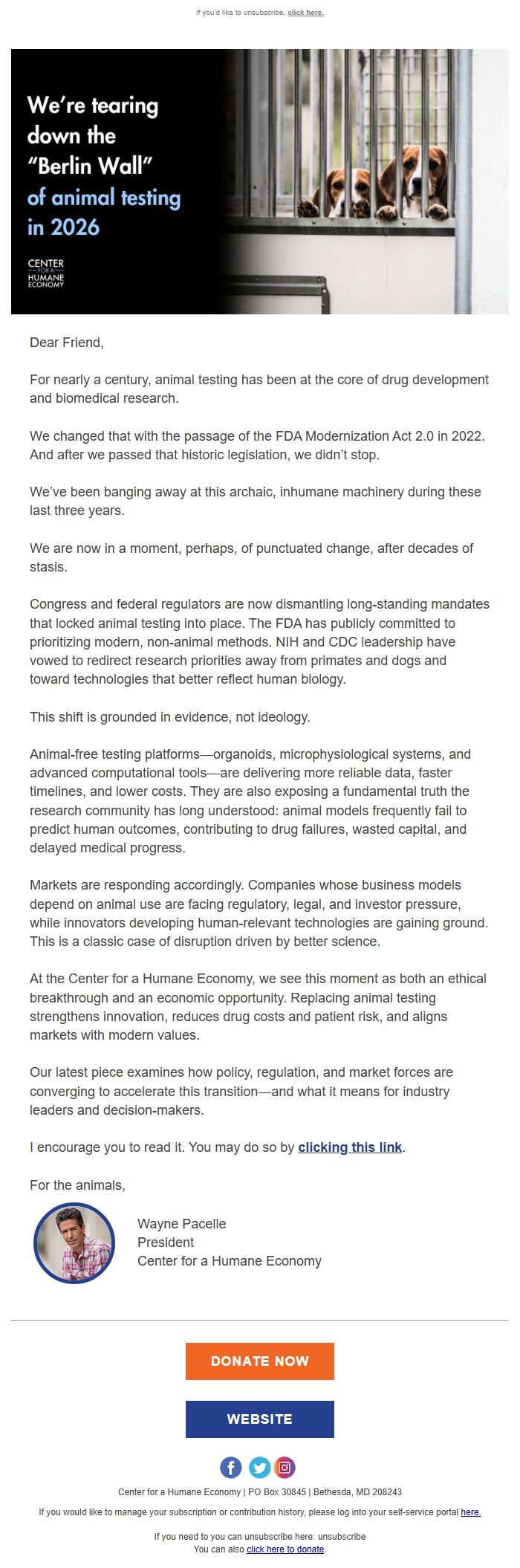
For nearly a century, animal testing has been at the core of drug development and biomedical research.
We changed that with the passage of the FDA Modernization Act 2.0 in 2022. And after we passed that historic legislation, we didn’t stop.
We’ve been banging away at this archaic, inhumane machinery during these last three years.
We are now in a moment, perhaps, of punctuated change, after decades of stasis.
Congress and federal regulators are now dismantling long-standing mandates that locked animal testing into place. The FDA has publicly committed to prioritizing modern, non-animal methods. NIH and CDC leadership have vowed to redirect research priorities away from primates and dogs and toward technologies that better reflect human biology.
This shift is grounded in evidence, not ideology.
Animal-free testing platforms—organoids, microphysiological systems, and advanced computational tools—are delivering more reliable data, faster timelines, and lower costs. They are also exposing a fundamental truth the research community has long understood: animal models frequently fail to predict human outcomes, contributing to drug failures, wasted capital, and delayed medical progress.
Markets are responding accordingly. Companies whose business models depend on animal use are facing regulatory, legal, and investor pressure, while innovators developing human-relevant technologies are gaining ground. This is a classic case of disruption driven by better science.
At the Center for a Humane Economy, we see this moment as both an ethical breakthrough and an economic opportunity. Replacing animal testing strengthens innovation, reduces drug costs and patient risk, and aligns markets with modern values.
Our latest piece examines how policy, regulation, and market forces are converging to accelerate this transition—and what it means for industry leaders and decision-makers.
I encourage you to read it. You may do so by clicking this link [[link removed]] .
For the animals,
Wayne Pacelle [[link removed]] Wayne Pacelle
President
Center for a Humane Economy
[[link removed]] DONATE NOW [[link removed]]
[[link removed]] WEBSITE [[link removed]]
[link removed] [[link removed]] [link removed] [[link removed]] [link removed] [[link removed]]
Center for a Humane Economy | PO Box 30845 | Bethesda, MD 208243
If you would like to manage your subscription or contribution history, please log into your self-service portal here. [[link removed]]
If you need to you can unsubscribe here: unsubscribe: [link removed]
You can also click here to donate [[link removed]] .
[link removed] [[link removed]]
Dear Friend,
For nearly a century, animal testing has been at the core of drug development and biomedical research.
We changed that with the passage of the FDA Modernization Act 2.0 in 2022. And after we passed that historic legislation, we didn’t stop.
We’ve been banging away at this archaic, inhumane machinery during these last three years.
We are now in a moment, perhaps, of punctuated change, after decades of stasis.
Congress and federal regulators are now dismantling long-standing mandates that locked animal testing into place. The FDA has publicly committed to prioritizing modern, non-animal methods. NIH and CDC leadership have vowed to redirect research priorities away from primates and dogs and toward technologies that better reflect human biology.
This shift is grounded in evidence, not ideology.
Animal-free testing platforms—organoids, microphysiological systems, and advanced computational tools—are delivering more reliable data, faster timelines, and lower costs. They are also exposing a fundamental truth the research community has long understood: animal models frequently fail to predict human outcomes, contributing to drug failures, wasted capital, and delayed medical progress.
Markets are responding accordingly. Companies whose business models depend on animal use are facing regulatory, legal, and investor pressure, while innovators developing human-relevant technologies are gaining ground. This is a classic case of disruption driven by better science.
At the Center for a Humane Economy, we see this moment as both an ethical breakthrough and an economic opportunity. Replacing animal testing strengthens innovation, reduces drug costs and patient risk, and aligns markets with modern values.
Our latest piece examines how policy, regulation, and market forces are converging to accelerate this transition—and what it means for industry leaders and decision-makers.
I encourage you to read it. You may do so by clicking this link [[link removed]] .
For the animals,
Wayne Pacelle [[link removed]] Wayne Pacelle
President
Center for a Humane Economy
[[link removed]] DONATE NOW [[link removed]]
[[link removed]] WEBSITE [[link removed]]
[link removed] [[link removed]] [link removed] [[link removed]] [link removed] [[link removed]]
Center for a Humane Economy | PO Box 30845 | Bethesda, MD 208243
If you would like to manage your subscription or contribution history, please log into your self-service portal here. [[link removed]]
If you need to you can unsubscribe here: unsubscribe: [link removed]
You can also click here to donate [[link removed]] .
Message Analysis
- Sender: Center for a Humane Economy
- Political Party: n/a
- Country: United States
- State/Locality: n/a
- Office: n/a
-
Email Providers:
- EveryAction