|
Goldstein For Congress - Please Subscribe and also visit us at www.goldsteinforcongress.com



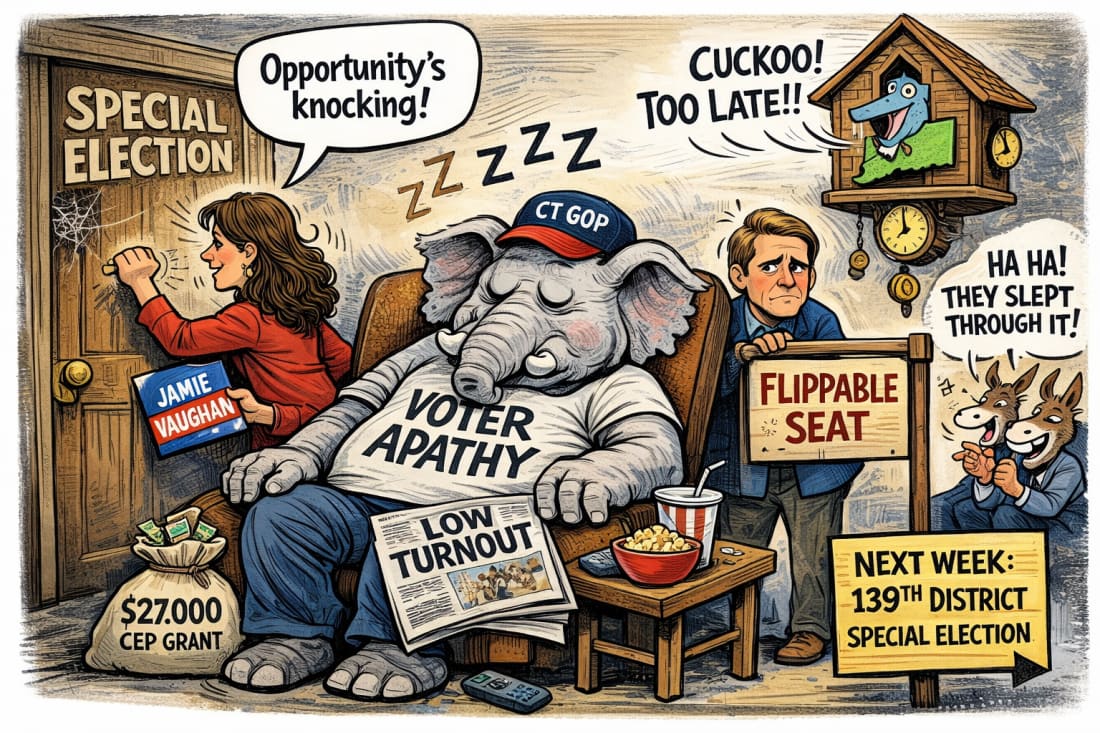 |
Yesterday’s special election in New Britain should have been a wake-up call for Connecticut Republicans—and for anyone who believes voter engagement still matters.
The race pitted Republican Jamie Vaughan against Democrat Iris Noemi Sánchez. Turnout was strikingly low: fewer than 600 voters cast ballots.
The results were as follows:
Iris Noemi Sánchez (D): 365 votes
Jamie Vaughan (R): 181 votes
This outcome is especially frustrating given the context. Vaughan previously ran for the same seat in 2024 and earned 1,543 votes, just under 30 percent of the total. Had even 40 percent of those prior supporters turned out in Tuesday’s special election, Vaughan would have won.
They didn’t—and that is the real story.
A Systemic Engagement Failure
What happened in New Britain reflects a broader, recurring problem in Connecticut politics: when there is a real opportunity to flip a seat, voters often do not show up—or do not even know the election is happening.
That failure is particularly striking given that New Britain is home to gubernatorial candidate Erin Stewart. Vaughan qualified for the Citizens’ Election Program (CEP) for $27,000 and had visible institutional backing, including Stewart’s support. Yet even with name recognition, resources, and leadership nearby, turnout barely registered.
This is not about one candidate or one endorsement. It points to a deeper issue: organizational follow-through and voter activation are breaking down, even in places where conditions should favor engagement.
The Numbers Tell the Story
The contrast could not be clearer. In November 2024, 5,157 voters cast ballots in this district. On Tuesday, that number collapsed to just over 500.
What makes this even more baffling is that Connecticut now offers early voting and online absentee ballot requests, tools specifically designed to make participation easier. And still, special elections routinely attract only a fraction of the electorate.
Special elections should be opportunities. Instead, they are being squandered.
Another Test Next Week
This issue will be tested again almost immediately.
Next week, a special election will be held in the 139th Assembly District, covering parts of Ledyard, Montville, and Norwich. Democrat Larry Pemberton Jr., also endorsed by the Working Families Party, will face Republican Brandon Sabbag.
Early voting for the January 13 election will be available from January 8–11, between 10 a.m. and 6 p.m.
In the 2024 general election, 10,799 voters turned out in this district.
The question now is simple—and troubling:
Will turnout again collapse into the hundreds?
A Call to Action, Not Infighting
This is not about creating infighting within the Republican Party, favoring one gubernatorial candidate over another, or assigning blame after the fact. It is a call to action.
Special elections are won on awareness and turnout. If you know voters in these towns, if you are connected to local Republican Town Committees, or if you are part of grassroots networks, there is a responsibility to apply pressure where it matters: getting voters to the polls when a seat is truly in play.
In New Britain, Jamie Vaughan could have won. With modest engagement, that seat could have flipped—nudging the Democratic supermajority back, even if only slightly. Those margins matter. Every seat matters.
The lesson here is not ideological. It is operational.
If parties want to win special elections, they must do more than nominate candidates or issue endorsements. They must communicate urgency, activate local networks, and treat special elections as what they are: rare, high-impact opportunities.
Otherwise, the result in New Britain will not be an exception. It will be the rule.
And that should concern everyone—regardless of party.
 | A guest post by
|
The Goldstein Substack is free today. But if you enjoyed this post, you can tell The Goldstein Substack that their writing is valuable by pledging a future subscription. You won't be charged unless they enable payments.
| ||||||||||

