Expert analysis made easy. Breaking down the news with data, charts, and maps.
Edited by Brady Africk and Isabella Grunspan
Happy Tuesday! In this final DataPoints newsletter of 2025, we examine five figures that help explain the policies and events that shaped the past year.
Don’t forget—subscribe and send DataPoints to a friend!
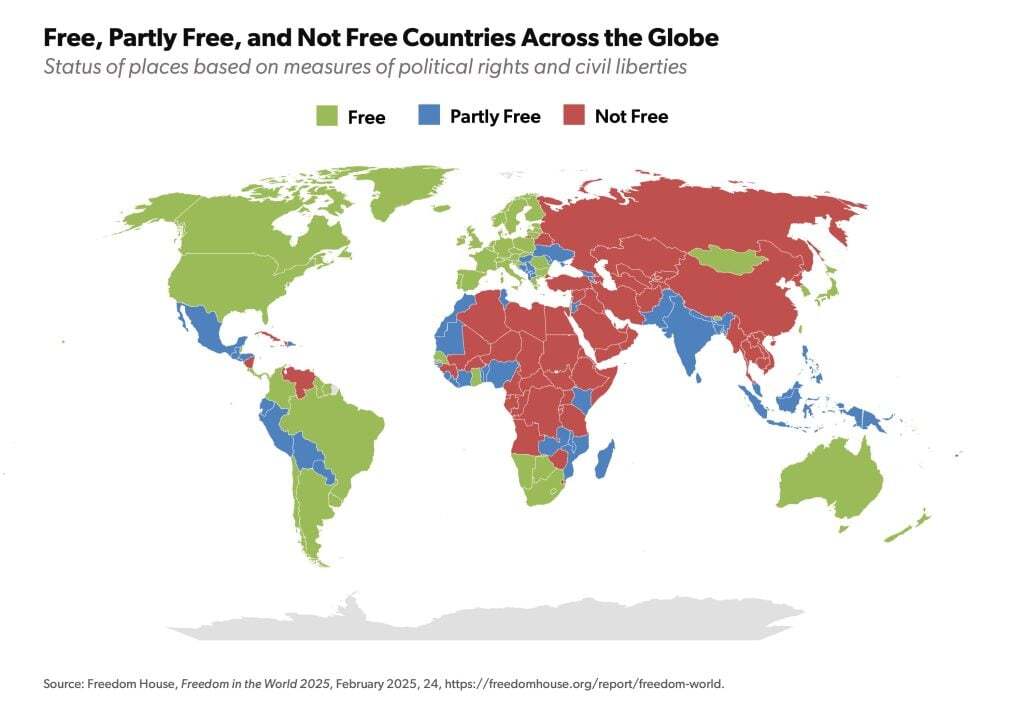
Topline: From World War II to the early 21st century, democracies grew to be the dominant form of government. Now, AEI’s Hal Brands warns that democracy’s popularity is slipping. In each of the past 19 years, more countries have shifted toward authoritarianism than toward democracy.
The Numbers: Roughly half of the global population lived in a democracy in 2004, but now three-quarters reside in an autocracy. Globally, autocracies command a larger share of global gross domestic product than do democracies, when measured at purchasing power parity.
Looking to the Future: Historically, the balance of rival forms of government has typically mirrored that of rival states. Brands argues that President Donald Trump, a frequent ally of strongmen, has created two plausible scenarios—the US retreats from the fight for the world's democracies or becomes an illiberal superpower itself.
"The world’s ideological complexion changed dramatically, for the better, once democracy’s fortunes were buoyed by US power. It could change dramatically, for the worse, if America gives up on—or switches sides in—the fight.”
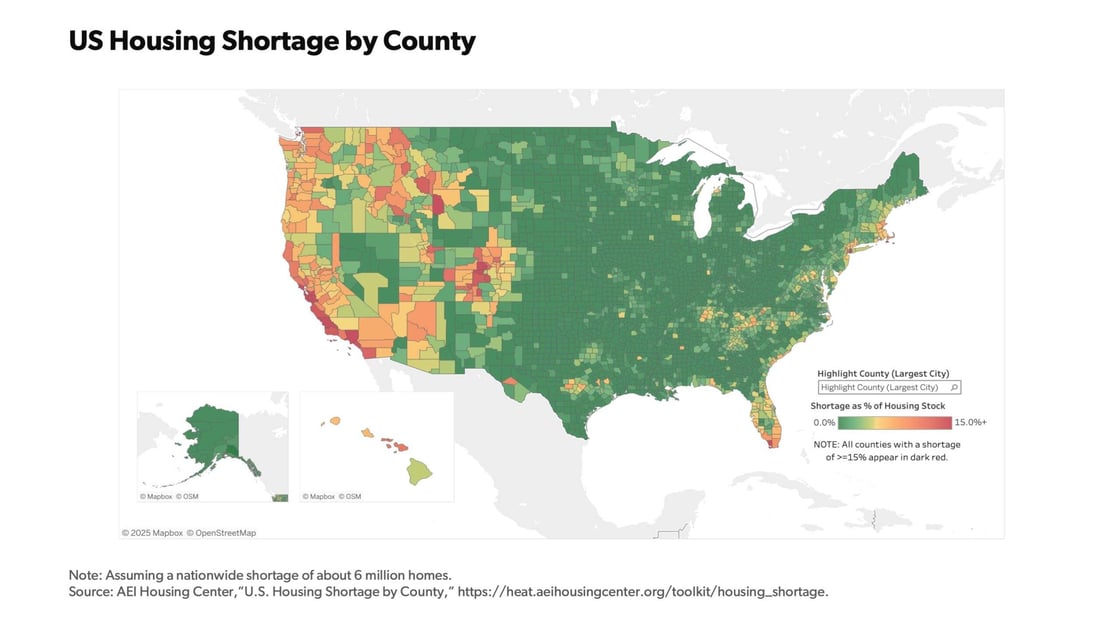
Topline: An analysis of new data estimates that the US currently faces a major housing shortage of between 3.8 million and 8.2 million homes. AEI’s Tobias Peter and Edward J. Pinto pinpoint local shortages and find that California is the epicenter of the issue, with approximately two million missing homes traced back to the state.
A Regional Failure: By itself, California accounts for about 1.4 million missing homes. With the state's history of tight regulations, housing prices have soared while supply continues to falter. The problem has bled into neighboring states. As people have fled California’s high housing costs, mass movement across state lines has driven up home prices and rents in receiving states such as Nevada and Idaho.
Build Better Homes: To address this ongoing crisis, Peter and Pinto argue that boosting supply in states with the most severe shortages is essential. Allowing smaller lot sizes in new subdivisions, enabling single-family-to-townhome conversions in expensive neighborhoods, and adding mixed-use zoning in underused commercial corridors are potential policy solutions to alleviating housing shortages in the next decade.
"California alone accounts for an estimated 1.4 million homes of this excess shortage, making it the single largest contributor to America’s housing crisis. The other 10 blast zone states contribute another 0.6 million homes in excess of the national baseline. This finding underscores a stark reality: if these 11 states had maintained housing supply levels similar to the rest of the country, the national housing shortage would have been nearly one-third lower."
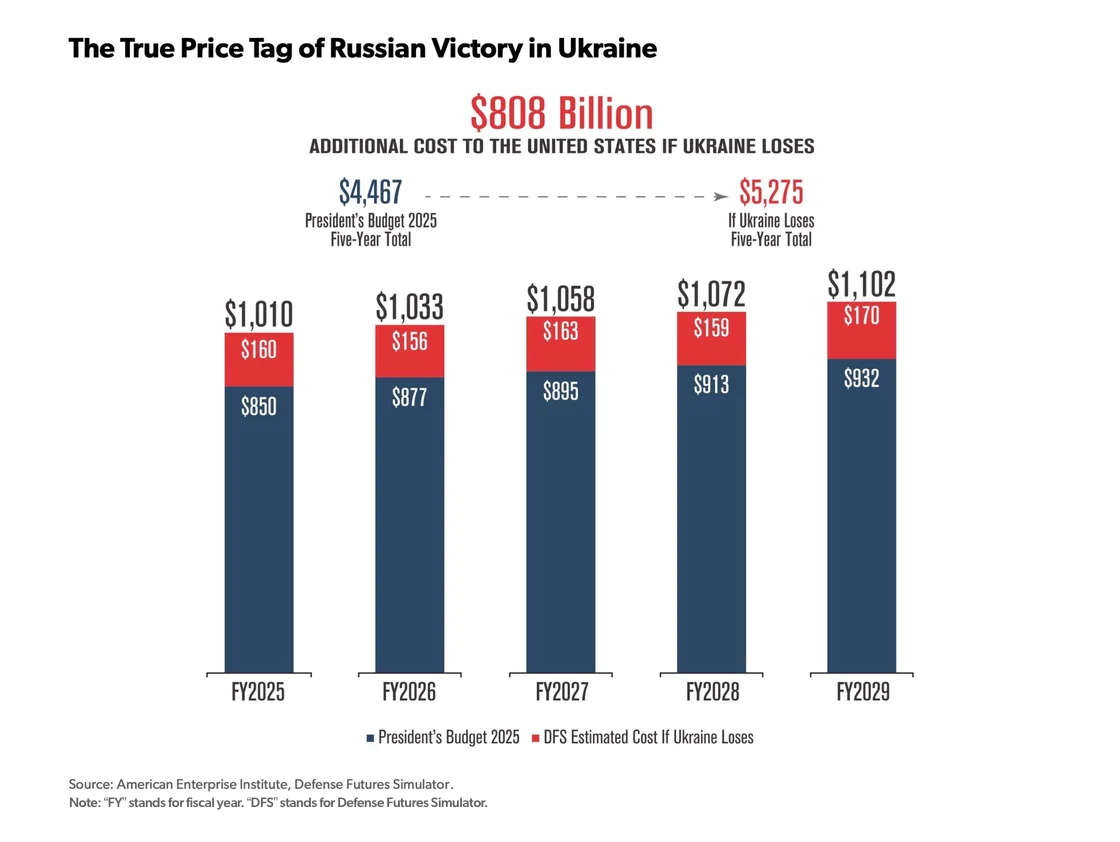
Topline: If Russia wins in Ukraine, US defense spending will likely increase by hundreds of billions of dollars over the next five years. AEI’s Elaine McCusker, Frederick W. Kagan, and Richard Sims examine what it would cost for America to defend Europe from a victorious Russia and conclude that the US would need to spend an additional $808 billion on defense by 2030.
The Details: US defense spending would need to increase across the board to defend America’s crucial global interests and allies. This includes an increase in spending on land power ($87.8 billion), sea power ($50.3 billion), airpower ($108.7 billion), unmanned assets ($28.9 billion), munitions and air defense ($173.1 billion), basing and troop readiness ($248.4 billion), and space and cyber capabilities ($36.5 billion).
Key Takeaway: Supporting Ukraine is in America’s best financial interest. McCusker, Kagan, and Sims conclude that the near-term cost of supporting Ukraine is dwarfed by the long-term costs of allowing Russia to win. We should do everything we can to help Ukraine win now—or we will pay more in “blood and treasure later."
"A world in which Russia beats Ukraine will be more dangerous and more expensive for America—and likely much more of both than we capture here.”
AEI's work depends on the generosity of our supporters, who believe in our vision of a freer, safer, and stronger America. Would you be willing to make a tax-deductible donation today that will help our scholars continue this important work?