Janine Jackson interviewed Popular Information's Judd Legum and Citations Needed's Adam Johnson about gambling on the news for the December 12, 2025, episode of CounterSpin. This is a lightly edited transcript.
Janine Jackson: If you see no problem in news outlets reporting on horrific conditions in Gaza, and what various political entities are doing or could do to address them, while at the same time a ticker at the bottom of the screen offers you the chance to gamble, for money, on whether or not "famine" in Gaza will be officially declared—this episode is not for you.
We'll be learning about the deal just struck by "news" outlets CNN and CNBC with the “prediction market operator,” evidently what we're calling them now, Kalshi Inc. We'll hear from Judd Legum, founder and author at the newsletter Popular Information, and from author and analyst, Adam Johnson of the SubstackThe Column and the podcast Citations Needed.
CounterSpin and FAIR have, for decades now, been calling out the conflict in having the media that we rely on for news be owned and operated by corporations whose only abiding interest is profit, and quarterly profit at that. If officially signing up with gambling companies to encourage news consumers to win, or of course lose, actual money on the outcome of real-world events isn't a clear enough sign of that conflict, and of the urgency of supporting non-corporate journalism, well, it's hard to know what would be. You're listening to CounterSpin, brought to you each week by the media watch group FAIR.
***
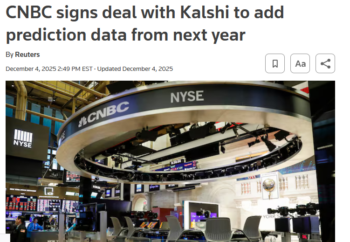
Janine Jackson: CNN and CNBChave announced they are partnering with Kalshi Inc., described by Wikipedia as "a financial exchange and prediction market…offering gambling via event contracts." Their tagline is “Prediction Market for Trading the Future.” So these news outlets, we're told, will now integrate Kalshi’s predictive information into their journalism. I could joke, “What could go wrong?” But seriously, what could go right?
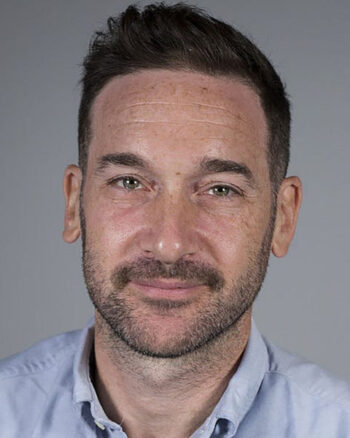
Judd Legum is founder of the independent newsletter Popular Information. Their mission statement, if you will, declares, “You are not a spectator, and democracy is not a game.” He joins us now by phone. Welcome CounterSpin, Judd Legum.
JJ: Kalshi CEO Tarek Mansour has been going around saying—you cite it in your recent report—that “Kalshi is replacing debate, subjectivity, and talk with markets, accuracy and truth”—which I think should raise hairs on the back of your neck, frankly. He added, “We have created a new way of consuming and engaging with information.” Again, so many more questions than answers there.
But I know that there are many listeners asking, “What's a Kalshi?” You can't explain everything, but if you could just ground us a little bit in what we are talking about, what could be different when I turn on CNN, or next month's CNBC, looking to find news about the world?
JL: Kalshi is a platform—and there are other similar platforms; there's one called Polymarket as well that's fairly prominent—and they basically allow you to take bets on any future event. We're very familiar with sports bets, because they've become ubiquitous in American life, as that's become legal. Who's going to win in the Giants versus the Broncos? You can pick one team, you can pick the other. You can make a whole bunch of different kinds of bets on different things that might happen in the game. And if what you predict comes true, you win some money. If what you predict doesn't come true, you lose your money.
Kalshi basically takes that concept and has expanded it to every aspect of your life. So politics obviously is something that I focus on in the newsletter. That's something that is a major source of these prediction markets on Kalshi as well. You could bet on, who do you think is going to be the president in 2028? Do you think it's going to be JD Vance? Do you think it's going to be Gavin Newsom? Those are probably a couple of the leading candidates; that might be, at this point, 30 cents to buy one share of JD Vance, and if he does become president, you get the full dollar. If he doesn't, you lose your 30 cents.
It goes well beyond that. You can bet about whether a pop star will say the word “cheese” during their acceptance speech for an award. You can bet on who's going to win the next Oscars. You can bet on anything. And this has really exploded in popularity, really in 2025, because before then, we didn't know whether it was legal, and in 2024 they won a big lawsuit, essentially establishing them as at least mostly legal.
JJ: Even with what you've just said—because I looked at the Kalshi site, and it was, who's going to be president, would it be JD Vance or Gavin Newsom?—can't we already see the journalistic problems there, where you're already telling people that the next presidential race is going to be between JD Vance and Gavin Newsom already?
My first work at FAIR was around the 1992 presidential primary, and one of the things I was coding for was horserace coverage: stories that didn't talk about ideas, didn't talk about policy or the impacts of that policy, but were solely about who looked to be ahead in the polls. And at that time, it was generally understood that that was bad, that was bad journalism. That wasn't what a press corps was there to do. So questions leaped to the mind about this, yeah?
JL: So I think there's a couple of issues with that, and the first one is what you just touched on, which is that it really trivializes this coverage. Even if you just assume for a minute that these markets are accurate, and it really is a 33% chance that candidate X is going to be the next president, and a 15% chance that this other candidate is going to be—it really doesn't matter. We will find out in November 2028 (hopefully) who will be the next president, and then we will all know. So the prediction itself isn't really very useful if you're a news consumer.
Judd Legum: ""If you're a wealthy supporter of JD Vance, you now have an easy way to create a story on CNN, simply by placing a bet for your favorite candidate."
But the other really big issue with this, especially as we are now using this to drive coverage, and essentially what CNN is saying, and what CNBC is saying, is that if we see a big move, if JD Vance goes from 30 cents to 50 cents, we're now considering this a news event which we are going to cover on our air. So that's crowding out the other events.
But also, these markets, while they are large overall—there's about $50 billion wagered on Kalshi this year; it'll probably be more next year—they are still very small in terms of markets. Stocks, there's over $600 billion transacted in stocks every day, so it's much easier to manipulate these markets. So if you're a wealthy supporter of JD Vance, you now have an easy way to create a story on CNN, simply by placing a bet for your favorite candidate. It might only cost, even in the presidential context, a couple of million dollars. If you go down to the congressional level, or the Senate level, it's going to cost much less. These are relatively small markets.
JJ: And it seems to me to be coming back to money as speech. What if I'm not betting on an election? What if I'm just a concerned citizen who wants a president or elected officials who can enact policies that help me? I'm not looking to a media outlet to tell me who's winning in the market of money betting on the election. I want news about what's meaningful to me. It just seems like such a core perversion.
JL: Yeah, it's a very sort of libertarian philosophy that these markets are what's revealing the truth. You saw that in the quote from the Kalshi CEO, which you read in the beginning, that it's incorporating all of the relevant information. But especially in a political context—maybe you can argue that's true (it's not always true) with stocks, but stocks are really just about money. I mean, that's what they are. You're trading them. These are corporations that are trying to make money.
There's so much more involved in politics, and especially in an era of wealth inequality, and where we are now, where most people are not using these prediction markets, to say that all available information is captured in who is deciding to spend money where in these markets, is just clearly a fallacy, which people can believe that, or they cannot believe that. But then you take that premise, and you're now saying, “We as CNN, we as CNBC, fairly prominent news organizations, are going to accept that, and now present changes in these values as news,” really creates a distortion effect—even beyond purposeful manipulation, which I think is a big problem. But even beyond that, it distorts whose voice counts and whose voice doesn't count.
JJ: Absolutely. And it would be one thing, and back in '92 there would be stories that would report solely on polling, and that would be its own story, and it would be one thing, I'd have my own questions about it. But if CNN, CNBC, had a section in the news where they were like, “Oh and hey, here according to polling, or this particular kind of polling that is expressed with money, here's this.” But to say, we are going to consider that news, and we are going to use that to shape our coverage, is Bizarro World to me, in terms of journalistic judgment.
JL: They are buckling to the pressure, under a lot of pressure, with this idea that they are biased. So that's really what drew so many people to the polling coverage. There was quite a bit in 1992, but I would argue that there's a lot more now, that this has become a bigger and bigger slice of the news pie, so to speak.
This is an extension of that, because what it allows you to do is have a whole other way of talking about politics, without having to actually grapple with the issues of values, with the issues of the impact on people. Because when you start talking about that, that's when you start to open yourselves up to allegations of bias.
And it really goes to the heart of, what is your role as a journalist? Is your role to not say anything that offends anyone, and not say anything that anyone could possibly disagree with? Or is your role to actually report accurately about the actual impacts of what's at stake in these events?
JJ: And one might say even, importantly, to represent the voices of the people who don't have money to bet on the presidential race, to represent the voices of people who are affected by policy, but who are not making policy, who are affected by changes, but who are not in charge of making those changes. It just seems like a core part of a journalist's job.
JL: I agree with that. I agree with that. And I think, even beyond that, even if you have money, this is not a good place to spend it. These markets are not good places to spend it.
You can look at the stock market. There's all sorts of issues with how these companies manipulate their stock prices, and are maybe too focused on pushing their stocks up and up. But if you're investing for your retirement, or something of that nature, you can look at the trends over 10, 20, 30, 40 years, and generally, they go up, at least over the very long term, because there are things being created. There is stuff being done, and you're buying a little chunk of that.
These prediction markets are zero sum games. There's somebody who's betting that Gavin Newsom is going to be the next president. There's someone betting that he's not going to be. And you're either winning or you're losing.
And then on top of that, Kalshi, they have to make money too, so they take a fee, a chunk of that for themselves. So, overall, the participants in this market—unlike the stock market, where there's value being created—overall, people are losing.
So if you place these bets, you can expect to lose, and that's exactly what happens. It's guaranteed. It's very similar to a casino in that way. You might pull a slot machine and win, and you might win over a couple of days, but if you just sit there and pull the slot machine for six months, you're definitely going to lose. And that's very similar to what happens in these markets over the long term.
JJ: That's going to leave me with my final question. I'm, first of all, going to try to imagine us talking to people who are like, “Candidate X needs to win because I have money on candidate X, and so I'm going to do some stuff to encourage candidate X to win, whatever that might entail.” I think folks can think about that for themselves.
But in response to the last thing you said, I want to tell you what the Kalshi spokesperson said: “Kalshi works like the stock market instead of a casino. In casinos, the house always wins. With Kalshi, there is no house. We don't win when our customers lose.” Sounds like you don't think that's a hundred….
JL: Yeah, that's not true. I would agree that it's not necessarily like a slot machine, where the odds are against you. You can see the odds, but you're competing against the other people who are betting, and then Kalshi is taking fees. They have to make money, so you're going to lose.
JJ: They make it sound like they're not making any money at all. Like it's a public interest enterprise.
JL: It's a lot of things, but it is definitely not that. They're interested in making money.
JJ: Well, I said finally, but I'll just, as a coda: It sounds like, as in many issues, independent reporting that is outside of corporate control that is interested to make deals, to make money, to make…. Sometimes, as in this case, the world seems to make the case for those of us who support independent journalism. And I think we still want to say that. I don't want a story like this to make people think “the media” are corrupt and “the media” are terrible, because there's folks out there that are trying to actually interrogate deals like this, and trying to have a different definition of what news is.
JL: Yeah, I think that's right. I think if there's anything we've learned, really, over the last year, it's that it's really important to diversify your news consumption beyond corporate media, because so many of these companies are becoming more and more compromised politically.
JJ: Right. We'll end on that note. We've been speaking with Judd Legum. He's founder of the newsletter Popular Information. You should check it out. Thank you very much, Judd Legum, for joining us this week on CounterSpin.
Janine Jackson: AdWeek,Business Insider, CoinDesk,Card Player,Investopedia,Gaming Today—they were all over it. But so far, as we record on December 10, big, important elite news media don't seem very interested in the fact that major news outlets CNN and CNBC are going to integrate predictive market operator Kalshi into what we, perhaps quaintly, call journalism.
The deals indicate the growing need for prediction-market data, long viewed as niche and sometimes controversial, in the mainstream financial news, as publishers look to enhance audience engagement with new insights.
OK, so that's troubling enough, but it isn't “financial news” that will be affected alone.
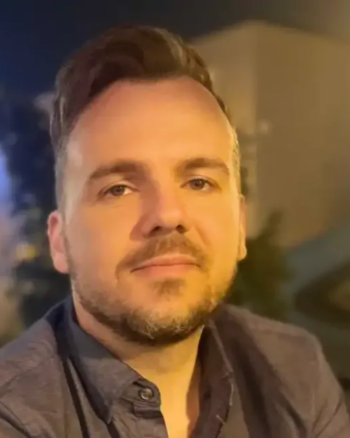
We're joined now by Adam Johnson. He is the author, with contributions from Sarah Lazare, of the media criticism and political analysis SubstackThe Column, and co-host, with Nima Shirazi, of the podcast Citations Needed. He joins us now by phone. Welcome back to CounterSpin, Adam Johnson.
Adam Johnson: Hi, thanks so much for having me on.
JJ: I touched with Judd Legum on the obvious (to me) screaming problems with telling people to bet on who's going to win the next presidential election, JD Vance or Gavin Newsom. Amongst so many other thought-stopping things, that tells you that these are the only two people that you need to be thinking about. It's just bizarre to think that serious news outlets would think that this is on mission in any conceivable way. But for anyone thinking, “Well, elections are kind of a contest, like a football game, whatever,” we need to understand this isn't the scope of what we're talking about here.
Adam Johnson: "You have a double standard about which populations are considered roulette chips on a roulette table, to be used as wagers."
AJ: No, it's not. In fact, Kalshi permits—or permitted, I should say, before the market closed in August of last year—for people to bet on whether or not there'll be famine in Gaza. There are many other betting opportunities at both Kalshi and their main competitor, Polymarket—which is a more lurid, more grimy version, backed by Peter Thiel. Unlike Kalshi, it's not seeking as much mainstream credibility, although it is, of course, a main sponsor of the Young Turks.
And Polymarket lets you bet on whether, when and if Gaza will be bombed next, when the West Bank will be bombed, whether the West Bank or Gaza will be annexed—indeed, still has a market, if one wishes to bet on it, for whether or not there'll be ethnic cleansing in Gaza. They let you bet on “mass population transfers,” which is another term for ethnic cleansing.
So these betting markets permit people—of course you can bet on whether or not Russia will bomb or invade certain territories in Ukraine. Needless to say, you cannot bet on whether or not Israel will be bombed or attacked. That is not permitted, or at least not offered. So obviously there are certain populations who are deemed worthy of this level of dehumanization and gamification, and those that are not.
You can't bet on whether the US gets attacked. You can't bet on whether or not Trump will be killed, although some people may argue you could, by implication, by simply betting on whether or not JD Vance will take office, or whatever. But, obviously, there are many ways that could happen.
So you have a double standard about which populations are considered roulette chips on a roulette table, to be used as wagers. Obviously these things, just prima facie, should not be legal. You should not be able to bet on genocide. I think that's probably a fair baseline moral assertion that I would be comfortable making.
But these guys, by their own admission, they want to gamify, they want to turn every single uncertainty in life into a wagering opportunity. And as I'm sure your previous guest touched on, this is obviously rife with conflicts of interest and moral hazards for fairly obvious reasons, which is, unlike the outcome of the Bears/Packers game, there are sometimes hundreds, if not thousands of humans who have intimate knowledge of whether or not these outcomes will take place prior to the settling of the betting market. (They call it a prediction market, but it's a betting market.) And it basically just incentivizes and promotes insider-trading. It promotes rent-seeking. Of course, none of this has any social value.
Now, the thin sort of moral logic or moral argument that its defenders have used, especially in the context of their partnership with CNBC and CNN, is that, “Oh, it provides more clear analysis," and CNN uses this term "data.” Now, when CNN uses the word "data" in the context of its partnership with Kalshi, what it means is betting odds, just like they put the betting odds on ESPN a few years ago when ESPN and Disney got into the gambling industry. They want to promote you to go on the app and bet.
Now, presumably, we don't know for sure, but presumably CNN is taking some percentage of this gambling money. Again, one of the dozens of obvious moral hazards is that this will incentivize the news to prioritize that which solicits the most gambling, and not that which has the most political or social relevance, not that which challenges power, not that which exposes injustice or highlights misdeeds, but that which generates people wagering.
So, obviously, this is a more extreme, kind of pornographic version of what we've seen in a trend in media over the last decade or so, which is this polling obsession, right? This horserace polling obsession. Obviously FAIR has written about it for decades, but this idea that, the way you turn politics into a spectator sport where you're sort of watching, everything's disempowered. There's no real moral stakes, there's certainly no kind of sense of injustice, or right or wrong. There's just two teams that are playing, and you're a passive consumer who roots for their respective team, or, in this instance, gambles on them.
This, of course, removes the conversation away from the normative or the ideological into the realm of fatuous and speculative and horserace, because, again, predicting things is not a very meaningful political analysis. It's not a meaningful political insight. You're not at the Gulf Greyhound race with some retirees waving tickets in the air. These are real human, life-and-death situations.
Obviously, many of the things being wagered on, now some of the things you're wagering on, are maybe fairly benign. What's the weather in Chicago? There are markets for all kinds of inanities, but there's really a lot of human life–ending stuff, like the genocide in Gaza, like whether or not certain cities in Ukraine are occupied and bombed by Russian forces. And, again, the fact that you can't do that for Israelis or Americans does indicate that there are certain lives that are considered intrinsically valuable, and there are those who are considered chips on a roulette table.
And so the conflicts of interests are obvious. Obviously, CNN cannot determine the news, but they can certainly determine the perception of the news, which is to say they can very easily move markets by any report or comment they make on air. Now, Kalshi has in-house betters, so Kalshi themselves wagers on the market. So to what extent are they going to use their partnership, or their emphasis on certain betting markets, to manipulate markets to their liking?
And, again, all this does is incentivize scams and insider-trading and rent-seeking and all these kinds of parasitic economic activity that produces nothing of value. It doesn't cure a disease, it doesn't make the trains go faster, it doesn't provide news. It doesn't edify or educate or create a more robust civic polity. It does nothing of moral or social value. It's just pure race-to-the-bottom degenerate gambling, which is unfortunately one of the major exploding markets in our economy, along with various kinds of AI scams.
And so CNN getting in on it is really just an open admission that their job is not even really to hold power to account, or to whatever the kind of Journalism 101 moral cliche you want to use, “afflict the comfortable," that kind of thing. It's a gamification.
And Harry Enten, the data guy who’s spearheading this, I asked him directly on Twitter. I said, “Are you going to permit, are you going to put odds up on the screen, to bet on famine in Gaza?” He didn't get back to me, but I am sort of curious where they're going to draw that line. Are they going to use things like war, conflict, genocide, starvation, famine, disease as that which can be wagered on, which I think on a basic moral intuitive level we know is wrong, even if it's directly or indirectly, many of these markets are openly, directly wagering these things. And whether or not this is something that CNN gets a rake from, like any other casino.
And like all gambling, it's a regressive tax. It fundamentally takes money, in the aggregate, from poor and working people, and moves it to five counties in Connecticut and Nevada and California and New York.
And that's the end game. The end game is just to keep picking people's pockets. We see this with the rise of pushing crypto. And, again, it's no accident that the Trump family fortune has increased $1.8 billion since he's taken office, and it's almost all on crypto. It's just a way of legalized bribery, and they want to “democratize” the pool of people who were involved, whether it's crypto or NFTs, before that fad went away. And gambling is just another version of that. It's a way of creating more marks. And by partnering with CNN, you’re pushing this app on more marks.
JJ: All right, well, we're going to end there for now, for the moment. We've been speaking with Adam Johnson of the SubstackThe Column, and of the podcast Citations Needed. Thank you so much, Adam Johnson, for joining us this week on CounterSpin.