|

|
Alliance Leader Stresses Importance of Strengthening Social Security and Expanding Access to Pensions at Senate Hearing |
|
|
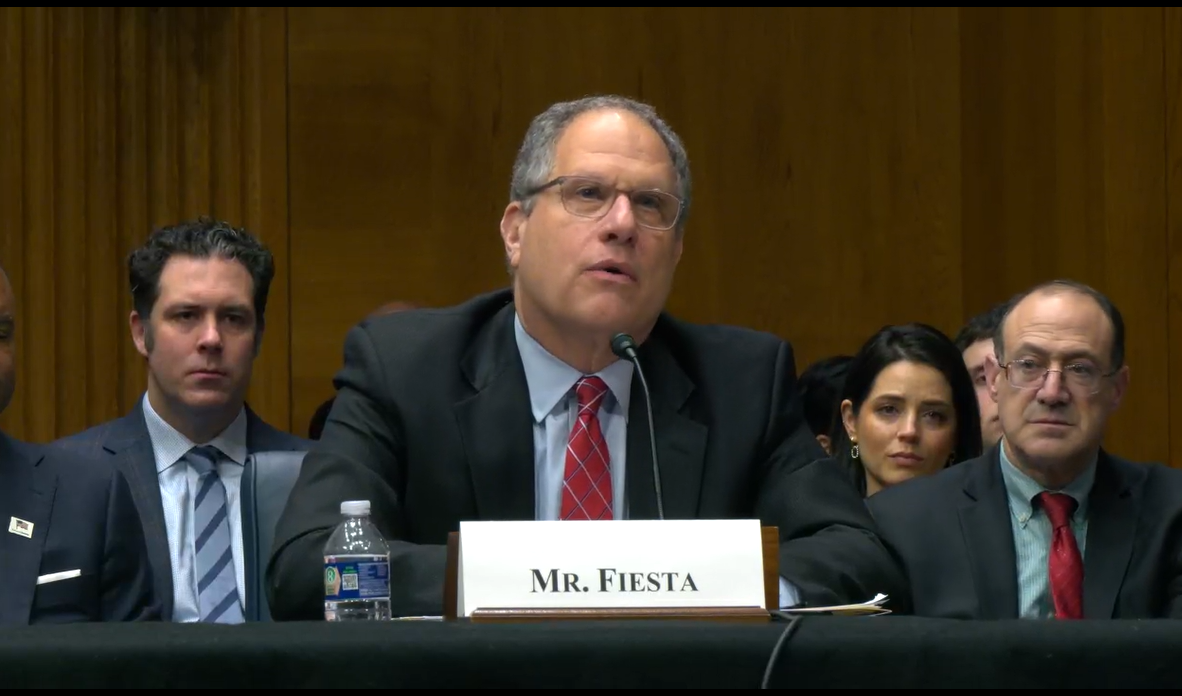
On Wednesday, Alliance Executive Director Richard Fiesta testified at a hearing entitled “The Future of Retirement,” in the Senate Committee on Health, Education, Labor & Pensions (HELP). A recording of the hearing can be viewed here. |
|
Fiesta’s testimony focused on the fact that retirement security is slipping away for too many Americans, and what we can do to address the problem: strengthen and expand Social Security, increase wages and access to defined benefit pension plans for workers, and ensure that $2.1 trillion in unclaimed 401(k) funds reach the workers who earned them.
Democratic Senators touched upon Alliance priorities, including adopting the Consumer Price Index for the Elderly (CPI-E) for annual Social Security cost of living adjustments, and making the wealthy pay their fair share into Social Security. Senators also discussed relevant legislation, including the Social Security Expansion Act (S. 770), introduced by Ranking Member Bernie Sanders (VT).
“Let's be clear, expanding Social Security is only part of the solution, but it’s an important one. If we do what my legislation proposes, you would increase the solvency of Social Security for 75 years and increase benefits for people on Social Security,” said Sen. Sanders.
Sen. Patty Murray (WA) pointed out that lawmakers need to take meaningful steps to reduce costs, reminding viewers that Affordable Care Act tax credits will expire soon and increase premiums for millions of older Americans unless Congress takes action. She also described how this year’s staffing cuts have resulted in long call wait times and difficulties for her constituents when they try to contact the Social Security Administration, asking Alliance Executive Director Fiesta if members have similar experiences.
“We've heard similar stories. It used to be a year or so ago you could go into a Social Security office if you needed a new card, prove who you were, and a new card appeared in the mail within ten days or so. Now, if you can even get to an office, you can't do that and they'll get you an appointment in two, three months for something so simple as that,” said Fiesta. “We're at a point in our history where 11,400 people are turning 65 every day, and have the lowest number of staff at Social Security in 50 years. So we're in a demographic crisis, but for individuals who need those services -- which we pay for, because all those workers are paid out of the Social Security Trust Fund -- they aren't getting them.” |
|
Senate Fails to Extend Affordable Care Act Subsidies As Republicans Struggle to Build Consensus on Health Care Plans |
|
The U.S. Senate rejected two separate health care proposals by a margin of 51 to 48 votes on Thursday, dimming the outlook for an extension of expiring Affordable Care Act tax credits. If the tax credits end, 22 million Americans who purchase health insurance through ACA exchanges will see their premiums increase by as much as 114 percent in January.
The first bill, proposed by Democrats, called for extending ACA subsidies for three years. The second bill, offered by Republicans, would have created new health savings accounts to assist Americans with medical expenses but would not have restored the tax credits.
House Speaker Mike Johnson (LA) said he is committed to holding a vote on health care next week. But so far members have failed to reach consensus regarding legislative options. A group of moderate Republicans upended discussions on Wednesday by introducing a discharge petition to force a vote on a bill to extend ACA tax credits for two years.
“Millions of older Americans rely on the Affordable Care Act for health coverage. They shouldn’t have to deal with huge premium increases at a time when they’re already struggling to afford necessities because Congress can’t get its act together,” said Robert Roach, Jr., President of the Alliance. “It’s time for lawmakers to take action and fix the health care crisis. Health care should be accessible and affordable for all of us.” |
|
Medicare Scam Calls Reach Critical Level for Seniors |
|
A news report from the New York Times this week showed how intrusive scam calls have become during Medicare’s annual open enrollment period. Complaints about fraudulent calls have increased 40 percent over the last year.
Scammers typically impersonate health care professionals or insurance providers to get personal details they can use to make a profit by fraudulently billing the victim’s Medicare account and/or secondary insurer for services they didn’t actually request, often distorting the victim’s medical records as a result. Some scammers use information they have already compiled about older Americans, including Social Security or Medicare numbers, to establish credibility during calls and extract more details to add to their data troves.
Seniors will receive up to dozens of calls each day, seeking personal information or offering benefits they already have. The calls happen throughout the day, making their phones unusable and basic daily life nearly impossible for victims. Calls often continue despite efforts to block numbers.
Open enrollment season is an especially vulnerable time for many seniors, and scammers exploit the anxieties and questions. Unfortunately for many, calls often continue after the period is over.
“Medicare officials will never call beneficiaries unsolicited and ask them for personal details or payment information,” said Joseph Peters, Jr., Secretary-Treasurer of the Alliance. “Seniors can fight back by hanging up and reporting suspicious callers, looking out for medical services or devices listed on statements that they did not request, and contacting their local Senior Medicare Patrol office for help.” |
|
KFF Health News: Trump’s Idea for Health Accounts Has Been Tried. Millions of Patients Have Ended Up in Debt. |
|
Sarah Monroe once had a relatively comfortable middle-class life.
She and her family lived in a neatly landscaped neighborhood near Cleveland. They had a six-figure income and health insurance. Then, four years ago, when Monroe was pregnant with twin girls, something started to feel off.
“I kept having to come into the emergency room for fainting and other symptoms,” recalled Monroe, 43, who works for an insurance company.
The babies were fine. But after months of tests and hospital trips, Monroe was diagnosed with a potentially dangerous heart condition.
It would be costly. Within a year, as she juggled a serious illness and a pair of newborns, Monroe was buried under more than $13,000 in medical debt.
Part of the reason: Like tens of millions of Americans, she had a high-deductible health plan. People with these plans typically pay thousands of dollars out of their own pockets before coverage kicks in.
|

|
Thanks for reading. Every day, we're fighting to lower prescription drug prices and protect retirees' earned benefits and health care. But we can't do it without your help. Please support our work by donating below. |
|
|
|
|




Alliance for Retired Americans | 815 16th Street, NW | Washington, DC 20006 | www.retiredamericans.org
