|
 |
Thank you for being a free subscriber to So, Does It Matter? Please support what we do. And also get 100% of our content (right now you get about 60% of it!).
Newsom's "Cap and Invest" Massive Climate Tax Scheme Is Making California Less Affordable For Everyone
New state analysis shows the program now operates as a permanent revenue platform funded through consumer price increases
|

| |||||||||||||||


 |
This is one of our afternoon columns, where most of the analysis lives below the waterline for paid subscribers — like an iceberg. What appears above the paywall is the visible portion. The deeper fiscal mechanics, political strategy, and long-term consequences are reserved for those who directly support this work. If you would like to read the full column, you can start a free one-week trial and unlock everything beneath the paywall.
A Program Built to Raise Prices
California’s newly renamed Cap-and-Invest program is promoted as a climate strategy. In practice, its core function is to raise prices across the economy, by design, to generate revenue for the state government.
The state imposes a regulatory cost on energy production, transportation, and industrial activity. Those costs do not stay on a balance sheet in Sacramento. They show up in the price of everyday goods and services and are passed directly to consumers, making the program inherently regressive in its real-world impact.
Breaking News from the State Legislative Analyst
A newly released report from California’s Legislative Analyst’s Office confirms a structural shift that changes the nature of the entire program. Auction proceeds from Cap-and-Invest, the LAO notes, “can be allocated for any purpose” within the Greenhouse Gas Reduction Fund.
What had long been presented as a narrow emissions-reduction tool now functions as a recurring off-budget revenue stream supporting projects well beyond traditional environmental policy.
How Cap-and-Trade Works at the Ground Level
At its core, Cap-and-Trade—now called Cap-and-Invest—is a state-run market for the legal right to emit carbon. Firms purchase allowances at government auction. The state captures the proceeds. Those compliance costs are then passed through to fuel prices, electricity rates, shipping charges, and retail prices until households bear the final cost.
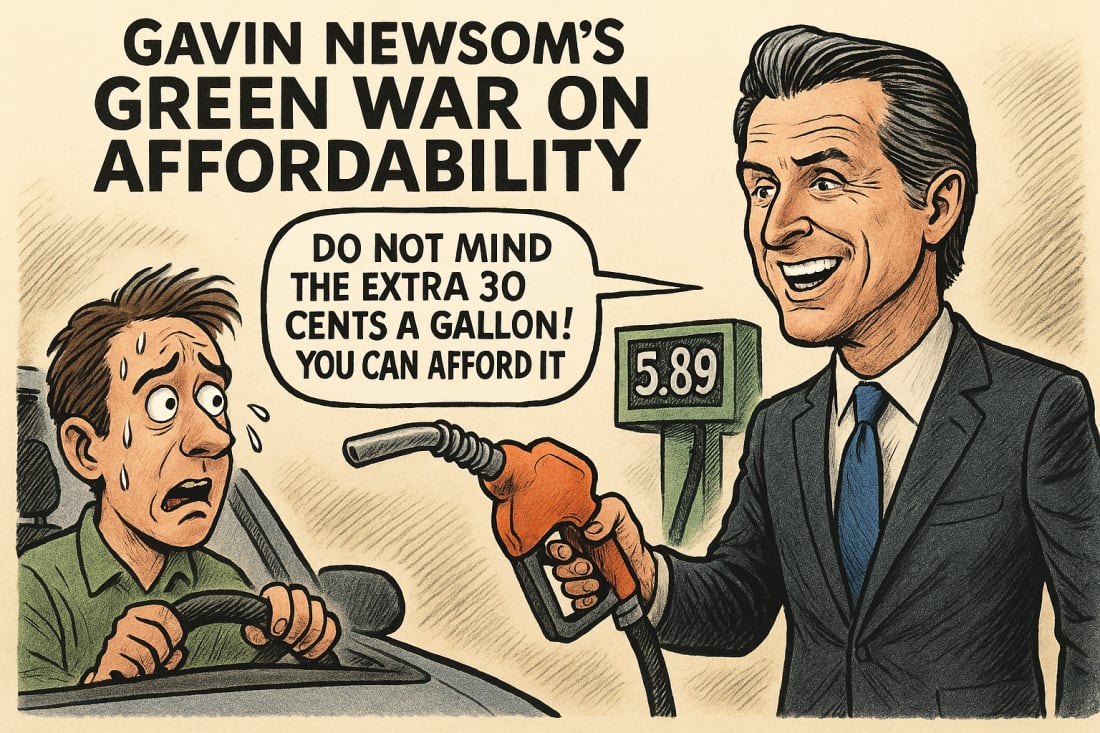
Under the state’s cap-and-trade framework, cap-and-invest now adds roughly 20 to 30 cents per gallon to the cost of gasoline at current carbon allowance prices, a built-in surcharge that shows up every time drivers fill their tanks.
The broader fiscal implications of Cap-and-Invest, how it quietly evolved into a permanent revenue platform, what Sacramento is now financing with these dollars, and why the global climate math makes this entire strategy economically quixotic are detailed below for paid subscribers.
The rest of this column is below the paywall. What paid subscribers will see below:
How a climate compliance program quietly became one of Sacramento’s most reliable revenue streams
Why the affordability debate surrounding Cap-and-Invest fundamentally misses the real fiscal issue
The statutory change that allowed carbon dollars to flow into unrelated political priorities
The scale mismatch between California’s costs and its global climate effect
How this program is now embedded into the state’s long-term budget architecture
What this means for household cost structures over the next decade...
Keep reading with a 7-day free trial
Subscribe to So, Does It Matter? California Politics! to keep reading this post and get 7 days of free access to the full post archives.
A subscription gets you:
 | Subscriber-only Afternoon Posts. Analysis on breaking News |
| Saturday’s Popular “What is Jon Reading” Column |
| 100% percent of our site content is yours! |
| ||||||||||

