
John, I know you care about changing our society's wasteful ways, so I thought you should know this:
In order to keep up with trends, the fashion industry is producing more clothing than ever before -- and more clothing than we can wear.
The result: Many retailers are sending tons of clothing that has never been worn to be buried in landfills or burned in incinerators.1
As a retail leader, H&M can help change that. We're asking H&M to do its part by committing to not burning and dumping unworn, unsold clothes. Join us by taking action right now.
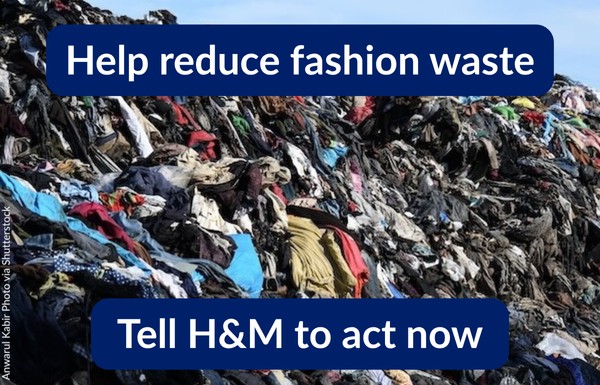
By many metrics, the clothing industry, due in large part to fast fashion, has become one of the most polluting industries in the world. Every year, around 100 million tons of textile waste are generated globally.2
Some of that waste starts with retailers, who order more clothes than they end up selling -- many of those unsold, unworn clothes end up burned, sending often dangerous chemicals into surrounding environments, or in landfills.3
It's an absurd way to handle waste, but there's also a clear opportunity for improvement in the fashion industry. H&M can be a leader in reducing waste and pollution.
Here's what we're asking H&M to do: Publicly commit to not dumping or burning overstock clothing.4
Thank you,
Faye Park
President
1. Vibhu Mishra, "Fast fashion fueling global waste crisis, UN chief warns," United Nations, March 27, 2025.
2. "Unsustainable fashion and textiles in focus for International Day of Zero Waste 2025," United Nations Environment Programme, March 27, 2025.
3. Vibhu Mishra, "Fast fashion fueling global waste crisis, UN chief warns," United Nations, March 27, 2025.
4. "Unsustainable fashion and textiles in focus for International Day of Zero Waste 2025," United Nations Environment Programme, March 27, 2025.
Support U.S. PIRG. Contributions by people just like you make our advocacy possible. Your contribution supports a staff of organizers, attorneys, scientists and other professionals who monitor government and corporate decisions and advocate on the public's behalf.
Join us on Facebook | Follow us on Twitter
U.S. PIRG, Main Office: 1543 Wazee St., Suite 460, Denver, CO 80202, (303) 801-0582
Federal Advocacy Office: 600 Pennsylvania Ave. SE, 4th Fl., Washington, DC 20003, (202) 546-9707
Member Questions or Requests: 1-800-838-6554.

If you want us to stop sending you email then follow this link -- unsubscribe.