
| From | Liberty Fund <[email protected]> |
| Subject | Adam Smith and the Architecture of a Free Society |
| Date | December 5, 2025 2:00 PM |
Links have been removed from this email. Learn more in the FAQ.
Links have been removed from this email. Learn more in the FAQ.
[link removed]
WEEK OF NOVEMBER 30, 2025
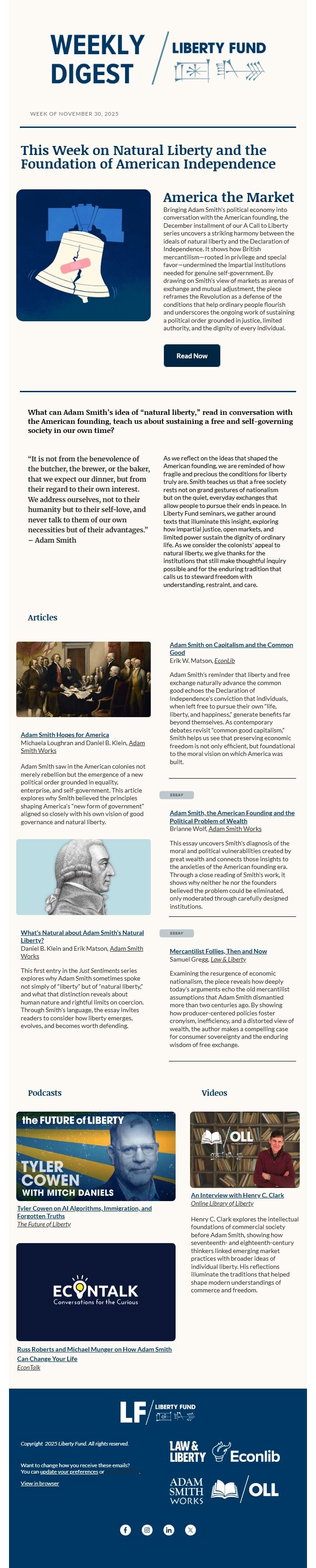
** This Week on Natural Liberty and the Foundation of American Independence
------------------------------------------------------------
[link removed]
** America the Market ([link removed])
------------------------------------------------------------
Bringing Adam Smith’s political economy into conversation with the American founding, the December installment of our A Call to Liberty series uncovers a striking harmony between the ideals of natural liberty and the Declaration of Independence. It shows how British mercantilism—rooted in privilege and special favor—undermined the impartial institutions needed for genuine self-government. By drawing on Smith’s view of markets as arenas of exchange and mutual adjustment, the piece reframes the Revolution as a defense of the conditions that help ordinary people flourish and underscores the ongoing work of sustaining a political order grounded in justice, limited authority, and the dignity of every individual.
Read Now ([link removed])
** What can Adam Smith’s idea of “natural liberty,” read in conversation with the American founding, teach us about sustaining a free and self-governing society in our own time?
------------------------------------------------------------
** “It is not from the benevolence of the butcher, the brewer, or the baker, that we expect our dinner, but from their regard to their own interest. We address ourselves, not to their humanity but to their self-love, and never talk to them of our own necessities but of their advantages.”
------------------------------------------------------------
** – Adam Smith
------------------------------------------------------------
As we reflect on the ideas that shaped the American founding, we are reminded of how fragile and precious the conditions for liberty truly are. Smith teaches us that a free society rests not on grand gestures of nationalism but on the quiet, everyday exchanges that allow people to pursue their ends in peace. In Liberty Fund seminars, we gather around texts that illuminate this insight, exploring how impartial justice, open markets, and limited power sustain the dignity of ordinary life. As we consider the colonists’ appeal to natural liberty, we give thanks for the institutions that still make thoughtful inquiry possible and for the enduring tradition that calls us to steward freedom with understanding, restraint, and care.
** Articles
------------------------------------------------------------
[link removed]
** Adam Smith Hopes for America ([link removed])
------------------------------------------------------------
Michaela Loughran and Daniel B. Klein, Adam Smith Works ([link removed])
Adam Smith saw in the American colonies not merely rebellion but the emergence of a new political order grounded in equality, enterprise, and self-government. This article explores why Smith believed the principles shaping America’s “new form of government” aligned so closely with his own vision of good governance and natural liberty.
[link removed]
** What’s Natural about Adam Smith’s Natural Liberty? ([link removed])
------------------------------------------------------------
Daniel B. Klein and Erik Matson, Adam Smith Works ([link removed])
This first entry in the Just Sentiments series explores why Adam Smith sometimes spoke not simply of “liberty” but of “natural liberty,” and what that distinction reveals about human nature and rightful limits on coercion. Through Smith’s language, the essay invites readers to consider how liberty emerges, evolves, and becomes worth defending.
** Adam Smith on Capitalism and the Common Good ([link removed])
------------------------------------------------------------
Erik W. Matson, EconLib ([link removed])
Adam Smith’s reminder that liberty and free exchange naturally advance the common good echoes the Declaration of Independence’s conviction that individuals, when left free to pursue their own “life, liberty, and happiness,” generate benefits far beyond themselves. As contemporary debates revisit “common good capitalism,” Smith helps us see that preserving economic freedom is not only efficient, but foundational to the moral vision on which America was built.
** Adam Smith, the American Founding and the Political Problem of Wealth ([link removed])
------------------------------------------------------------
Brianne Wolf,[link removed] Smith Works ([link removed])
This essay uncovers Smith’s diagnosis of the moral and political vulnerabilities created by great wealth and connects those insights to the anxieties of the American founding era. Through a close reading of Smith’s work, it shows why neither he nor the founders believed the problem could be eliminated, only moderated through carefully designed institutions.
** Mercantilist Follies, Then and Now ([link removed])
------------------------------------------------------------
Samuel Gregg, Law & Liberty ([link removed])
Examining the resurgence of economic nationalism, the piece reveals how deeply today’s arguments echo the old mercantilist assumptions that Adam Smith dismantled more than two centuries ago. By showing how producer-centered policies foster cronyism, inefficiency, and a distorted view of wealth, the author makes a compelling case for consumer sovereignty and the enduring wisdom of free exchange.
** Podcasts
------------------------------------------------------------
[link removed]
** Tyler Cowen on AI Algorithms, Immigration, and Forgotten Truths ([link removed])
------------------------------------------------------------
The Future of Liberty ([link removed])
[link removed]
** Russ Roberts and Michael Munger on How Adam Smith Can Change Your Life ([link removed])
------------------------------------------------------------
EconTalk ([link removed])
** Videos
------------------------------------------------------------
[link removed]
** An Interview with Henry C. Clark ([link removed])
------------------------------------------------------------
Online Library of Liberty ([link removed])
Henry C. Clark explores the intellectual foundations of commercial society before Adam Smith, showing how seventeenth- and eighteenth-century thinkers linked emerging market practices with broader ideas of individual liberty. His reflections illuminate the traditions that helped shape modern understandings of commerce and freedom.
[link removed]
Copyright 2025 Liberty Fund. All rights reserved.
Want to change how you receive these emails?
You can update your preferences ([link removed]) or unsubscribe ([link removed]) .
View in browser ([link removed])
[link removed] [link removed]
[link removed] [link removed]
[link removed]
[link removed]
[link removed]
[link removed]
WEEK OF NOVEMBER 30, 2025
** This Week on Natural Liberty and the Foundation of American Independence
------------------------------------------------------------
[link removed]
** America the Market ([link removed])
------------------------------------------------------------
Bringing Adam Smith’s political economy into conversation with the American founding, the December installment of our A Call to Liberty series uncovers a striking harmony between the ideals of natural liberty and the Declaration of Independence. It shows how British mercantilism—rooted in privilege and special favor—undermined the impartial institutions needed for genuine self-government. By drawing on Smith’s view of markets as arenas of exchange and mutual adjustment, the piece reframes the Revolution as a defense of the conditions that help ordinary people flourish and underscores the ongoing work of sustaining a political order grounded in justice, limited authority, and the dignity of every individual.
Read Now ([link removed])
** What can Adam Smith’s idea of “natural liberty,” read in conversation with the American founding, teach us about sustaining a free and self-governing society in our own time?
------------------------------------------------------------
** “It is not from the benevolence of the butcher, the brewer, or the baker, that we expect our dinner, but from their regard to their own interest. We address ourselves, not to their humanity but to their self-love, and never talk to them of our own necessities but of their advantages.”
------------------------------------------------------------
** – Adam Smith
------------------------------------------------------------
As we reflect on the ideas that shaped the American founding, we are reminded of how fragile and precious the conditions for liberty truly are. Smith teaches us that a free society rests not on grand gestures of nationalism but on the quiet, everyday exchanges that allow people to pursue their ends in peace. In Liberty Fund seminars, we gather around texts that illuminate this insight, exploring how impartial justice, open markets, and limited power sustain the dignity of ordinary life. As we consider the colonists’ appeal to natural liberty, we give thanks for the institutions that still make thoughtful inquiry possible and for the enduring tradition that calls us to steward freedom with understanding, restraint, and care.
** Articles
------------------------------------------------------------
[link removed]
** Adam Smith Hopes for America ([link removed])
------------------------------------------------------------
Michaela Loughran and Daniel B. Klein, Adam Smith Works ([link removed])
Adam Smith saw in the American colonies not merely rebellion but the emergence of a new political order grounded in equality, enterprise, and self-government. This article explores why Smith believed the principles shaping America’s “new form of government” aligned so closely with his own vision of good governance and natural liberty.
[link removed]
** What’s Natural about Adam Smith’s Natural Liberty? ([link removed])
------------------------------------------------------------
Daniel B. Klein and Erik Matson, Adam Smith Works ([link removed])
This first entry in the Just Sentiments series explores why Adam Smith sometimes spoke not simply of “liberty” but of “natural liberty,” and what that distinction reveals about human nature and rightful limits on coercion. Through Smith’s language, the essay invites readers to consider how liberty emerges, evolves, and becomes worth defending.
** Adam Smith on Capitalism and the Common Good ([link removed])
------------------------------------------------------------
Erik W. Matson, EconLib ([link removed])
Adam Smith’s reminder that liberty and free exchange naturally advance the common good echoes the Declaration of Independence’s conviction that individuals, when left free to pursue their own “life, liberty, and happiness,” generate benefits far beyond themselves. As contemporary debates revisit “common good capitalism,” Smith helps us see that preserving economic freedom is not only efficient, but foundational to the moral vision on which America was built.
** Adam Smith, the American Founding and the Political Problem of Wealth ([link removed])
------------------------------------------------------------
Brianne Wolf,[link removed] Smith Works ([link removed])
This essay uncovers Smith’s diagnosis of the moral and political vulnerabilities created by great wealth and connects those insights to the anxieties of the American founding era. Through a close reading of Smith’s work, it shows why neither he nor the founders believed the problem could be eliminated, only moderated through carefully designed institutions.
** Mercantilist Follies, Then and Now ([link removed])
------------------------------------------------------------
Samuel Gregg, Law & Liberty ([link removed])
Examining the resurgence of economic nationalism, the piece reveals how deeply today’s arguments echo the old mercantilist assumptions that Adam Smith dismantled more than two centuries ago. By showing how producer-centered policies foster cronyism, inefficiency, and a distorted view of wealth, the author makes a compelling case for consumer sovereignty and the enduring wisdom of free exchange.
** Podcasts
------------------------------------------------------------
[link removed]
** Tyler Cowen on AI Algorithms, Immigration, and Forgotten Truths ([link removed])
------------------------------------------------------------
The Future of Liberty ([link removed])
[link removed]
** Russ Roberts and Michael Munger on How Adam Smith Can Change Your Life ([link removed])
------------------------------------------------------------
EconTalk ([link removed])
** Videos
------------------------------------------------------------
[link removed]
** An Interview with Henry C. Clark ([link removed])
------------------------------------------------------------
Online Library of Liberty ([link removed])
Henry C. Clark explores the intellectual foundations of commercial society before Adam Smith, showing how seventeenth- and eighteenth-century thinkers linked emerging market practices with broader ideas of individual liberty. His reflections illuminate the traditions that helped shape modern understandings of commerce and freedom.
[link removed]
Copyright 2025 Liberty Fund. All rights reserved.
Want to change how you receive these emails?
You can update your preferences ([link removed]) or unsubscribe ([link removed]) .
View in browser ([link removed])
[link removed] [link removed]
[link removed] [link removed]
[link removed]
[link removed]
[link removed]
[link removed]
Message Analysis
- Sender: Liberty Fund
- Political Party: n/a
- Country: United States
- State/Locality: n/a
- Office: n/a
-
Email Providers:
- MailChimp