
| From | RAND Policy Currents <[email protected]> |
| Subject | The Race to Artificial General Intelligence |
| Date | December 4, 2025 7:24 PM |
Links have been removed from this email. Learn more in the FAQ.
Links have been removed from this email. Learn more in the FAQ.
Policy Currents | The newsletter for policy people
Web version: [link removed]
** Dec. 4, 2025
------------------------------------------------------------
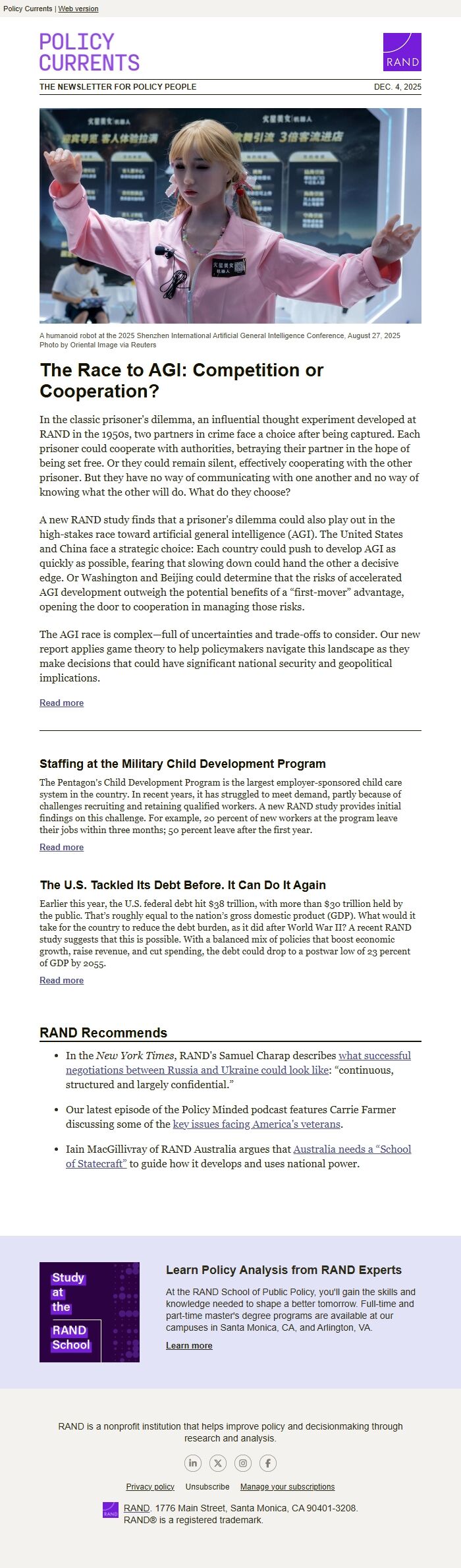
The Race to AGI: Competition or Cooperation?
In the classic prisoner's dilemma, an influential thought experiment developed at RAND in the 1950s, two partners in crime face a choice after being captured. Each prisoner could cooperate with authorities, betraying their partner in the hope of being set free. Or they could remain silent, effectively cooperating with the other prisoner. But they have no way of communicating with one another and no way of knowing what the other will do. What do they choose?
A new RAND study finds that a prisoner's dilemma could also play out in the high-stakes race toward artificial general intelligence (AGI). The United States and China face a strategic choice: Each country could push to develop AGI as quickly as possible, fearing that slowing down could hand the other a decisive edge. Or Washington and Beijing could determine that the risks of accelerated AGI development outweigh the potential benefits of a "first-mover" advantage, opening the door to cooperation in managing those risks.
The AGI race is complex--full of uncertainties and trade-offs to consider. Our new report applies game theory to help policymakers navigate this landscape as they make decisions that could have significant national security and geopolitical implications.
Read more: [link removed]
Staffing at the Military Child Development Program
The Pentagon's Child Development Program is the largest employer-sponsored child care system in the country. In recent years, it has struggled to meet demand, partly because of challenges recruiting and retaining qualified workers. A new RAND study provides initial findings on this challenge. For example, 20 percent of new workers at the program leave their jobs within three months; 50 percent leave after the first year.
Read more: [link removed]
The U.S. Tackled Its Debt Before. It Can Do It Again
Earlier this year, the U.S. federal debt hit $38 trillion, with more than $30 trillion held by the public. That's roughly equal to the nation's gross domestic product (GDP). What would it take for the country to reduce the debt burden, as it did after World War II? A recent RAND study suggests that this is possible. With a balanced mix of policies that boost economic growth, raise revenue, and cut spending, the debt could drop to a postwar low of 23 percent of GDP by 2055.
Read more: [link removed]
** RAND Recommends
------------------------------------------------------------
- In the New York Times, RAND's Samuel Charap describes what successful negotiations between Russia and Ukraine could look like: "continuous, structured and largely confidential."
[link removed]
- Our latest episode of the Policy Minded podcast features Carrie Farmer discussing some of the key issues facing America's veterans.
[link removed]
- Iain MacGillivray of RAND Australia argues that Australia needs a "School of Statecraft" to guide how it develops and uses national power.
[link removed]
** Learn Policy Analysis from RAND Experts
------------------------------------------------------------
At the RAND School of Public Policy, you'll gain the skills and knowledge needed to shape a better tomorrow. Full-time and part-time master's degree programs are available at our campuses in Santa Monica, CA, and Arlington, VA.
Learn more: [link removed]
** Follow RAND
------------------------------------------------------------
RAND is a nonprofit institution that helps improve policy and decisionmaking through research and analysis.
Connect with us on:
LinkedIn: [link removed]
X: [link removed]
Instagram: [link removed]
Facebook: [link removed]
Privacy Policy: [link removed]
Unsubscribe to stop receiving these emails: [link removed]
Manage your subscriptions
[link removed]
RAND
1776 Main Street
Santa Monica, CA 90401
Web version: [link removed]
** Dec. 4, 2025
------------------------------------------------------------
The Race to AGI: Competition or Cooperation?
In the classic prisoner's dilemma, an influential thought experiment developed at RAND in the 1950s, two partners in crime face a choice after being captured. Each prisoner could cooperate with authorities, betraying their partner in the hope of being set free. Or they could remain silent, effectively cooperating with the other prisoner. But they have no way of communicating with one another and no way of knowing what the other will do. What do they choose?
A new RAND study finds that a prisoner's dilemma could also play out in the high-stakes race toward artificial general intelligence (AGI). The United States and China face a strategic choice: Each country could push to develop AGI as quickly as possible, fearing that slowing down could hand the other a decisive edge. Or Washington and Beijing could determine that the risks of accelerated AGI development outweigh the potential benefits of a "first-mover" advantage, opening the door to cooperation in managing those risks.
The AGI race is complex--full of uncertainties and trade-offs to consider. Our new report applies game theory to help policymakers navigate this landscape as they make decisions that could have significant national security and geopolitical implications.
Read more: [link removed]
Staffing at the Military Child Development Program
The Pentagon's Child Development Program is the largest employer-sponsored child care system in the country. In recent years, it has struggled to meet demand, partly because of challenges recruiting and retaining qualified workers. A new RAND study provides initial findings on this challenge. For example, 20 percent of new workers at the program leave their jobs within three months; 50 percent leave after the first year.
Read more: [link removed]
The U.S. Tackled Its Debt Before. It Can Do It Again
Earlier this year, the U.S. federal debt hit $38 trillion, with more than $30 trillion held by the public. That's roughly equal to the nation's gross domestic product (GDP). What would it take for the country to reduce the debt burden, as it did after World War II? A recent RAND study suggests that this is possible. With a balanced mix of policies that boost economic growth, raise revenue, and cut spending, the debt could drop to a postwar low of 23 percent of GDP by 2055.
Read more: [link removed]
** RAND Recommends
------------------------------------------------------------
- In the New York Times, RAND's Samuel Charap describes what successful negotiations between Russia and Ukraine could look like: "continuous, structured and largely confidential."
[link removed]
- Our latest episode of the Policy Minded podcast features Carrie Farmer discussing some of the key issues facing America's veterans.
[link removed]
- Iain MacGillivray of RAND Australia argues that Australia needs a "School of Statecraft" to guide how it develops and uses national power.
[link removed]
** Learn Policy Analysis from RAND Experts
------------------------------------------------------------
At the RAND School of Public Policy, you'll gain the skills and knowledge needed to shape a better tomorrow. Full-time and part-time master's degree programs are available at our campuses in Santa Monica, CA, and Arlington, VA.
Learn more: [link removed]
** Follow RAND
------------------------------------------------------------
RAND is a nonprofit institution that helps improve policy and decisionmaking through research and analysis.
Connect with us on:
LinkedIn: [link removed]
X: [link removed]
Instagram: [link removed]
Facebook: [link removed]
Privacy Policy: [link removed]
Unsubscribe to stop receiving these emails: [link removed]
Manage your subscriptions
[link removed]
RAND
1776 Main Street
Santa Monica, CA 90401
Message Analysis
- Sender: RAND Corporation
- Political Party: n/a
- Country: United States
- State/Locality: n/a
- Office: n/a
-
Email Providers:
- Predictive Response