|
 |
Are Disability Accommodations Being Abused?
Intercollegiate Review | Conservatism's sharpest voices, curated weekly. ISI's weekly newsletter brings you the best in serious conservative thought.
|

| |||||||||||||||


A is for Accommodations
 |
Over the past five years, educators at every level, from elementary schools to universities, have been sounding the alarm about the state of education in America. From the steep decline in basic reading and math skills following COVID-19 shutdowns to the rise of AI use in classrooms by both students and teachers, it’s clear that our educational system is in serious danger.
Writing for The Atlantic, Rose Horowitch highlights another quietly growing crisis: the abuse of disability accommodations, particularly among elite students. Over the last 15 years, the percentage of students at America’s top universities who qualify for accommodations such as extended exam time has skyrocketed. In the name of disability access, school administrations began relaxing the requirements for receiving accommodations just as diagnoses of ADHD, anxiety, and depression climbed nationwide.
The result? More than 20 percent of undergrads at Harvard and Brown are now registered as having a disability, and nearly a quarter of Stanford undergrads received academic or housing accommodations this past fall.
Horowitch argues that some students may be gaming the system to gain a competitive edge, while others have convinced themselves that their commonplace academic struggles are signs of disability. If schools truly care about helping disadvantaged students, they’ll need to start disentangling these cases from the legitimate cases of disability.
Read the rest of Horowitch’s article here via a gift link.
|
Memento Mori
 |
Over the past two centuries, global life expectancy has more than doubled. Thanks to medical advancements and improved living conditions, death feels far less immediate than it once did, making it easier than ever before to ignore our own mortality.
In an essay for The Lamp, Kelly Scott Franklin reflects on the way that his mortality became real to him after the sequential loss of both his parents shortly before his fortieth birthday. Despite our culture’s attempts to hide, soften, or distract from the inevitability of death, every person must eventually confront the truth that they, too, will die and be forgotten.
Franklin also writes about the consolation that he finds in his Catholic faith and the hope of resurrection promised in the Christian gospel. In his view, the hope of the good news can only be understood when one reckons with the terrible weight of the bad news. By recognizing that all things pass away, he suggests, we are better equipped to appreciate the beauty in the present.
Read the rest of Franklin’s reflection on mortality here.
Compendium
Every article we feature here is available to read for free. Articles from paywalled publications are available through gift links.
Aaron M. Renn on the hidden dangers of abolishing property taxes in The New York Times.
James Orr interviews Freya India on Gen Z’s crisis of meaning and purpose in First Light.
Barry Threw and Scott Moore on why Silicon Valley must recover its artistic, spiritual, and experimental soul in Palladium Mag.
Tyler Cowen, replying to Michael W. Green, on the methodology and economics that determine the poverty line in The Free Press.
Charles C. Mann on the promise of progress in The New Atlantis.
John Ehrett on why young men feel trapped in a culture of randomness and despair in Commonplace.
Katya Ungerman (pen name: Katherine Dee) on redefining the role our phones play in shaping reality in The New York Times.
Ryan Burge on the political divide between mainline clergy and laity in Graphs About Religion.
Maria Baer and Brad Wilcox on the impact online life has on dating and marriage in the Institute for Family Studies.
Timothy Reichert on a Christian stewardship approach to capitalism in First Things.
 |
Upcoming ISI Events
If you enjoy what you’re reading here, we invite you to engage with ISI at one of our upcoming in-person events.
Christmas Open House | December 15 | Washington, DC
Join the Intercollegiate Studies Institute on Monday, December 15 for a free, exclusive Christmas gathering at Butterworth’s in Washington, DC. This is a festive occasion to network with fellow conservatives and ring in the holiday season.
Visit our events page on our website to see all upcoming events.
Thanks for reading Intercollegiate Studies Institute! Subscribe for free to receive new posts.

This week, from ISI’s Digital Media:
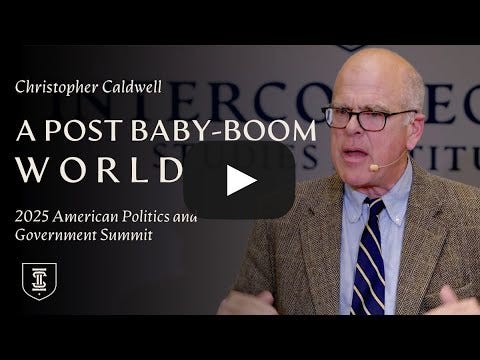
At ISI’s annual American Politics and Government Summit in October, Christopher Caldwell delivered a compelling keynote address on post-baby boom America. He argues that the baby boomers’ long dominance over American politics, culture, and institutions is fading, creating a looming generational rupture. Further, younger Americans reject many of the boomers’ assumptions and no longer share their certainties, signaling a major cultural shift in America.
Subscribe to our YouTube channel for more content like this.
This week, from the Collegiate Network:
ISI’s Collegiate Network supports over 80 student-run publications across the country, empowering students to run independent college newspapers, magazines, and journals that report on important issues ignored by the mainstream media.
INVESTIGATION: Stanford Earth Sciences Chair Collaborates with China’s Nuclear Program via The Stanford Review
New evidence shows that a Stanford professor has maintained deep research ties with an institution linked to China’s nuclear weapons program.
In Defense of Privacy: Civil Liberty and Small Government in the Age of Palantir via The Princeton Tory
The rise of Palantir’s centralized data systems forces Americans to confront an old question anew: how much privacy must we sacrifice to the state before liberty itself is endangered?
Learning to Love America from Planes, Trains, and Automobiles via The New Guard Press
This essay weaves the hero’s journey in Planes, Trains, and Automobiles with America’s 250-year odyssey to make a case for national gratitude.
Tom Stoppard and the Futility of Logic via The Lemur
A reflection on Tom Stoppard’s death and the profound truth revealed in his plays: pure rationality cannot save us from meaninglessness.
The Collapse of Liberal Internationalism in Europe’s Last Protectorate via The American Postliberal
A claim that modern Bosnia embodies the paradox of the post-Cold War order: a state meticulously stabilized by outsiders, yet denied the sovereignty it needs to form a political community.
Visit our Student Journalism section to read more from the Collegiate Network.
The Prophetic Genius of Fyodor Dostoevsky
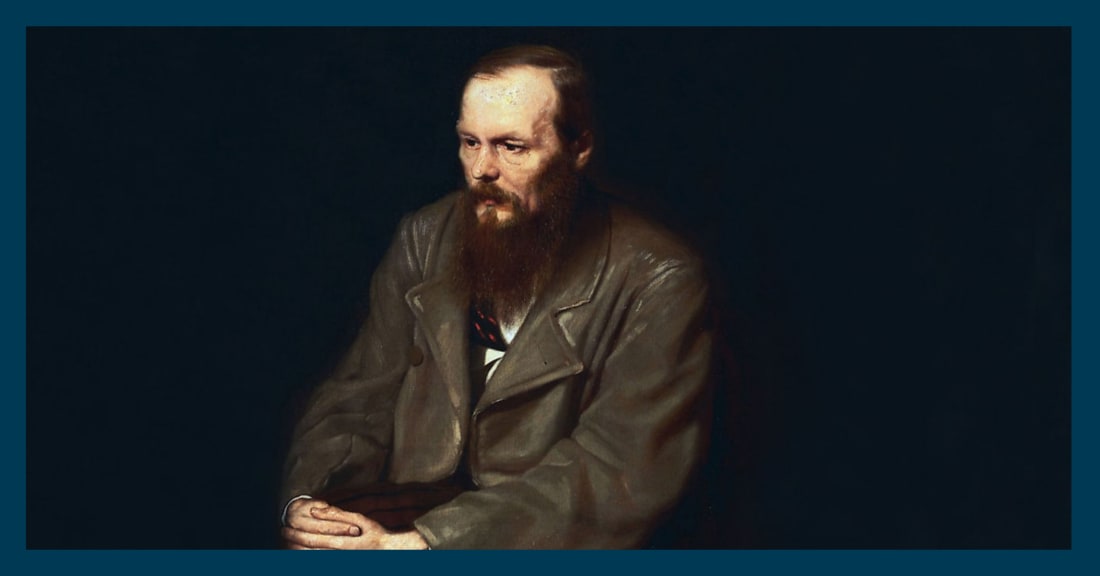 |
Fyodor Dostoevsky’s Crime and Punishment and The Brothers Karamazov are regarded as two of the greatest novels of all time. Yet in his own lifetime, most literary critics failed to appreciate his genius, dismissing the novels as overly long and the characters as overly melodramatic. It wasn’t until the 20th century that readers and scholars began to recognize the depth of Dostoevsky’s insight into the human condition.
In this week’s Modern Age article, originally published in the Fall 1981 issue, Russian critic and philosopher Sergei Levitzky argues that Dostoevsky was “a prophet of a spiritual malaise that still devours the body of our epoch.” His genius went largely unnoticed during his life because its prophetic nature could only be understood in retrospect.
Levitsky contends that Dostoevsky’s ability to plumb the depths of his characters’ souls made him “an artist of the subconscious.” The tragic situations that characterize his novels were deliberately crafted to expose his characters’ innermost selves and to lay bare the spiritual dead-end of humanistic atheism. This fusion of profound psychological insight with the spiritual wisdom of Christianity makes Dostoevsky’s works so enduring.
Read more of Levitsky’s reflection on Dostoevsky’s prophetic genius here on the Modern Age website.
Modern Age is ISI’s flagship publication. Visit modernagejournal.com and subscribe to receive a free daily newsletter.
“The mystery of human existence lies not in just staying alive, but in finding something to live for.”
– Fyodor Dostoevsky, The Brothers Karamazov
Celebrate America’s semiquincentennial with ISI and help shape the next 250 years of our country. Your support of the America 500 Education Fund will help ISI reach, teach, and launch the next generation of conservative leaders. Visit isi.org/america500 to learn more.
| ||||||||||

