
| From | The American Prospect <[email protected]> |
| Subject | The cost of climate |
| Date | December 4, 2025 11:02 AM |
Links have been removed from this email. Learn more in the FAQ.
Links have been removed from this email. Learn more in the FAQ.
You’re going to pay for it.Was this email forwarded to you? Sign up here to get The Daily Prospect Monday through Friday. [link removed]
[link removed]
**DECEMBER 4, 2025**
Click to read this email in your browser. [link removed]
The climate crisis [link removed] has thrown our relationships with water out of kilter. Some places struggle to manage the sudden chaos of severe storms and deliver potable water to residents at a reasonable cost. Other locales juggle the consequences of deluges and drought and what they mean for their livelihoods raising crops and livestock. What’s unfolding in New Orleans and in Vermont doesn’t get enough attention. But growing numbers of Americans face their own versions of these water-centric emergencies no matter where they live and more regularly than they ever have in the past. They’re situations that we ignore at our peril.
**–Gabrielle Gurley, senior editor**
[link removed]
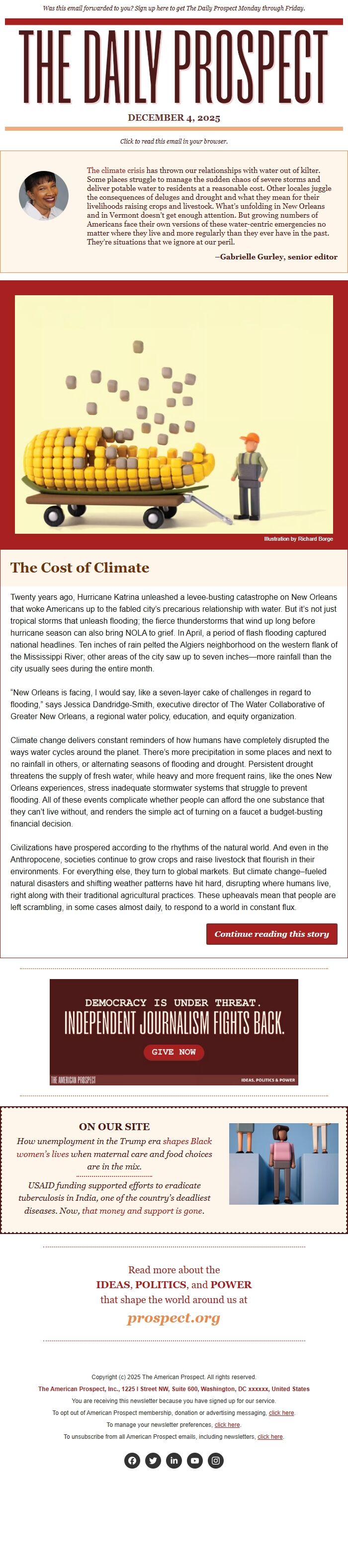
Illustration by Richard Borge
The Cost of Climate [link removed]
Twenty years ago, Hurricane Katrina unleashed a levee-busting catastrophe on New Orleans that woke Americans up to the fabled city’s precarious relationship with water. But it’s not just tropical storms that unleash flooding; the fierce thunderstorms that wind up long before hurricane season can also bring NOLA to grief. In April, a period of flash flooding captured national headlines. Ten inches of rain pelted the Algiers neighborhood on the western flank of the Mississippi River; other areas of the city saw up to seven inches—more rainfall than the city usually sees during the entire month.
“New Orleans is facing, I would say, like a seven-layer cake of challenges in regard to flooding,” says Jessica Dandridge-Smith, executive director of The Water Collaborative of Greater New Orleans, a regional water policy, education, and equity organization.
Climate change delivers constant reminders of how humans have completely disrupted the ways water cycles around the planet. There’s more precipitation in some places and next to no rainfall in others, or alternating seasons of flooding and drought. Persistent drought threatens the supply of fresh water, while heavy and more frequent rains, like the ones New Orleans experiences, stress inadequate stormwater systems that struggle to prevent flooding. All of these events complicate whether people can afford the one substance that they can’t live without, and renders the simple act of turning on a faucet a budget-busting financial decision.
Civilizations have prospered according to the rhythms of the natural world. And even in the Anthropocene, societies continue to grow crops and raise livestock that flourish in their environments. For everything else, they turn to global markets. But climate change–fueled natural disasters and shifting weather patterns have hit hard, disrupting where humans live, right along with their traditional agricultural practices. These upheavals mean that people are left scrambling, in some cases almost daily, to respond to a world in constant flux.
Continue reading this story [link removed]
prospect.org/donate
****ON OUR SITE****
How unemployment in the Trump era shapes Black women’s lives [link removed] when maternal care and food choices are in the mix.
USAID funding supported efforts to eradicate tuberculosis in India, one of the country’s deadliest diseases. Now, that money and support is gone [link removed].
[link removed]
Read more about the [link removed]
IDEAS, POLITICS, and POWER [link removed]
that shape the world around us at [link removed]
prospect.org [link removed]
Copyright (c) 2025 The American Prospect. All rights reserved.**The American Prospect, Inc., 1225 I Street NW, Suite 600, Washington, DC xxxxxx, United States**
You are receiving this newsletter because you have signed up for our service.
To opt out of American Prospect membership, donation or advertising messaging, click here [link removed].
To manage your newsletter preferences, click here [link removed].
To unsubscribe from all American Prospect emails, including newsletters, click here [link removed].
[link removed]
[link removed]
[link removed]
[link removed]
[link removed]
Sent to: [email protected]
Unsubscribe [link removed]
The American Prospect, Inc., 1225 I Street NW, Suite 600, Washington, DC xxxxxx, United States
[link removed]
**DECEMBER 4, 2025**
Click to read this email in your browser. [link removed]
The climate crisis [link removed] has thrown our relationships with water out of kilter. Some places struggle to manage the sudden chaos of severe storms and deliver potable water to residents at a reasonable cost. Other locales juggle the consequences of deluges and drought and what they mean for their livelihoods raising crops and livestock. What’s unfolding in New Orleans and in Vermont doesn’t get enough attention. But growing numbers of Americans face their own versions of these water-centric emergencies no matter where they live and more regularly than they ever have in the past. They’re situations that we ignore at our peril.
**–Gabrielle Gurley, senior editor**
[link removed]
Illustration by Richard Borge
The Cost of Climate [link removed]
Twenty years ago, Hurricane Katrina unleashed a levee-busting catastrophe on New Orleans that woke Americans up to the fabled city’s precarious relationship with water. But it’s not just tropical storms that unleash flooding; the fierce thunderstorms that wind up long before hurricane season can also bring NOLA to grief. In April, a period of flash flooding captured national headlines. Ten inches of rain pelted the Algiers neighborhood on the western flank of the Mississippi River; other areas of the city saw up to seven inches—more rainfall than the city usually sees during the entire month.
“New Orleans is facing, I would say, like a seven-layer cake of challenges in regard to flooding,” says Jessica Dandridge-Smith, executive director of The Water Collaborative of Greater New Orleans, a regional water policy, education, and equity organization.
Climate change delivers constant reminders of how humans have completely disrupted the ways water cycles around the planet. There’s more precipitation in some places and next to no rainfall in others, or alternating seasons of flooding and drought. Persistent drought threatens the supply of fresh water, while heavy and more frequent rains, like the ones New Orleans experiences, stress inadequate stormwater systems that struggle to prevent flooding. All of these events complicate whether people can afford the one substance that they can’t live without, and renders the simple act of turning on a faucet a budget-busting financial decision.
Civilizations have prospered according to the rhythms of the natural world. And even in the Anthropocene, societies continue to grow crops and raise livestock that flourish in their environments. For everything else, they turn to global markets. But climate change–fueled natural disasters and shifting weather patterns have hit hard, disrupting where humans live, right along with their traditional agricultural practices. These upheavals mean that people are left scrambling, in some cases almost daily, to respond to a world in constant flux.
Continue reading this story [link removed]
prospect.org/donate
****ON OUR SITE****
How unemployment in the Trump era shapes Black women’s lives [link removed] when maternal care and food choices are in the mix.
USAID funding supported efforts to eradicate tuberculosis in India, one of the country’s deadliest diseases. Now, that money and support is gone [link removed].
[link removed]
Read more about the [link removed]
IDEAS, POLITICS, and POWER [link removed]
that shape the world around us at [link removed]
prospect.org [link removed]
Copyright (c) 2025 The American Prospect. All rights reserved.**The American Prospect, Inc., 1225 I Street NW, Suite 600, Washington, DC xxxxxx, United States**
You are receiving this newsletter because you have signed up for our service.
To opt out of American Prospect membership, donation or advertising messaging, click here [link removed].
To manage your newsletter preferences, click here [link removed].
To unsubscribe from all American Prospect emails, including newsletters, click here [link removed].
[link removed]
[link removed]
[link removed]
[link removed]
[link removed]
Sent to: [email protected]
Unsubscribe [link removed]
The American Prospect, Inc., 1225 I Street NW, Suite 600, Washington, DC xxxxxx, United States
Message Analysis
- Sender: American Prospect
- Political Party: n/a
- Country: United States
- State/Locality: n/a
- Office: n/a