|
Welcome to You’re Probably Getting Screwed, a weekly newsletter and video series from J.D. Scholten and Justin Stofferahn about the Second Gilded Age and the ways economic concentration is putting politics and profits over working people.
Tyson’s Nebraska Shutdown Shows Exactly Why America Has a Monopoly Problem
You're Probably Getting Screwed
|

| |||||||||||||||


 |
Welcome to You’re Probably Getting Screwed, a weekly newsletter and video series from J.D. Scholten and Justin Stofferahn about the Second Gilded Age and the ways economic concentration is putting politics and profits over working people.
Tyson Foods wants to shut down one of the biggest beef plants in America — the 3,000-worker facility in Lexington, Nebraska. Most people outside the Midwest may shrug this off. But make no mistake: this decision will raise your grocery bill, hurt American ranchers, and hand even more power to a few giant corporations that already control our food supply.

This story isn’t just about one plant closing. It’s about how Tyson, JBS, Cargill, and National Beef — four companies who control over 80% of the beef industry — have turned America’s beef industry into a chokehold. When one of them moves, the entire country feels it.
The Lexington plant processes nearly 5,000 cattle a day. Tyson is also cutting production at its Amarillo plant, slicing capacity there to a single shift. That’s roughly 7.5% of the nation’s slaughter capacity wiped out with two corporate announcements — made in a boardroom, with zero regard for the ranchers, workers, or consumers left to deal with the fallout.
For cattle producers in Nebraska, this is a kick in the gut. With one less major buyer, ranchers will get paid less. And if you’re wondering whether lower cattle prices mean cheaper beef for you — they won’t. Consumers will pay more, because the same handful of companies that push down prices for ranchers will happily inflate prices at the grocery store.
That’s the monopoly math they’ve perfected.
If the Trump administration is serious about lowering beef prices, they shouldn’t be just talking about it — they should be in Lexington, Nebraska, stopping Tyson from padlocking a plant that anchors an entire region. If Tyson wants out, fine. But force them to sell the plant instead of letting them quietly mothball a critical piece of America’s food infrastructure.
Here’s the truth: packing plants have always opened and closed. But decades of consolidation have made the remaining plants so massive that shutting down just one sends shockwaves through the whole system. We watched this happen to the hog industry in the late ’90s. Tyson was part of that mess, too. The fewer companies left, the more power they get — over producers, over prices, over our food supply.
Meanwhile, just as the U.S. has outsourced a lot of our manufacturing, the U.S. seems to be headed that direction in agriculture. The U.S. now imports about 60% of its fresh fruit and 40% of its fresh vegetables. We should not be relying on other countries for our food supply! Food security is national security.
Now, the U.S is importing record amounts of beef — often from countries with weaker standards. And because we still don’t have mandatory Country-of-Origin Labeling (COOL), imported beef can be slapped with a “Product of the USA” label just because it was processed here. That’s deception, plain and simple.
American ranchers work hard to produce some of the highest-quality beef in the world. Yet they’re forced to compete against imported beef that consumers can’t even distinguish. And the big packers like it that way — they buy imported beef cheaper, sell it at U.S. prices, and pocket the difference.
That’s not a free market. That’s rigging the system.
Tyson’s defenders say margins are tight, as if a company dominating America’s premium protein market is suddenly a charity case. Give me a break. Tyson isn’t shutting down this plant because it can’t make enough money. It’s shutting it down because it can — by tightening supply, lowering the price it pays ranchers, and raising the price it charges families at the store.
This is how monopolies behave. They pull a lever, and the rest of us pay.
And that’s why the administration needs to step in. At a minimum:
1. Don’t let Tyson close Lexington without putting the plant up for sale.
If they don’t want to run it, someone else will — and we should incentivise regional processors and co-ops to jump in and to give them a fair shot.
2. Restore mandatory Country-of-Origin Labeling.
Consumers deserve to know if their beef is American or imported. Ranchers deserve a fair fight.
3. Take on the monopoly power inside the meatpacking industry.
Four companies shouldn’t control over 80% of U.S. beef processing. It’s dangerous and un-American.
This isn’t complicated. When a single corporation can erase nearly a tenth of our national processing capacity in one move, that’s not a market — that’s a monopoly problem. And rural communities, ranchers, and consumers are the ones paying the price.
What happens in Lexington, Nebraska, matters to almost every dinner table in America. This plant shouldn’t be another casualty of corporate manipulation. It should be the line in the sand where we finally say enough is enough.
If America cares about competition, fair prices, and a stable food supply, the fight starts right here. In Lexington. With one plant. And with a government that refuses to let meat monopolies call all the shots.
YOU’RE PROBABLY (ALSO) GETTING SCREWED BY:
Surveillance/Dynamic Pricing
Grace Gedye talks about surveillance pricing and how corporations track your data to maximize how much you spend!!!

It’s so worrisome that even the New York Times created an opinion video:

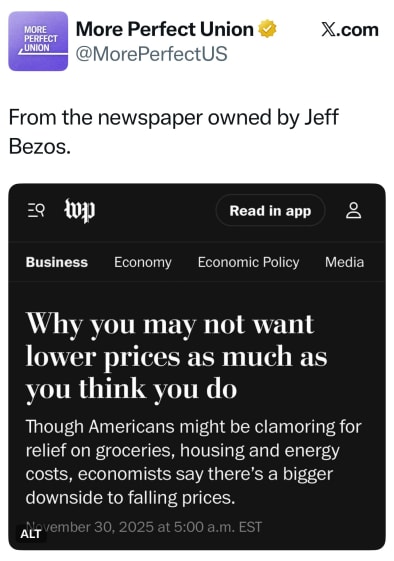
Billionaires Owning Papers
Somehow I feel like this isn’t an independent press…
 |
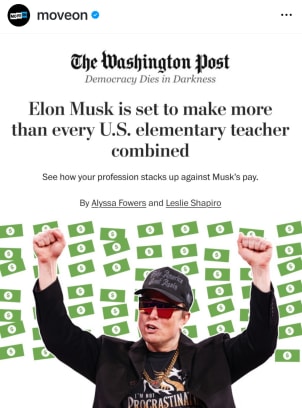
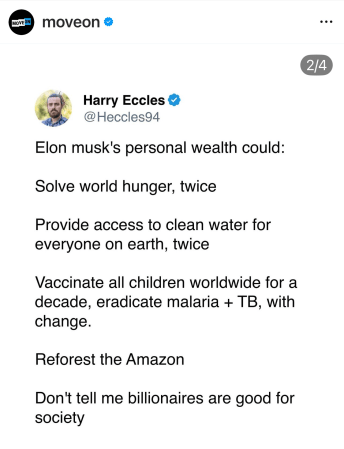
Elon Musk
Nobody should be receiving $1 trillion pay packages while 60% of people live paycheck to paycheck.
 |
 |
Ag Monopolies
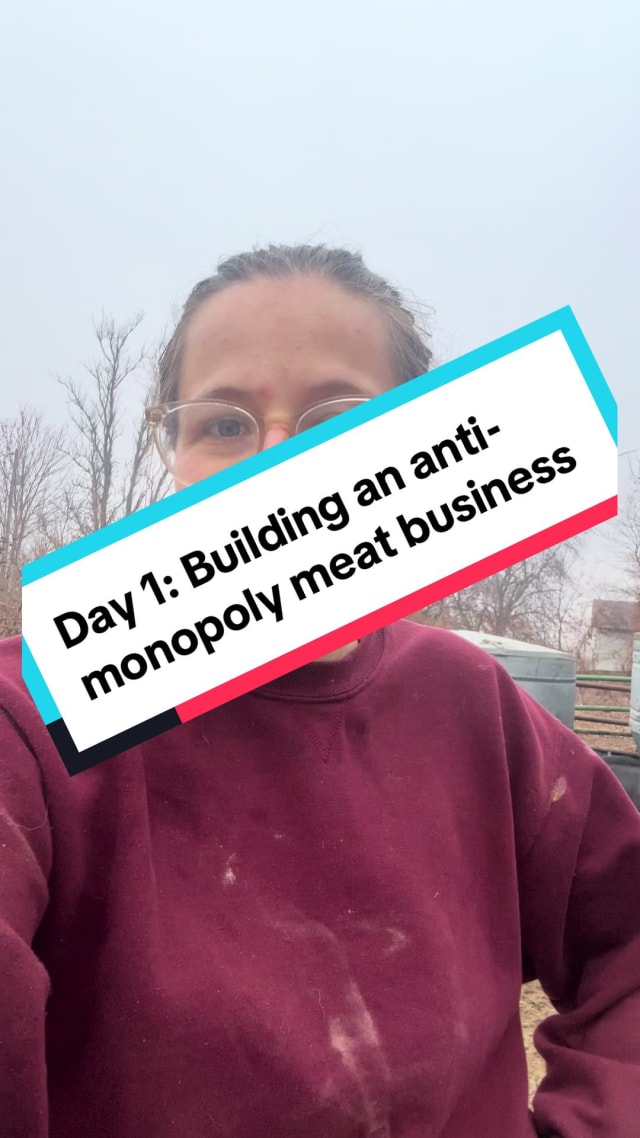
Here’s something that is really cool. A NE Iowa farmer is building an “antimonopoly meat business”!!! She created a series on TikTok. Here’s day 1:
Jobs Report
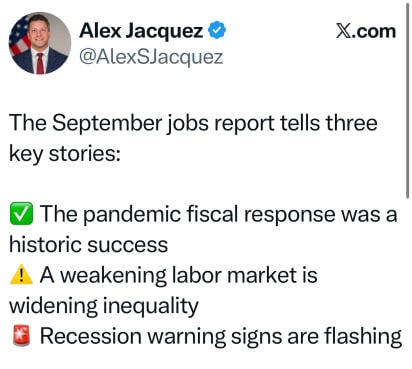
After a gap caused by the government shutdown, employment numbers are back, albeit a month delayed. So Groundwork Collaborative did a report!
The TL,DR version:
 |
Billionaires
Washington Post analysis finds the 100 wealthiest Americans have spent $1B in federal election donations in 2024. 80% is going to Republicans.
BEFORE YOU GO
Before you go, I need two things from you: 1) if you like something, please share it on social media or the next time you have coffee with a friend. 2) Ideas, if you have any ideas for future newsletter content please comment below. Thank you.
Standing Tall for All,
J.D. Scholten
Thanks for reading You're Probably Getting Screwed! Subscribe for free to receive new posts and support my work.
| ||||||||||

