
| From | Ryan Clancy, No Labels <[email protected]> |
| Subject | The Health Care Fight That Will Decide Your Premiums |
| Date | December 3, 2025 12:38 AM |
Links have been removed from this email. Learn more in the FAQ.
Links have been removed from this email. Learn more in the FAQ.
Congress has three choices this month, and only one protects affordable coverage.
<<<RSVP HERE TO JOIN OUR THURSDAY CALL ON THE HEALTH CARE FIGHT IN CONGRESS>>> ([link removed] )
John,
In today’s topsy-turvy political environment, it can seem foolish to try and predict what might happen next. But here is one prediction we are absolutely confident in making: The most important fight in Washington this month will be over how much millions of American families will pay for health insurance next year. Now that the shutdown is over, Congress has to decide whether to extend the expanded Affordable Care Act (ACA) premium tax credits initially passed during COVID. Because open enrollment for January 1 coverage closes around December 15 in most states, this decision cannot wait.
In simple terms, lawmakers have three options.
They can stage partisan “show votes” on bills that are drafted to fail, which may generate talking points but will not prevent premium spikes.
They can do nothing, allow the enhanced tax credits to expire, and watch as millions of people see painful jumps in their premiums or lose coverage altogether.
Or they can write a serious bipartisan, bicameral bill that extends the expanded tax credits, reforms them or creates a new way to provide affordable health insurance to people buying insurance in the individual marketplace, which includes many older workers, small business owners, and early retirees.
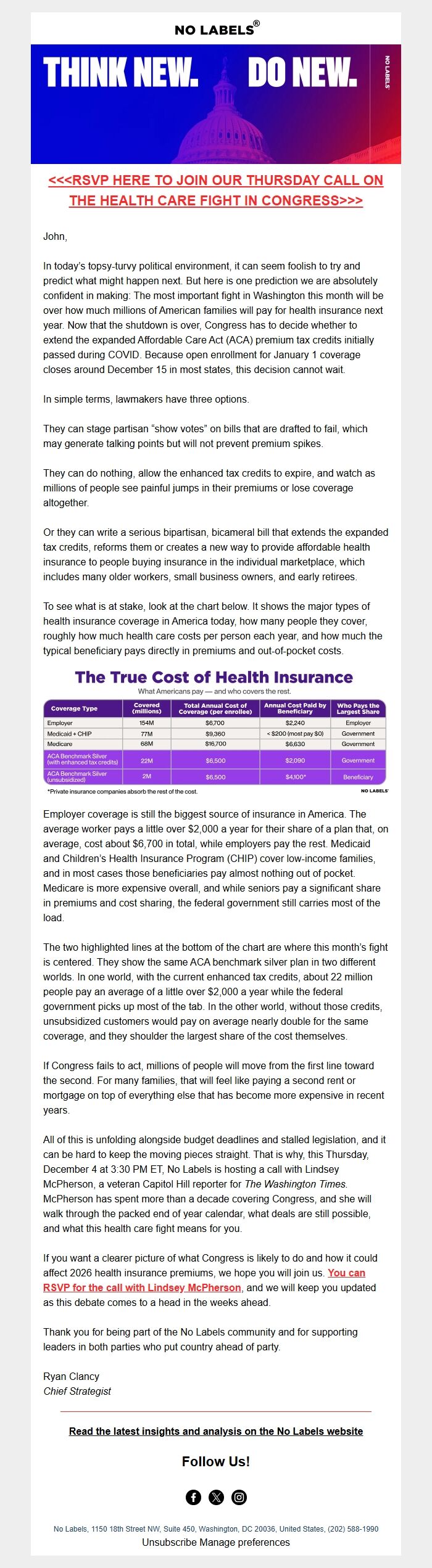
To see what is at stake, look at the chart below. It shows the major types of health insurance coverage in America today, how many people they cover, roughly how much health care costs per person each year, and how much the typical beneficiary pays directly in premiums and out-of-pocket costs.
Employer coverage is still the biggest source of insurance in America. The average worker pays a little over $2,000 a year for their share of a plan that, on average, cost about $6,700 in total, while employers pay the rest. Medicaid and Children’s Health Insurance Program (CHIP) cover low-income families, and in most cases those beneficiaries pay almost nothing out of pocket. Medicare is more expensive overall, and while seniors pay a significant share in premiums and cost sharing, the federal government still carries most of the load.
The two highlighted lines at the bottom of the chart are where this month’s fight is centered. They show the same ACA benchmark silver plan in two different worlds. In one world, with the current enhanced tax credits, about 22 million people pay an average of a little over $2,000 a year while the federal government picks up most of the tab. In the other world, without those credits, unsubsidized customers would pay on average nearly double for the same coverage, and they shoulder the largest share of the cost themselves.
If Congress fails to act, millions of people will move from the first line toward the second. For many families, that will feel like paying a second rent or mortgage on top of everything else that has become more expensive in recent years.
All of this is unfolding alongside budget deadlines and stalled legislation, and it can be hard to keep the moving pieces straight. That is why, this Thursday, December 4 at 3:30 PM ET, No Labels is hosting a call with Lindsey McPherson, a veteran Capitol Hill reporter for The Washington Times. McPherson has spent more than a decade covering Congress, and she will walk through the packed end of year calendar, what deals are still possible, and what this health care fight means for you.
If you want a clearer picture of what Congress is likely to do and how it could affect 2026 health insurance premiums, we hope you will join us. You can RSVP for the call with Lindsey McPherson ([link removed] ) , and we will keep you updated as this debate comes to a head in the weeks ahead.
Thank you for being part of the No Labels community and for supporting leaders in both parties who put country ahead of party.
Ryan Clancy
Chief Strategist
Read the latest insights and analysis on the No Labels website ([link removed] )
Follow Us!
Facebook ([link removed] )
X ([link removed] )
Instagram ([link removed] )
No Labels, 1150 18th Street NW, Suite 450, Washington, DC 20036, United States, (202) 588-1990
Unsubscribe ([link removed] )
Manage preferences ([link removed] )
<<<RSVP HERE TO JOIN OUR THURSDAY CALL ON THE HEALTH CARE FIGHT IN CONGRESS>>> ([link removed] )
John,
In today’s topsy-turvy political environment, it can seem foolish to try and predict what might happen next. But here is one prediction we are absolutely confident in making: The most important fight in Washington this month will be over how much millions of American families will pay for health insurance next year. Now that the shutdown is over, Congress has to decide whether to extend the expanded Affordable Care Act (ACA) premium tax credits initially passed during COVID. Because open enrollment for January 1 coverage closes around December 15 in most states, this decision cannot wait.
In simple terms, lawmakers have three options.
They can stage partisan “show votes” on bills that are drafted to fail, which may generate talking points but will not prevent premium spikes.
They can do nothing, allow the enhanced tax credits to expire, and watch as millions of people see painful jumps in their premiums or lose coverage altogether.
Or they can write a serious bipartisan, bicameral bill that extends the expanded tax credits, reforms them or creates a new way to provide affordable health insurance to people buying insurance in the individual marketplace, which includes many older workers, small business owners, and early retirees.
To see what is at stake, look at the chart below. It shows the major types of health insurance coverage in America today, how many people they cover, roughly how much health care costs per person each year, and how much the typical beneficiary pays directly in premiums and out-of-pocket costs.
Employer coverage is still the biggest source of insurance in America. The average worker pays a little over $2,000 a year for their share of a plan that, on average, cost about $6,700 in total, while employers pay the rest. Medicaid and Children’s Health Insurance Program (CHIP) cover low-income families, and in most cases those beneficiaries pay almost nothing out of pocket. Medicare is more expensive overall, and while seniors pay a significant share in premiums and cost sharing, the federal government still carries most of the load.
The two highlighted lines at the bottom of the chart are where this month’s fight is centered. They show the same ACA benchmark silver plan in two different worlds. In one world, with the current enhanced tax credits, about 22 million people pay an average of a little over $2,000 a year while the federal government picks up most of the tab. In the other world, without those credits, unsubsidized customers would pay on average nearly double for the same coverage, and they shoulder the largest share of the cost themselves.
If Congress fails to act, millions of people will move from the first line toward the second. For many families, that will feel like paying a second rent or mortgage on top of everything else that has become more expensive in recent years.
All of this is unfolding alongside budget deadlines and stalled legislation, and it can be hard to keep the moving pieces straight. That is why, this Thursday, December 4 at 3:30 PM ET, No Labels is hosting a call with Lindsey McPherson, a veteran Capitol Hill reporter for The Washington Times. McPherson has spent more than a decade covering Congress, and she will walk through the packed end of year calendar, what deals are still possible, and what this health care fight means for you.
If you want a clearer picture of what Congress is likely to do and how it could affect 2026 health insurance premiums, we hope you will join us. You can RSVP for the call with Lindsey McPherson ([link removed] ) , and we will keep you updated as this debate comes to a head in the weeks ahead.
Thank you for being part of the No Labels community and for supporting leaders in both parties who put country ahead of party.
Ryan Clancy
Chief Strategist
Read the latest insights and analysis on the No Labels website ([link removed] )
Follow Us!
Facebook ([link removed] )
X ([link removed] )
Instagram ([link removed] )
No Labels, 1150 18th Street NW, Suite 450, Washington, DC 20036, United States, (202) 588-1990
Unsubscribe ([link removed] )
Manage preferences ([link removed] )
Message Analysis
- Sender: No Labels
- Political Party: n/a
- Country: United States
- State/Locality: n/a
- Office: n/a
-
Email Providers:
- HubSpot