|
 |
The Hard Truth About the D.C. Attack
The danger didn’t come from abroad. It came out of what we did here.
|
| |||||||||||||||


 |
What happened in Washington, D.C., on Thanksgiving Eve was horrific. A National Guard member is dead, another critically injured, and families are forever changed. I have spent my career focused on homeland security and counterterrorism—including screening and vetting, as well as refugee policy. I helped build the very systems now being blamed.
I want to be honest with you about what the evidence actually suggests. First, no vetting process is flawless, and we should continually review it carefully. But given years inside these screening and intelligence debates, this tragedy appears less like a vetting failure and far more like a case of someone who radicalized after arriving in the United States, shaped by trauma from war, the conditions he encountered here, and an environment this administration has made exponentially more volatile.
Yet the immediate response from the Trump administration was to point fingers, distort facts, and use this tragedy to justify sweeping new crackdowns. The reality is far more uncomfortable and far more critical if we want to prevent future attacks.
The Vetting Was Among the Most Rigorous on Earth
Afghans who served alongside U.S. forces, especially those tied to sensitive intelligence units, underwent the most exhaustive vetting I’ve seen in two decades of national security work.
Their screening included:
biographic data, biometrics, and contextual intelligence
continuous assessments by U.S. personnel embedded with their units
CIA polygraphs
retinal scans and detailed biometric databases
layered intelligence reviews
human-source validation through tribal and family networks
These individuals were not "lightly vetted." They were scrutinized more deeply than many U.S. government employees are when hired.
I sat in the rooms where these standards were debated. I took part in the policy battles over how to screen and protect Afghan and Iraqi translators who risked their lives for U.S. operations. I pushed back against the xenophobic barriers Stephen Miller and others tried to impose, blanket suspicion aimed at the very people who stood beside our troops and intelligence officers. I say that as someone who has relied on interpreters to stay alive. Inside heated Situation Room discussions during the first Trump presidency, it became unmistakably clear that Miller and his circle were driving toward a single end state: a system in which virtually no one would be allowed to enter the United States.
Stephen Miller’s worldview, then and now, isn’t about security. It’s rooted in a xenophobic idea that America is “safer” only if fewer people, especially from certain regions, are allowed to exist inside its borders. His policies follow the same script every time: shut down refugee pathways, strip humanitarian protections, ban Muslim-majority countries, block wartime allies, and impose ideological purity tests. It’s an extremist rewrite of who counts as American.
And after all of that, after the most intensive screening architecture we’ve ever built, here’s the part almost no one wants to say clearly: What failed wasn’t the vetting. It was exactly this type of immigration policy that this administration constructed around it.
Radicalization is not a static trait. It is a process, shaped by:
financial hardship
isolation and lack of belonging
trauma or untreated mental-health challenges
political scapegoating
humiliation
exposure to extremist narratives
the sense of being viewed as the permanent enemy
For years, the United States has created exactly these conditions. Afghan and Iraqi partners who risked their lives for us were later demonized, abandoned, denied entry, deported, smeared as infiltrators, and told they were unwelcome, unsafe, and unworthy.
This is betrayal-based trauma, and it is an accelerant of radicalization, not because people arrive as threats, but because we treat them like threats after they get here. I warned internally during Trump 1.0, and later publicly, that this pattern was unsustainable. You cannot rely on allies in war zones and then discard them. You cannot humiliate communities, create fear-based policy, and then be shocked by the consequences.
We are not seeing imported extremism. We are seeing American-made radicalization.
Far-right extremists are regrouping and signaling readiness for being Trump’s “militia”.
Young men across communities feel isolated, angry, and disposable.
Immigrant communities are traumatized, scapegoated, and targeted for collective blame.
Allies who stood with U.S. forces feel betrayed and discarded.
This is what it looks like when a country becomes a fertile landscape for extremism, not because of who crosses the border, but because of what is happening inside the border. No vetting system can protect a society that is actively manufacturing the conditions that fuel radicalization.
Instead of acknowledging domestic radicalization, the Trump administration seized this tragedy to justify the most extreme immigration crackdown in modern U.S. history.
Within hours, they announced:
a complete halt on all asylum decisions
a sweeping review of green cards, even for long-settled individuals
plans to pause migration from all “Third World countries” permanently
Senior officials like went even further, declaring that "migrants and their descendants" recreate the "conditions and terrors" of their homelands.
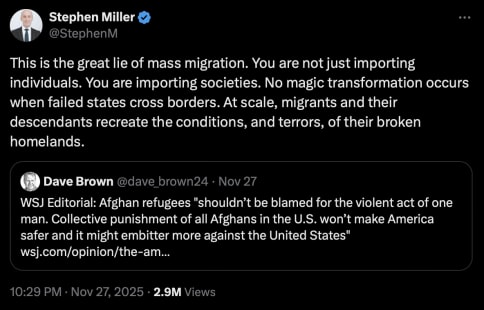 |
Descendants. Meaning U.S.-born children. Citizens. Americans.
Manufacture fear → label entire populations dangerous → justify authoritarian measures.
The ICE Spectacle Is Making Us Less Safe
We also can’t ignore the damage being done by the administration’s deliberate public displays of ICE raids and mass detentions.
The images of migrants tackled, zip-tied, dragged away, or filmed as political props aren’t just cruel; they are strategically reckless.
Public humiliation is a known contributor to radicalization environments. It breeds anger and alienation, strengthens extremist narratives, and erodes trust between communities and the government.
The attack in D.C. didn’t happen in a vacuum. National Guard troops were deployed across the city, not because of credible intelligence, but because the administration wanted a political image. From a counterterrorism perspective, placing uniformed troops in civilian spaces with no clear mission creates symbolic targets, especially in a politically charged environment.
This wasn’t security. It was staged. And it opened the door to tragedy.
There is a final irony.
The Trump administration helped build a stronger vetting architecture, but it now claims it “failed.”
I was in government when National Security Presidential Memorandum-9 created the National Vetting Center, an interagency intelligence system integrating data across DHS, DOJ, DOD, CIA, NSA, and more. They celebrated it, insisted it would eliminate gaps, and then used it to approve this individual’s asylum.
Now they pretend it basically never existed and that somehow Joe Biden is to blame. You cannot build a system, rely on it to admit someone, and then blame everyone else when that person radicalizes inside an environment you created.
Stephen Miller’s Long Game — And Why This Moment Serves It
For years, Miller has worked toward a single outcome: an America with the narrowest possible definition of who gets to belong. His strategy has always been the same: restrict entry, dismantle humanitarian protections, and turn immigration policy into an ideological sorting test. A tragedy like this gives him exactly what he needs:
a justification to frame entire communities, including U.S.-born children, as inherently unsafe.
The danger isn’t just the policies. It’s the narrative beneath them—that safety requires exclusion, and that America survives by narrowing who gets to be part of it.
This worldview erodes national security. It does not strengthen it.
You cannot bomb boats overseas, violate international norms, publicly abuse migrants, demonize allies, militarize city streets, destabilize working families economically, and tell entire communities they do not belong, and then expect no one to break under the weight of that environment.
This is classic radicalization theory. This is how grievances harden. This is how violence grows. We are more vulnerable because our current leaders prefer spectacle over strategy.
Why This Matters to You
Every American now lives in a pressure cooker created from the top down:
economic pain
political rage
identity fear
militarized streets instead of real safety
demonization of immigrants
extremists feeling emboldened
Radicalization no longer fits one profile. It cuts across communities and ideologies. The real question isn’t how to stop one group, it’s how to stop creating the conditions that radicalize people in the first place. If we don’t address the root causes, this won’t be the last tragedy. And no ban, crackdown, or militarized image will compensate for what policy failure continues to fuel.
To the families of the fallen: I am so deeply sorry.
To our Afghan allies: You deserved far better.
To Americans trying to make sense of this moment: Do not fall for the easy narrative.
Unless we confront the environment this administration is creating, one that breeds radicalization rather than preventing it, we will only see more horrific tragedies and heartbreak. The choice now is whether we let fear drive us deeper into danger, or whether we demand a security strategy rooted in truth, competence, and humanity.
-Olivia
PS: Last call on the holiday discount. And because it’s Giving Tuesday, a portion of today’s new paid subs goes to The Ten News Kids Podcast. If you want to support independent reporting that stays fearless and unsilenced, and help fund trustworthy news for kids, today’s the day. Subscribe here.
This Substack is reader-supported. Paid subscriptions allow me to continue to pour significant time and energy into breaking down the headlines and keeping my content available to others. Thank you for your support!
Have an idea or feedback? Reply directly to this email.
| ||||||||||

