|



Today is Giving Tuesday, the unofficial holiday of urgency, inbox overload, and well-intentioned appeals from every corner of the nonprofit universe. But this year, I don’t want to ask you for money.
Instead, I want to ask you for something far more powerful:
Your attention. Your reflection. And your intention for the year ahead.
Today, I’m sharing my conversation with sociologist Dalton Conley, whose groundbreaking work on the social genome fundamentally reshapes how we understand inequality in America. His research forces us to look beyond individual choices and toward the structures that shape who gets ahead, who gets left behind, and, crucially, who gets seen by our society.
Watch the Conversation with Dalton Conley
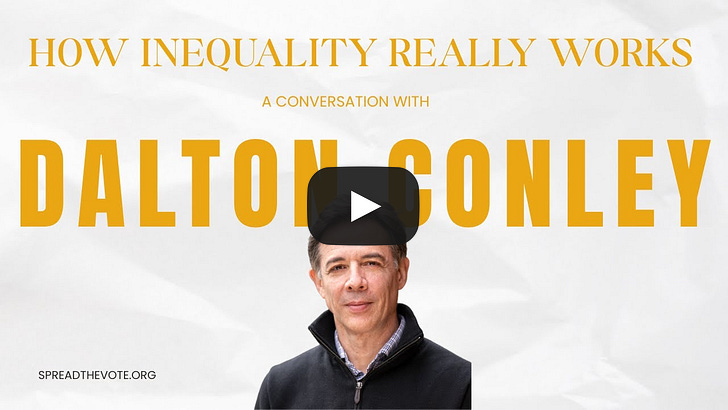
Conley’s work makes one point especially clear:
If we want real equality, we can’t wait for someone else to fix it. We have to decide who we will be in 2026, and act accordingly.
As we close out this year, I’m asking you to take time not to give, but to reflect.
Why this matters right now
2026 is more than another election year.
It is a test of what kind of country we want to be.
A year where:
Millions of Americans still cannot access an ID and therefore cannot work, vote, or exist fully in our systems
Inequality continues to reproduce itself across generations
Social belonging is fraying in ways that undermine democracy itself
The distance between those who feel seen and those who feel invisible grows sharper
Dalton Conley’s work reminds us that none of this is accidental. Inequality is structured, patterned, inherited. But that also means it can be interrupted. It can be reshaped. It can be undone, if we choose to do so.
A Different Kind of Giving Tuesday Ask
So this year, my request is simple:
1. Watch the Dalton Conley video.
Listen deeply. Let his ideas challenge you.
2. Spend the rest of 2025 reflecting on one question:
What will you do in 2026 to promote equality, dignity, and belonging?
Not “what should someone do.”
Not “what can an organization do.”
But you.
A shift in how you vote.
A commitment to learning.
A choice to engage locally.
A decision to support people who are systematically unseen.
A promise to yourself to speak up when it matters.
Whatever it is, big or small, personal or public, it counts.
Giving Tuesday isn’t just about generosity. It’s about responsibility.
The work of building a more equal America isn’t just policy or politics.
It’s a daily practice of choosing to see others, and choosing to be someone who expands belonging instead of shrinking it.
Dalton Conley’s research gives us the tools to understand why inequality persists.
The rest is up to us.
So today, I hope you’ll watch.
I hope you’ll think.
I hope you’ll imagine who you want to be a year from now.
And I hope you’ll join me in committing to a 2026 where equality isn’t abstract, it’s personal.
Let’s choose to make next year a turning point.
Thank you,
Kat
You're currently a free subscriber to IDs for Life. For the full experience, upgrade your subscription.
| ||||||||||

