
Email
Reminder to register for the May 28th NotMiSpecies webinar - What Lies Beneath: Detecting Invasive Plants in Michigan Lakes
| From | MI Dept. of Environment, Great Lakes, and Energy <[email protected]> |
| Subject | Reminder to register for the May 28th NotMiSpecies webinar - What Lies Beneath: Detecting Invasive Plants in Michigan Lakes |
| Date | May 27, 2025 4:02 PM |
Links have been removed from this email. Learn more in the FAQ.
Links have been removed from this email. Learn more in the FAQ.
Monthly webinar series takes an in-depth look at actions taking place to prevent the introduction and spread of invasives.
Share or view as a webpage [ [link removed] ] I Update preferences [ [link removed] ]
NotMiSpecies Web banner [ [link removed] ]
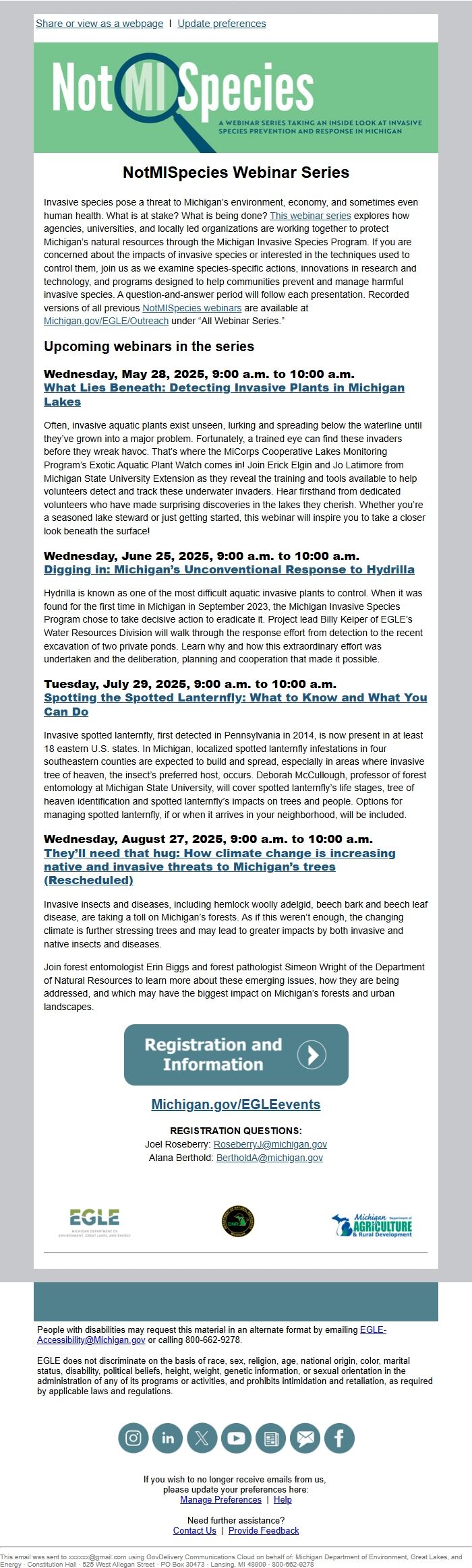
NotMISpecies Webinar Series
Invasive species pose a threat to Michigan’s environment, economy, and sometimes even human health. What is at stake? What is being done? This webinar series [ [link removed] ] explores how agencies, universities, and locally led organizations are working together to protect Michigan’s natural resources through the Michigan Invasive Species Program. If you are concerned about the impacts of invasive species or interested in the techniques used to control them, join us as we examine species-specific actions, innovations in research and technology, and programs designed to help communities prevent and manage harmful invasive species. A question-and-answer period will follow each presentation. Recorded versions of all previous NotMISpecies webinars [ [link removed] ] are available at Michigan.gov/EGLE/Outreach [ [link removed] ] under “All Webinar Series.”
Upcoming webinars in the series
*Wednesday, May 28, 2025, 9:00 a.m. to 10:00 a.m.
What Lies Beneath: Detecting Invasive Plants in Michigan Lakes [ [link removed] ]*
Often, invasive aquatic plants exist unseen, lurking and spreading below the waterline until they’ve grown into a major problem. Fortunately, a trained eye can find these invaders before they wreak havoc. That’s where the MiCorps Cooperative Lakes Monitoring Program’s Exotic Aquatic Plant Watch comes in! Join Erick Elgin and Jo Latimore from Michigan State University Extension as they reveal the training and tools available to help volunteers detect and track these underwater invaders. Hear firsthand from dedicated volunteers who have made surprising discoveries in the lakes they cherish. Whether you’re a seasoned lake steward or just getting started, this webinar will inspire you to take a closer look beneath the surface!
*Wednesday, June 25, 2025, 9:00 a.m. to 10:00 a.m.
Digging in: Michigan’s Unconventional Response to Hydrilla [ [link removed] ]*
Hydrilla is known as one of the most difficult aquatic invasive plants to control. When it was found for the first time in Michigan in September 2023, the Michigan Invasive Species Program chose to take decisive action to eradicate it. Project lead Billy Keiper of EGLE’s Water Resources Division will walk through the response effort from detection to the recent excavation of two private ponds. Learn why and how this extraordinary effort was undertaken and the deliberation, planning and cooperation that made it possible.
*Tuesday, July 29, 2025, 9:00 a.m. to 10:00 a.m.
Spotting the Spotted Lanternfly: What to Know and What You Can Do [ [link removed] ]*
Invasive spotted lanternfly, first detected in Pennsylvania in 2014, is now present in at least 18 eastern U.S. states. In Michigan, localized spotted lanternfly infestations in four southeastern counties are expected to build and spread, especially in areas where invasive tree of heaven, the insect’s preferred host, occurs. Deborah McCullough, professor of forest entomology at Michigan State University, will cover spotted lanternfly’s life stages, tree of heaven identification and spotted lanternfly’s impacts on trees and people. Options for managing spotted lanternfly, if or when it arrives in your neighborhood, will be included.
*Wednesday, August 27, 2025, 9:00 a.m. to 10:00 a.m.
They’ll need that hug: How climate change is increasing native and invasive threats to Michigan’s trees (Rescheduled) [ [link removed] ]*
Invasive insects and diseases, including hemlock woolly adelgid, beech bark and beech leaf disease, are taking a toll on Michigan’s forests. As if this weren’t enough, the changing climate is further stressing trees and may lead to greater impacts by both invasive and native insects and diseases.
Join forest entomologist Erin Biggs and forest pathologist Simeon Wright of the Department of Natural Resources to learn more about these emerging issues, how they are being addressed, and which may have the biggest impact on Michigan’s forests and urban landscapes.
Registration button EGLE Blue [ [link removed] ]
Michigan.gov/EGLEevents [ [link removed] ]
*REGISTRATION QUESTIONS:*
Joel Roseberry: [email protected] <[email protected]>
Alana Berthold: [email protected]
AIS agency footer
________________________________________________________________________
People with disabilities may request this material in an alternate format by emailing [email protected] or calling 800-662-9278.
EGLE does not discriminate on the basis of race, sex, religion, age, national origin, color, marital status, disability, political beliefs, height, weight, genetic information, or sexual orientation in the administration of any of its programs or activities, and prohibits intimidation and retaliation, as required by applicable laws and regulations.
Instagram [ [link removed] ] Linkedin [ [link removed] ] X [ [link removed] ] YouTube [ [link removed] ] MiEnvironment [ [link removed] ] GovDelivery [ [link removed] ] Facebook [ [link removed] ]
If you wish to no longer receive emails from us,
please update your preferences here:
Manage Preferences [ [link removed] ] | Help [ [link removed] ]
Need further assistance?
Contact Us <[email protected]> | Provide Feedback <[email protected]>
________________________________________________________________________
This email was sent to [email protected] using GovDelivery Communications Cloud on behalf of: Michigan Department of Environment, Great Lakes, and Energy · Constitution Hall · 525 West Allegan Street · PO Box 30473 · Lansing, MI 48909 · 800-662-9278
body .abe-column-block { min-height: 5px; } table.gd_combo_table img {margin-left:10px; margin-right:10px;} table.gd_combo_table div.govd_image_display img, table.gd_combo_table td.gd_combo_image_cell img {margin-left:0px; margin-right:0px;} table.govd_hr {min-width: 100%;} p, li, h1, h2, h3 { overflow-wrap: normal; word-wrap: normal; word-break: keep-all; -moz-hyphens: none; -ms-hyphens: none; -webkit-hyphens: none; hyphens: none; mso-hyphenate: none; }
Share or view as a webpage [ [link removed] ] I Update preferences [ [link removed] ]
NotMiSpecies Web banner [ [link removed] ]
NotMISpecies Webinar Series
Invasive species pose a threat to Michigan’s environment, economy, and sometimes even human health. What is at stake? What is being done? This webinar series [ [link removed] ] explores how agencies, universities, and locally led organizations are working together to protect Michigan’s natural resources through the Michigan Invasive Species Program. If you are concerned about the impacts of invasive species or interested in the techniques used to control them, join us as we examine species-specific actions, innovations in research and technology, and programs designed to help communities prevent and manage harmful invasive species. A question-and-answer period will follow each presentation. Recorded versions of all previous NotMISpecies webinars [ [link removed] ] are available at Michigan.gov/EGLE/Outreach [ [link removed] ] under “All Webinar Series.”
Upcoming webinars in the series
*Wednesday, May 28, 2025, 9:00 a.m. to 10:00 a.m.
What Lies Beneath: Detecting Invasive Plants in Michigan Lakes [ [link removed] ]*
Often, invasive aquatic plants exist unseen, lurking and spreading below the waterline until they’ve grown into a major problem. Fortunately, a trained eye can find these invaders before they wreak havoc. That’s where the MiCorps Cooperative Lakes Monitoring Program’s Exotic Aquatic Plant Watch comes in! Join Erick Elgin and Jo Latimore from Michigan State University Extension as they reveal the training and tools available to help volunteers detect and track these underwater invaders. Hear firsthand from dedicated volunteers who have made surprising discoveries in the lakes they cherish. Whether you’re a seasoned lake steward or just getting started, this webinar will inspire you to take a closer look beneath the surface!
*Wednesday, June 25, 2025, 9:00 a.m. to 10:00 a.m.
Digging in: Michigan’s Unconventional Response to Hydrilla [ [link removed] ]*
Hydrilla is known as one of the most difficult aquatic invasive plants to control. When it was found for the first time in Michigan in September 2023, the Michigan Invasive Species Program chose to take decisive action to eradicate it. Project lead Billy Keiper of EGLE’s Water Resources Division will walk through the response effort from detection to the recent excavation of two private ponds. Learn why and how this extraordinary effort was undertaken and the deliberation, planning and cooperation that made it possible.
*Tuesday, July 29, 2025, 9:00 a.m. to 10:00 a.m.
Spotting the Spotted Lanternfly: What to Know and What You Can Do [ [link removed] ]*
Invasive spotted lanternfly, first detected in Pennsylvania in 2014, is now present in at least 18 eastern U.S. states. In Michigan, localized spotted lanternfly infestations in four southeastern counties are expected to build and spread, especially in areas where invasive tree of heaven, the insect’s preferred host, occurs. Deborah McCullough, professor of forest entomology at Michigan State University, will cover spotted lanternfly’s life stages, tree of heaven identification and spotted lanternfly’s impacts on trees and people. Options for managing spotted lanternfly, if or when it arrives in your neighborhood, will be included.
*Wednesday, August 27, 2025, 9:00 a.m. to 10:00 a.m.
They’ll need that hug: How climate change is increasing native and invasive threats to Michigan’s trees (Rescheduled) [ [link removed] ]*
Invasive insects and diseases, including hemlock woolly adelgid, beech bark and beech leaf disease, are taking a toll on Michigan’s forests. As if this weren’t enough, the changing climate is further stressing trees and may lead to greater impacts by both invasive and native insects and diseases.
Join forest entomologist Erin Biggs and forest pathologist Simeon Wright of the Department of Natural Resources to learn more about these emerging issues, how they are being addressed, and which may have the biggest impact on Michigan’s forests and urban landscapes.
Registration button EGLE Blue [ [link removed] ]
Michigan.gov/EGLEevents [ [link removed] ]
*REGISTRATION QUESTIONS:*
Joel Roseberry: [email protected] <[email protected]>
Alana Berthold: [email protected]
AIS agency footer
________________________________________________________________________
People with disabilities may request this material in an alternate format by emailing [email protected] or calling 800-662-9278.
EGLE does not discriminate on the basis of race, sex, religion, age, national origin, color, marital status, disability, political beliefs, height, weight, genetic information, or sexual orientation in the administration of any of its programs or activities, and prohibits intimidation and retaliation, as required by applicable laws and regulations.
Instagram [ [link removed] ] Linkedin [ [link removed] ] X [ [link removed] ] YouTube [ [link removed] ] MiEnvironment [ [link removed] ] GovDelivery [ [link removed] ] Facebook [ [link removed] ]
If you wish to no longer receive emails from us,
please update your preferences here:
Manage Preferences [ [link removed] ] | Help [ [link removed] ]
Need further assistance?
Contact Us <[email protected]> | Provide Feedback <[email protected]>
________________________________________________________________________
This email was sent to [email protected] using GovDelivery Communications Cloud on behalf of: Michigan Department of Environment, Great Lakes, and Energy · Constitution Hall · 525 West Allegan Street · PO Box 30473 · Lansing, MI 48909 · 800-662-9278
body .abe-column-block { min-height: 5px; } table.gd_combo_table img {margin-left:10px; margin-right:10px;} table.gd_combo_table div.govd_image_display img, table.gd_combo_table td.gd_combo_image_cell img {margin-left:0px; margin-right:0px;} table.govd_hr {min-width: 100%;} p, li, h1, h2, h3 { overflow-wrap: normal; word-wrap: normal; word-break: keep-all; -moz-hyphens: none; -ms-hyphens: none; -webkit-hyphens: none; hyphens: none; mso-hyphenate: none; }
Message Analysis
- Sender: Michigan Department of Environment, Great Lakes, and Energy
- Political Party: n/a
- Country: n/a
- State/Locality: n/a
- Office: n/a
-
Email Providers:
- govDelivery